Every barrel Canada exports imports a rate hike
Canada faces an increasingly uncomfortable economic paradox. As one of the world's major net Oil exporters, the country benefits from rising energy prices through stronger export revenues, corporate profits and government income. Yet the same Oil rally is fueling inflationary pressure, prompting the Bank of Canada (BoC) to raise borrowing costs that potentially threaten the broader economy.
The central bank's decision on Wednesday to increase its benchmark interest rate by 25 basis points to 2.50%, its first hike since 2023, illustrates this dilemma. While elevated Oil prices support economic growth, the monetary tightening required to contain their inflationary consequences could eventually undermine those gains.
The question is no longer simply how much Canada benefits from expensive Oil, but how long those benefits can outweigh the costs.
Canada's Oil windfall comes with a hidden cost
Higher Oil prices traditionally improve Canada's terms of trade, allowing the country to earn more from its exports without necessarily increasing production volumes. According to RBC Economics, Canada's real Gross Domestic Product (GDP) increased 1.1% YoY in the second quarter, while real Gross Domestic Income (GDI), which captures changes in purchasing power, rose 3.1%.
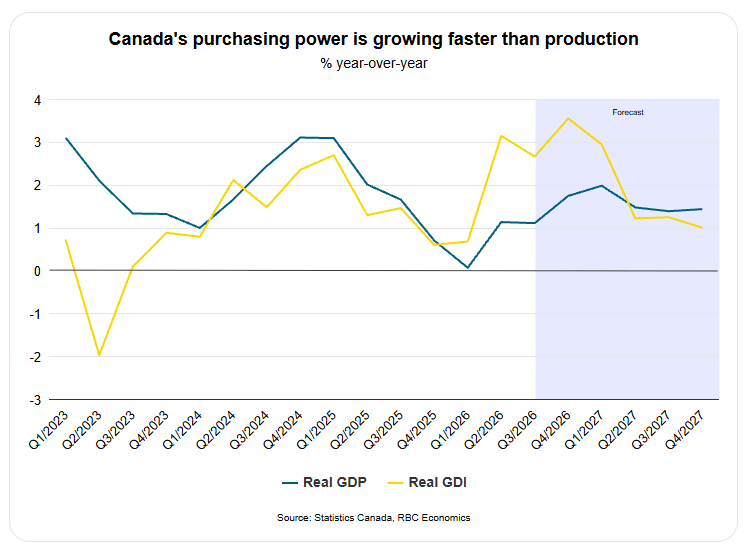
The difference reflects the economic benefits of higher export prices. RBC estimates that a 46% increase in Oil prices contributed approximately C$12 billion per quarter in additional purchasing power through improved terms of trade. However, these benefits are far from evenly distributed.
Energy producers, shareholders and resource-rich provinces capture much of the additional income, while households across the country face higher transportation and heating costs. Canadian households spent approximately C$2.6 billion more on motor fuel in the second quarter than a year earlier despite purchasing 3% less fuel, according to RBC.
This creates a structural imbalance: the economic benefits of higher Oil prices remain concentrated, while the inflationary costs spread across the country.
The Bank of Canada turns Oil's advantage into a monetary dilemma
The paradox becomes more pronounced when monetary policy enters the equation. On Wednesday, the BoC raised its benchmark rate to 2.50%, citing concerns that persistently elevated energy prices could translate into broader inflation. Governor Tiff Macklem explained the reasoning behind the decision: "An increase in the policy rate is needed to reduce the risk that elevated energy prices could spill over and become generalized inflation."
The central bank expects inflation to reach approximately 3.5% by the end of the year, while businesses increasingly pass higher production and transportation costs on to consumers.
However, interest rate increases cannot directly reduce global Oil prices or resolve supply disruptions linked to the Middle East conflict. Instead, they work by restraining domestic demand, increasing borrowing costs and discouraging spending and investment.
This creates a potentially damaging feedback loop: higher Oil prices strengthen Canada's export income but simultaneously force monetary tightening that weighs on households and businesses outside the energy sector.
RBC describes Wednesday's decision as preventative treatment, arguing that the central bank is responding primarily to future inflation risks rather than an immediate deterioration in underlying price pressure.
Could Oil prices reach a point where Canada stops benefiting?
Research from Scotiabank suggests that the economic advantages of rising Oil prices may have an upper limit. In a May study, the bank examined how Canada's economic response to Oil supply shocks changes at different price levels.
Scotiabank's findings suggest that higher Oil prices continue to benefit Canada's economy when West Texas Intermediate (WTI) prices are around $100, but those gains become increasingly uncertain as prices approach the $120-$130 range. Above this indicative range, the economic boost from higher Oil prices is no longer statistically distinguishable from zero.
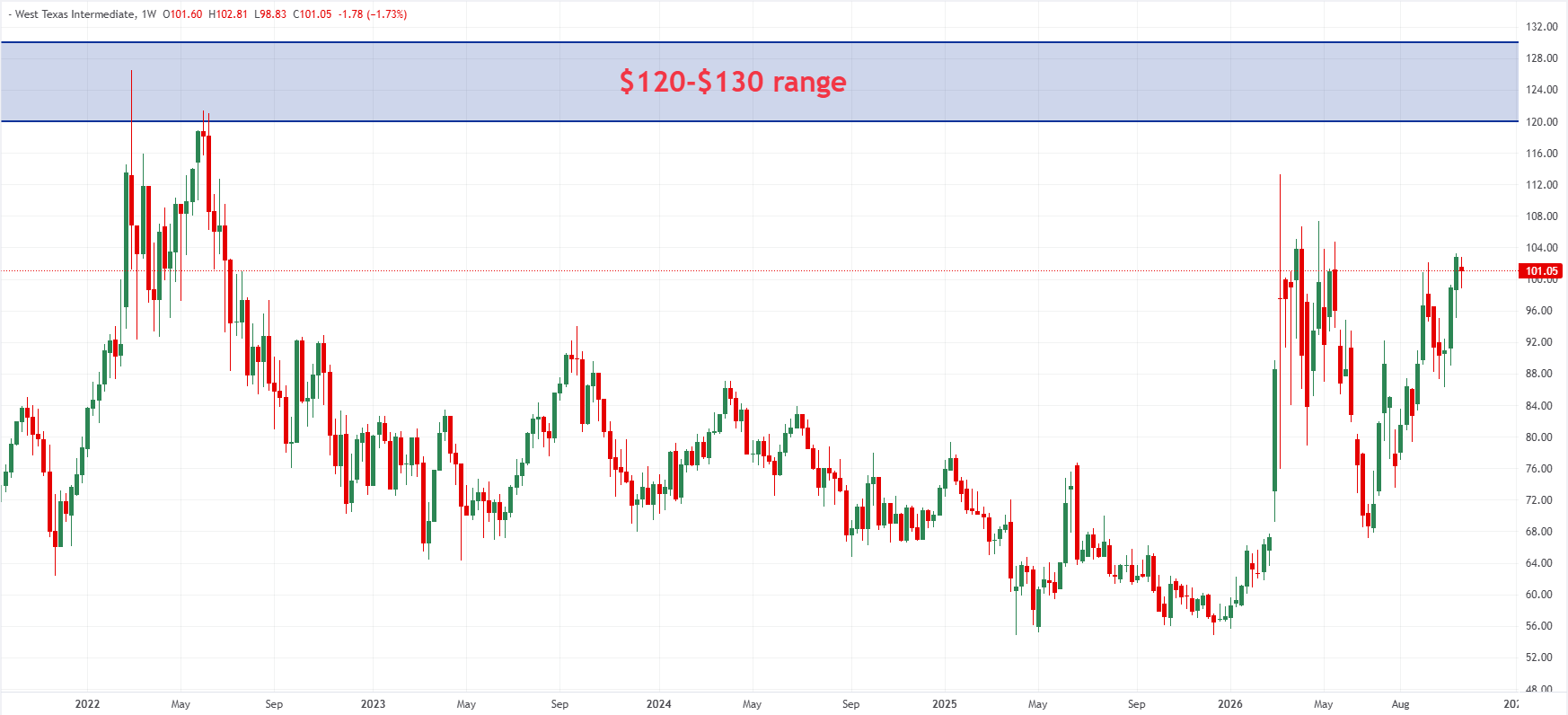
Scotiabank emphasizes that this is not a precise tipping point, but rather a zone where the traditional relationship between rising Oil prices and stronger Canadian growth becomes considerably weaker.
The explanation extends beyond domestic inflation. When Oil prices rise because of supply disruptions rather than stronger global demand, the resulting pressure on Canada's trading partners can reduce demand for Canadian exports. Combined with tighter financial conditions, this could eventually offset the benefits of higher energy revenues.
The BoC's tightening response introduces another potential constraint, particularly if elevated borrowing costs begin to suppress consumption, housing activity and business investment.
When an Oil blessing risks becoming a curse
Canada has not yet reached the point where higher Oil prices are clearly damaging its overall economy. The additional export income, stronger energy investment and increased government revenue continue to provide meaningful support.
But the October rate hike demonstrates that the economic equation is changing. The longer Oil prices remain elevated, the greater the risk that inflation spreads beyond energy, forcing the BoC to tighten monetary policy even as households and interest-rate-sensitive industries face mounting pressure.
Ultimately, Canada's vulnerability may not come from rising Oil prices alone, but from the interest rate increases needed to contain their consequences. What begins as an export windfall could gradually become an economic burden if the cost of fighting inflation overtakes the income generated by every additional barrel sold abroad.
Author

Ghiles Guezout
FXStreet
Ghiles Guezout is a Market Analyst with a strong background in stock market investments, trading, and cryptocurrencies. He combines fundamental and technical analysis skills to identify market opportunities.