Eurozone: General but uneven recovery of new loans for house purchase


The recovery in loans for house purchase spread to all eurozone countries in March 2025, but the picture is still mixed.
New loans to households for house purchase, excluding renegotiations, saw a year-on-year increase in all eurozone countries in March 2025, which is unprecedented since April 2022. However, it was a very mixed picture in terms of year-on-year increases, ranging from 4.3% in Croatia to 48.6% in Lithuania, with a volume-weighted average of 24.3% across the eurozone. As a result, new loans in the eurozone (EUR 60.3 billion) has returned in March 2025 to its August 2022 level, after hitting a low in January 2024 (EUR 37.0 billion).
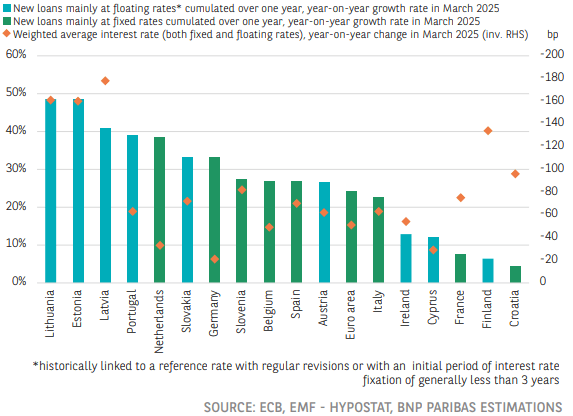
Countries with the strongest rate cuts also recorded the strongest rises.
The recovery in new loans for house purchase was naturally stimulated by the widespread fall in interest rates. Across the eurozone, the average interest rate applied to customers fell by 51 basis points over one year, to 3.31% in March 2025. The extent of the rate cut recorded in Lithuania, Estonia and Latvia can be explained, among other things, by past increases that were greater than in the rest of the eurozone. Nevertheless, the drop in new production in the Baltic countries during the rate hike phase had been relatively smaller than in the rest of the eurozone, supporting the continued rise in real estate prices.
The more widespread use of fixed rates or floating rates did not have a systematic effect on new loans.
The increased use of floating rate loans (linked to a reference rate such as the 6- or 12-month EURIBOR, for example) may have helped to limit the decline in new lending despite the size of the rate hike, as households might have anticipated a downward adjustment over the life of the loan. However, this cannot be the only explanatory factor, as suggested by the markets in Ireland, Finland and Cyprus. It can be seen from the chart that the increase in credit in these countries is significantly less dynamic than in the Baltic countries. Similarly, a more widespread use of fixed rates does not appear to have systematically put additional strain on new loans, as suggested by the development of new loans in the Netherlands and Germany, and to a lesser extent in France.
Household income growth also helps explain the differences in trajectories, which is less the case for average initial maturities, which are most often between 25 and 30 years old. In any case, national trajectories will mainly depend on domestic specificities and the position of the local market in the real estate cycle. The latest ECB’s Bank Lending Survey suggests that the recovery should continue into Q2 2025. But it should settle as interest rates stop decreasing or even rise.
Author
BNP Paribas Team
BNP Paribas
BNP Paribas Economic Research Department is a worldwide function, part of Corporate and Investment Banking, at the service of both the Bank and its customers.

















