|

Euros may look weak, and fundamentally that is hard to argue with

Euros may look weak, and fundamentally, that is hard to argue with.

However, as a technical trader, I have to trade what I see, not what I think.

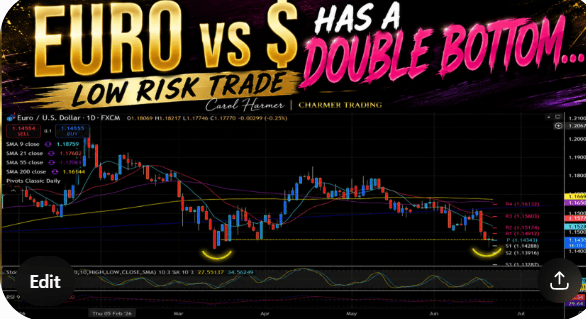
At the moment, EUR/USD appears to be forming a potential Double Bottom pattern around the 1.14 area. Unless we see a daily close below 1.1400, there is every possibility that buyers will step in at these lower levels and force a corrective move higher.

That does not detract from the longer-term weakness in the Euro. However, this is the first test of the lower end of the pattern and I still subscribe to the old trading adage:

"Double Bottoms often hold. Triple Bottoms rarely do."

Currently, there is very little activity in the Euro, but it is still early. Once London opens I would expect volume and volatility to increase.

For today, watch the Daily Pivot at 1.1454 and the previous low at 1.1410.

Any move into this zone should attract buying interest and support the market.

Should buyers gain control, I believe 1.1517 is the first natural target. Beyond that, if the Double Bottom holds, EUR/USD could work its way towards 1.1570 and potentially 1.1620 by Thursday.

What is also catching my attention is that the technical indicators on the daily charts are beginning to turn bullish.

For shorter-term traders, I would use the 4-hour charts to identify potential entry and exit points.

A daily close below 1.1400 invalidates this bullish scenario.

Until then, I favour a corrective move higher before the next leg lower develops.
Chart

Author

Carol Harmer

Carol Harmer

Charmer Trading

Carol Harmer has over 39 years experience of analysing and trading the world's markets and is undoubtedly one of the most respected technical trader in the world today.


More from Carol Harmer
Share:

Editor's Picks

AUD/USD keeps range near 0.6950 after Australian trade data

AUD/USD consolidates near a two-month low, trading around mid-0.6900s in the Asian session on Thursday amid a bullish US Dollar. The US PCE data tempered October Fed hike bets, though oil-driven inflation fears remain supportive of elevated US bond yields. Meanwhile, Australia's trade surplus shrank sharply in August to AUD495M, having limited impact on the Aussie Dollar and the pair.


USD/JPY sits at weekly top above 158.00 as bullish USD counters intervention risks

USD/JPY is sitting at the top end of its weekly range above 158.00 in the Asian session on Thursday. Despite the softer US PCE data, oil-driven inflation risks keep US bond yields elevated near multi-year highs. Moreover, the US-Iran standoff benefits the safe-haven US Dollar and supports the pair. Broad US Dollar strength counters hawkish BoJ expectations and Japanese intervention risks.

Gold alternates gains with losses below $4,200

Gold trades without a clear direction on Thursday, always below the key $4,200 mark per troy ounce. The yellow metal’s vacillating price action comes amid the marked advance in the US Dollar coupled with steady effervescence in the Middle East conflict.

Crypto Today: Bitcoin, Ethereum, XRP struggle to regain momentum amid returning ETF outflows

Bitcoin trades broadly between support at $82,500 and resistance at $85,000. Ethereum similarly remains under pressure, trading below $2,700 while the $2,600 level provides immediate support. At the same time, Ripple has slipped below the pivotal $1.50 level.

Markets are pricing a Fed pause. The jobs data says the hike is still coming

The market has rapidly changed its mind about the Fed. Only a week ago, investors saw an October interest-rate hike as the most likely outcome. However, softer inflation and cautious comments from policymakers have since turned a pause into the dominant scenario.

Markets are pricing a Fed pause. The jobs data says the hike is still coming
The market has rapidly changed its mind about the Federal Reserve (Fed). Only a week ago, investors saw an October interest-rate hike as the most likely outcome. However, softer inflation and cautious comments from policymakers have since turned a pause into the dominant scenario. Yet beneath that dramatic repricing, the US economy is sending a considerably less dovish message.














