European gas pricing shifts as storage risk drives April positioning

Key takeaways
- Low storage levels are setting the starting constraint for April pricing.
- LNG flows are concentrating into key terminals, reducing system flexibility.
- Gas pricing is shifting toward storage refill execution risk.
European gas is entering April with structural tension already embedded in the market environment.
The refill season begins without a comfortable buffer, shifting the focus away from supply availability and toward operational execution. Pricing is no longer anchored to whether gas is present, but to how effectively flows can be routed, allocated and stored.
Storage sets the tone for April
European gas begins the new month with storage levels that remain below comfortable refill conditions.
The infrastructure enters the injection phase with limited margin for inefficiencies. This changes how participants approach the market. The focus shifts from covering demand to rebuilding inventories under tighter operational conditions.
Injection becomes an active process. Timing, access and continuity turn into central variables. The network requires stable and continuous flows rather than intermittent supply bursts.
The starting point matters. April begins with pressure already embedded in the structure, leaving limited room for operational misalignment.
LNG flows concentrate into key entry points
Flows into Europe remain elevated.
Volumes continue to move above 580 mcm and the net balance holds positive. The market is being supplied, yet the distribution of these flows introduces a structural rigidity.
A large share of LNG cargoes is routed into a limited number of terminals. TVB and Zeebrugge continue to absorb a significant portion of incoming volumes, reinforcing their role as dominant entry nodes.
This configuration reduces flexibility.
When flows concentrate into specific locations, the network becomes dependent on those nodes. Routing optionality narrows, redistribution capacity weakens and localized pressure begins to build.
The market remains supplied, yet structurally less adaptable.
Access becomes the controlling variable
The market is shifting toward a different pricing logic.
Availability alone no longer defines conditions. Access to flows and the ability to move gas into storage now carry more weight in price formation.
Injection depends on timing, terminal capacity and regional flow dynamics. These elements introduce operational friction into the infrastructure, transforming supply into a constrained resource.
Participants operate within tighter logistical boundaries. Positioning becomes more selective, with allocation driven by access conditions rather than broad availability.
The structure evolves around control of flow pathways rather than absolute supply levels.
Pressure moves through the system
Constraints at entry points extend into the broader infrastructure and begin to shape internal balances.
Storage injection becomes uneven across regions. Timing differences between flows and available capacity start to matter more, creating competition for injection windows rather than for molecules.
This process generates internal pressure that propagates through spreads and forward pricing.
Regional differentials begin to adjust, reflecting localized imbalances. Forward curves incorporate execution uncertainty, embedding a premium linked to the difficulty of maintaining consistent injection flows.
The market starts to price operational friction.
The impact develops gradually, without requiring an immediate price spike, but it alters the underlying equilibrium of the network.
Cross asset signals remain contained
Signals outside the gas market remain relatively stable.
LNG shipping equities show limited movement despite sustained inflows above 580 mcm, suggesting that transport capacity is not under immediate stress. This indicates that the constraint does not originate from global supply or shipping availability.
Other shipping segments, including dry bulk and crude tankers, reflect steady activity without signaling disruption.
The absence of strong cross asset confirmation points to an adjustment driven internally rather than by an external shock.
Sentiment remains cautious, with positioning reflecting awareness of constraints rather than urgency.
Positioning tightens into the new month
April opens with a narrower operating window.
Storage needs to rebuild while flows remain concentrated and logistical rigidities persist. This combination reduces tolerance for imbalance and increases sensitivity to timing disruptions.
Participants are already adapting to this environment.
Positioning becomes more tactical, with decisions increasingly dependent on access, sequencing and short term operational visibility. Even small frictions can translate into meaningful shifts in balance.
The market operates closer to its limits, even without visible supply stress.
Technical structure: compression holds the market
The market is operating in a compression regime, reflecting controlled pressure rather than directional expansion.
Price continues to rotate within a defined range, with the pivot area near 3.01 acting as the central reference point. This level anchors short term positioning and defines the balance of the current structure.
Resistance develops toward the 3.13 area, where attempts to extend higher fail to generate follow through. Support remains stable near 2.89, containing downside movement and preserving the range.
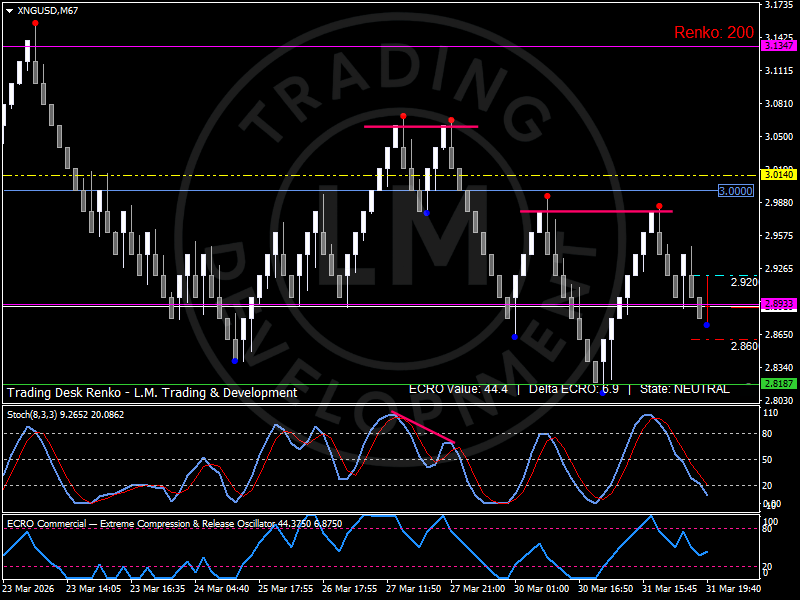
This repeated rotation without extension signals a lack of directional conviction.
Momentum remains contained. ECRO holds in a neutral range, indicating the absence of release dynamics. Delta signals show limited strength, while stochastic levels are moving lower from elevated zones, confirming the loss of short term momentum.
The next directional move will not depend solely on gas fundamentals.
XNG/USD remains sensitive to dollar dynamics, and today’s US macro releases, including ADP employment and ISM data, may introduce volatility across currency markets. Any strengthening of the dollar would tighten financial conditions and weigh on upside attempts, while a softer dollar could ease pressure on the upper boundary of the range.
The market is absorbing pressure within a confined structure, consistent with an environment pricing constraints without triggering expansion.
Synthesis: pricing shifts toward execution
European gas is moving into a phase where execution defines pricing conditions.
The market carries supply, yet the constraint develops around how that supply is accessed, routed and injected into storage.
This shift changes behavior.
Sensitivity increases around timing, logistics and capacity utilization. Pricing reflects the ability to maintain flow consistency rather than simple availability.
The structure evolves around operational control.
Outlook
As long as storage remains below comfortable levels and flows remain concentrated, the market is likely to stay within a controlled range.
A move higher would require tighter access conditions, increased competition for injection capacity and further concentration of flows into limited entry points. A move lower would require improved flow distribution, smoother routing dynamics and more balanced storage injection across regions.
Until these conditions change, compression remains the dominant market state.
European gas enters April with execution at the center of pricing.
Author

Luca Mattei
LM Trading & Development
Luca Mattei is a market analyst focusing on FX, metals, and macroeconomic trends. He develops trading tools for retail and professional traders, coding indicators and EAs for MT4/MT5 and strategies in Pine Script for TradingView.