Europe Likely in Recession Now: Germany, France, Italy Production Collapsed


German, French, and Italian industrial production collapsed in November. Italy GDP is negative for 3rd Quarter.
Italy GDP
Italy's GDP was negative for the third quarter. Gross domestic product (GDP) in the euro zone’s third largest economy fell by 0.1 percent in July-September due to weaker domestic demand, statistics bureau ISTAT said, the first decline since the second quarter of 2014.
Based on industrial production, Germany and France will soon follow.
Germany Industrial Production
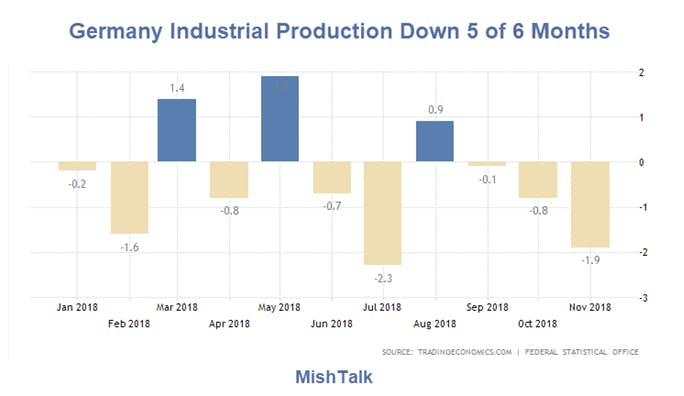
Analysts actually expected German IP to rise. Go figure.
German industrial output fell unexpectedly by 1.9 percent month-on-month in November 2018, missing market expectations of a 0.3 percent rise and following an upwardly revised 0.8 percent drop in October.
France Industrial Production

France's industrial production fell 1.3 percent from a month earlier in November 2018, reversing an upwardly revised 1.3 percent growth in October and missing market expectations of a 0.2 percent gain.
Italy Industrial Production
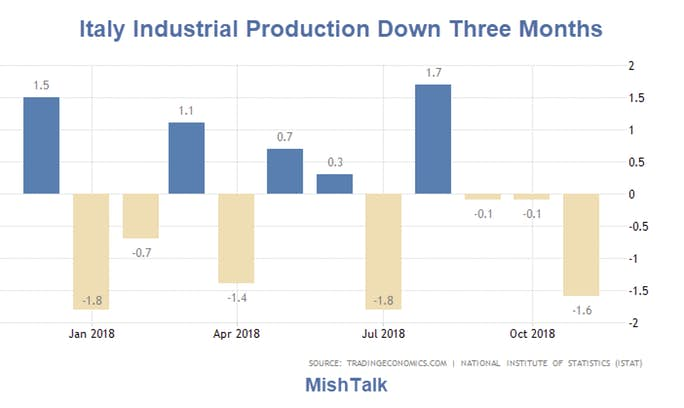
Italy's industrial production slumped 1.6 percent from a month earlier in November 2018, much worse than market expectations of a 0.3 percent decline and following a meager 0.1 percent gain in October.
Brink of Recession or Already In Recession?

The Telegraph asks Is Germany - and the Eurozone - On the Brink of Recession?
The water levels of the Rhine are low and Germany may be flirting with recession. The two are connected, many argue. The Rhine is a key artery for the transport of many goods into and through the country, particularly for the chemicals and energy industries.
But praying that the water rises and all will come good might not be enough. Just as the idea that negative growth in the third quarter was due to the temporary hit of emissions testing rules on an already troubled car industry, the one-off excuses are starting to wear a bit thin. There is a grander slowdown facing Berlin, and, as the eurozone’s economic powerhouse, potentially the rest of its members too.
“The general expectation was that we would see a rebound in the final quarter of last year. But the Ifo [business surveys] have continued to remain fairly subdued. They also show that weakness is no longer confined to the car sector, but it’s getting broader,” says Felix Huefner of UBS.
The fourth quarter of 2018 was “horrible” for the eurozone, says Claus Vistesen at Pantheon Macroeconomics. It is, in his view, highly likely that the country had a technical recession - two consecutive quarters where the economy shrinks - last year.
Unexpectedly Horrid Numbers
These are not only horrid numbers, they are unexpectedly and shockingly horrid numbers.
Blame Game
- France will blame the "yellow vest movement"
- Germany will blame cars and diesel and water levels on the Rhine
- Italy will blame France and Germany
But the numbers are what they are.
On top of it, Brexit concerns are in play as are Trump tariffs and a slowdown in China.
Add it all up and what do you get?
R E C E S S I O N
That's what. Forget talk of a "technical recession" this will be the real deal. And weakness will spill over into the US.
Author
Mike “Mish” Shedlock's
Sitka Pacific Capital Management,Llc