|

Euro slips as Eurozone PMIs dip, US PMIs next

The euro has started the trading week with considerable losses. EUR/USD is trading at 1.1103 in the European session at the time of writing, down 0.50% on the day. Later today, we’ll get a look at US services and manufacturing PMIs.

Eurozone and German PMIs disappoint

The August PMIs for services and manufacturing were a disappointment, as they decelerated in September and missed the estimates.

The manufacturing sector remains mired in contraction. The eurozone manufacturing PMI fell to 44.8, below the August reading of 45.8 and the market estimate of 45.6 and was the sharpest decline this year. Germany, the largest economy in the bloc, saw manufacturing fall to 40.3, below the August reading of 42.4 and the market estimate of 42.3. This marked the weakest level in a year. The 50 line separates expansion from contraction.

The services sector is looking a bit better, but also eased in September. The eurozone services PMI fell to 50.5, down from 52.9 in August and shy of the market estimate of 52.1. This was the weakest reading since February and indicates marginal expansion. It was a similar story in Germany, as the PMI reading of 50.6 was below the August read of 51.2 and the market estimate of 51.0.

The weak data has sent the euro lower today and will support the case for lower interest rates. The European Central Bank has shifted gears and has embarked on rate-cutting cycle with a cut in June and a second cut earlier this month. Inflation is within striking distance of the ECB’s 2% inflation target and the current goal is to kick-start the weak economy and avert a recession.

EUR/USD technical

  • EUR/USD has pushed below support at 1.1141 and tested support at 1.1094 earlier..

  • There is resistance at 1.1212 and 1.1259.
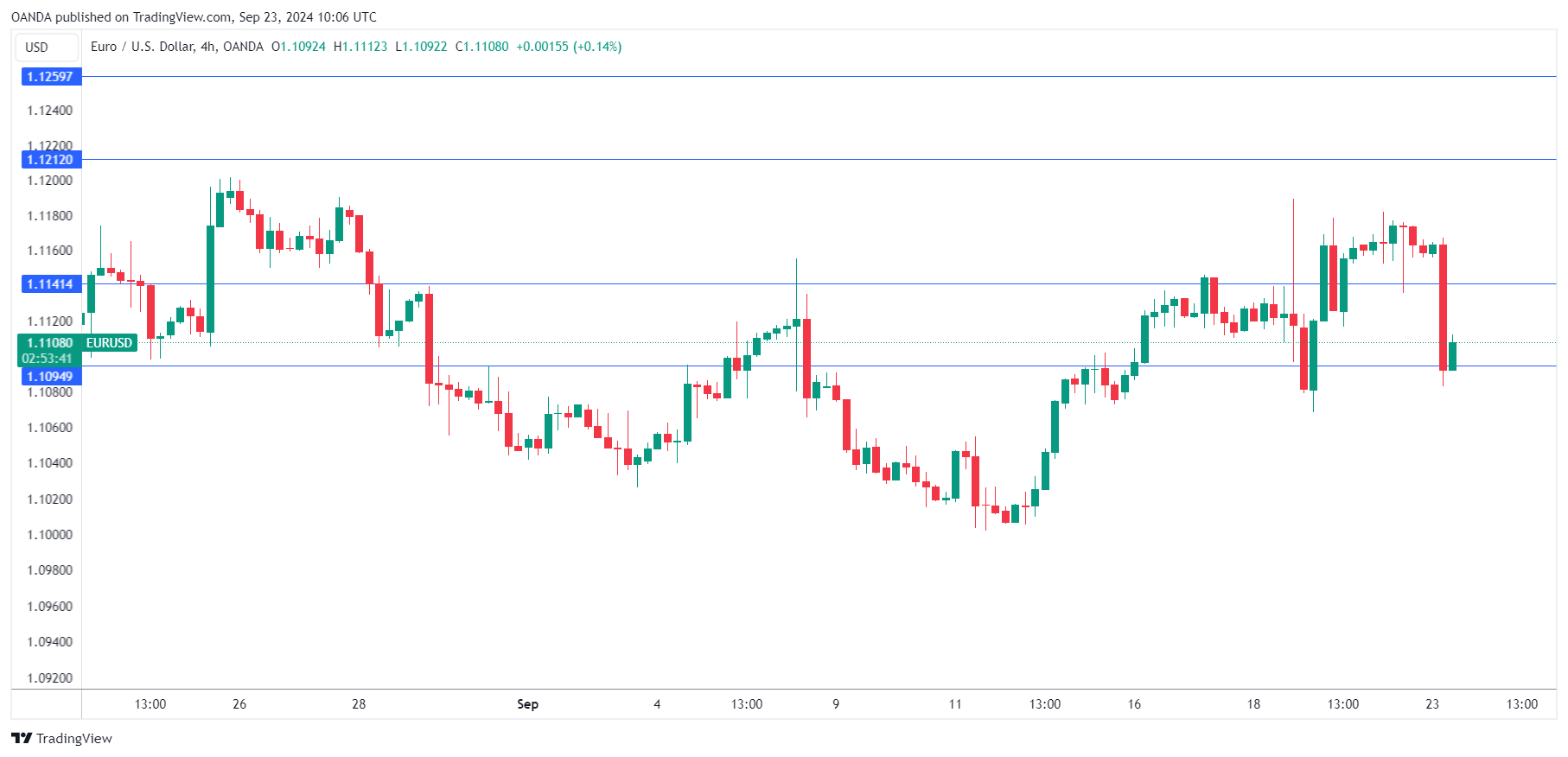
Chart

Author

Kenny Fisher

Kenny Fisher

MarketPulse

A highly experienced financial market analyst with a focus on fundamental analysis, Kenneth Fisher’s daily commentary covers a broad range of markets including forex, equities and commodities.


More from Kenny Fisher
Share:

Markets move fast. We move first.

Orange Juice Newsletter brings you expert driven insights - not headlines. Every day on your inbox.

By subscribing you agree to our Terms and conditions.

Editor's Picks

EUR/USD flatlines below 1.1800 ahead of Fed Minutes

EUR/USD struggles to find direction and continues to move sideways below 1.1800 for the second consecutive day on Tuesday as markets remain in holiday mood. Later in the American session, the Federal Reserve will publish the minutes of the December policy meeting.

GBP/USD retreats to 1.3500 area following earlier climb

GBP/USD loses its traction and trades flat on the day near 1.3500 after rising to the 1.3530 area early Tuesday. Trading conditions remain thin ahead of the New Year holiday, limiting the pair's volatility. The Fed will publish December meeting minutes in the late American session.

Gold rebounds toward $4,400 following sharp correction

Gold gathers recovery momentum and advances toward $4,400 on Tuesday after losing more than 4% on Monday. Increased margin requirements on gold and silver futures by the Chicago Mercantile Exchange Group, one of the world’s largest trading floors for commodities, prompted widespread profit-taking and portfolio rebalancing.

Tron steadies as Justin Sun invests $18 million in Tron Inc.

Tron (TRX) trades above $0.2800 at press time on Monday, hovering below the 50-day Exponential Moving Average (EMA) at $0.2859.

Economic outlook 2026-2027 in advanced countries: Solidity test

After a year marked by global economic resilience and ending on a note of optimism, 2026 looks promising and could be a year of solid economic performance. In our baseline scenario, we expect most of the supportive factors at work in 2025 to continue to play a role in 2026.

Crypto market outlook for 2026

Year 2025 was volatile, as crypto often is.  Among positive catalysts were favourable regulatory changes in the U.S., rise of Digital Asset Treasuries (DAT), adoption of AI and tokenization of Real-World-Assets (RWA).