Euro positioning hits a 597-report extreme as precious metals and lean hogs flash bullish COT signals

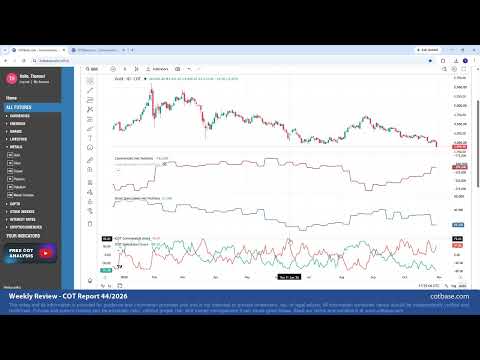
The euro is the standout reading in this week's Commitments of Traders data. Large Speculators have reached a 597-report extreme in net positioning — a level it has taken the market approximately ten years to revisit. To find a comparable reading, you need to scroll back to around 2016, when a similarly significant bullish COT extreme helped halt a prolonged decline, established a multi-year base, and was eventually followed by a sustained move higher. That historical episode is context, not a forecast, but it gives some sense of how unusual the current positioning has become.
A 597-report extreme in the Euro
When positioning stretches this far and remains at this level for this long, it warrants serious attention. Large Speculators — the large speculative trader category — are now at a positioning extreme that, on a futures-and-options combined basis, is the most stretched in roughly a decade. That is a genuinely rare reading, and the COT data as a whole is supporting the case for higher prices in the euro over the medium term.
I would not treat this as an immediate entry signal in isolation. A positioning extreme tells us where pressure has built; it does not tell us precisely when that pressure resolves or by how much. But the signal is clear: the current configuration in the euro is historically unusual, and it deserves a prominent place on any watchlist.
Lean Hogs and the Australian Dollar: All-Time COT Extremes Remain in Place
Two markets continue to carry all-time COT extreme signals from prior reports, and both are worth revisiting here.
In lean hogs, the bullish COT extreme is unambiguous on the full historical chart. Large Speculator net positioning is at levels not seen across the entire available data history, firmly supporting higher prices over the medium to longer term. I would not expect a sudden price spike — lean hogs is a volatile and technically difficult market, and caution is always appropriate there. What the COT data does suggest, in my view, is that the $40 to $58 price range could represent meaningful medium-term support. The signal itself is as strong as COT data produces.
The Australian dollar picture is similar in character. The all-time bullish COT extreme that was already in place has continued to build, with the stress in the market rising further in this report. Large Speculator net positioning, viewed against the full history of available COT data, supports higher prices to come. There is not much to add beyond what has already been documented in recent weeks, except that the signal has strengthened rather than faded.
Precious metals: Bullish weekly change signals in Platinum, Gold, and Copper
The metals complex produced three markets with notable weekly changes in Commercials' net positions — the hedger category — this week.
Platinum showed a 23% change in Commercials' net position, which on the shorter-term chart registers as a top-three change by size. That qualifies as a bullish COT change signal, suggesting potential strengthening in the near term. Viewed on the five-year chart, Commercials' net positioning is starting to lean toward the bullish side of the extreme range, though I would argue there is still meaningful space remaining before reaching the kind of all-time extreme that would generate the strongest signal. Commercials are currently around 11,744 contracts net short. A move toward net long territory, closer to the 4,000 to 5,000 contracts net long range, would bring the market much closer to that threshold.
Gold and copper each showed a 20% change in Commercials' net position, also qualifying as bullish COT change signals. In copper specifically, it is worth noting that Large Speculator positioning on the shorter-term ICOT view is approaching levels that previously generated significant signals — including a reading of 86 seen in late October. Whether the current move continues toward that kind of extreme is something to watch over the coming reports.
These are weekly change signals rather than long-term positioning extremes. The distinction matters. A large weekly change in Commercials' net position suggests near-term directional pressure; it does not carry the same weight as a multi-year or all-time extreme across the full COT history.
Key takeaway
The central story this week is the euro's 597-report bullish COT extreme — a reading that has taken roughly ten years to reach and that the COT data is treating as a meaningful signal supporting higher prices over the medium term. Supporting that broader picture, all-time COT extremes remain firmly in place in lean hogs and the Australian dollar. Across the metals complex, bullish weekly change signals in platinum, gold, and copper suggest near-term constructive pressure, though these remain change signals rather than confirmed long-term extremes. The overall direction of this week's data is skewed toward the bullish side across multiple markets, while the strength and time horizon of those signals vary considerably between them.
Watch the full COT review for the 44th report of 2026, including chart walkthroughs and the ICOT intraday indicator analysis.
This content was partially created by an AI tool.
Author

Thomas Lukacs
COTBase.com
Thomas Lukacs is the founder and CEO of COTbase.com.

















