EUR/USD Weekly Forecast: Eyes on Trump’s tariffs and Fed Chair Powell’s testimony
- Federal Reserve Chair Jerome Powell is due to testify before Congress in the upcoming days.
- Financial markets danced to the rhythm of sentiment as President Trump started a trade war.
- EUR/USD trades with a soft tone, lower lows likely in the upcoming sessions.


The EUR/USD pair ended last week trading at around 1.0370, little changed from its previous weekly close of 1.0361. Tensions related to the United States (US) trade war with its major counterparts dominated financial boards in the last few days and will likely remain as the main market mover.
Trump’s trade war is here to stay
The US Dollar (USD) gathered momentum at the beginning of last week, gaping higher against all major rivals as US President Donald Trump kick-started imposing tariffs over the weekend. Trump announced that they would impose sweeping 25% tariffs on Mexican and Canadian imports and 10% on Chinese goods entering the US. Even further, Trump warned that tariffs will “definitely” hit the European Union (EU) and the United Kingdom (UK), but added a deal could still be worked out with the UK.
Panic dominated the financial scene and the USD soared as high-yielding assets collapsed. Counter tariffs were quickly announced, but Trump postponed levies on Mexico and Canada for 30 days after authorities from both countries committed to reinforcing border security with the world’s largest economy.
However, levies on China started running last week, with Beijing announcing retaliatory tariffs, imposing a 15% tax on coal and liquefied natural gas and 10% on crude oil, agricultural machinery, large-displacement cars and pickup trucks. These measures take effect on February 10.
Easing tensions with neighbouring countries pushed the USD lower, helping EUR/USD to close the gap and even extend gains towards a peak of 1.0441 mid-week.
Investors temporarily put aside trade war concerns to watch the US employment situation. The country released the December JOLTS Job Openings report, which showed that the number of open positions stood at 7.6 million, decreasing from the 8.1 million posted in November. Additionally, the ADP report on Employment Change showed the US private sector added 183,000 jobs in January, more than the 176,000 gained in the previous month and beating expectations of 150,000.
On a negative note, Initial Jobless Claims in the week ended January 31 unexpectedly increased to 219,000 from 208,000 in the previous week, while Nonfarm Productivity in Q4 rose modestly to 1.2% after advancing 2.2% in the previous quarter and below the 1.7% gain anticipated by market players.
Finally, the US unveiled the January Nonfarm Payrolls (NFP) report on Friday, showing the economy added 143,000 new jobs in the month, less than the 170,000 anticipated by market participants.
The Unemployment Rate was confirmed at 4%, down from 4.1% in the previous month, while beating the expected 4.1%. Additionally, the Labor Force Participation Rate edged higher to 62.6% from 62.5%. Finally, annual wage inflation, as measured by the change in the Average Hourly Earnings, rose 4.1%, surpassing the market expectation of 3.8%.
European growth still dragging the Euro lower
Across the pond, the macroeconomic calendar was quite scarce. After the European Central Bank (ECB) cut interest rates for the fifth consecutive time late in January, officials delivered no fresh clues.
The European Union (EU) published the preliminary estimate of the January Harmonized Index of Consumer Prices (HICP), which rose by 2.5% YoY, as expected. The core annual reading, however, posted 2.7% matching the December reading yet above the 2.6% expected.
Additionally, the Hamburg Commercial Bank (HCOB) released the final estimates of the January Manufacturing Purchasing Managers’ Index (PMI), which suffered modest upward revisions yet remained within contraction levels. The final EU Manufacturing PMI was confirmed at 46.6, following a preliminary estimate of 46.1. Services output was also revised lower, confirmed at 51.3 in the same period, while the final Composite PMI matched the preliminary estimate of 50.2. The EU also published December Retail Sales, which fell by 0.2% in the month.
Germany reported that December Factory Orders rose 6.9% month-on-month (MoM) while Industrial Production in the same month decreased by 2.4%, worse than the -0.6% anticipated by market participants.
What’s next in the docket
Fed’s Chairman Jerome Powell will testify about the Semi-Annual Monetary Policy Report before Congress this week, starting before the Senate Banking Committee on Tuesday and before the House Financial Services Committee on Wednesday. The Fed has adopted a hawkish stance back in December amid trade uncertainty, repeating its message when it met in January. Powell’s testimony will likely point in the same direction, yet his words will be deeply scrutinised for clues on future monetary policy decisions.
The US will release the January Consumer Price Index (CPI) also on Wednesday, while Germany will publish the final estimate of the Harmonized Index of Consumer Prices (HICP) for the same month on Thursday.
The week will end on a high note, as the EU will release an estimate of the Q4 Gross Domestic Product (GDP), while the US will publish January Retail Sales and the preliminary estimate of the February Michigan Consumer Sentiment Index.

EUR/USD technical outlook
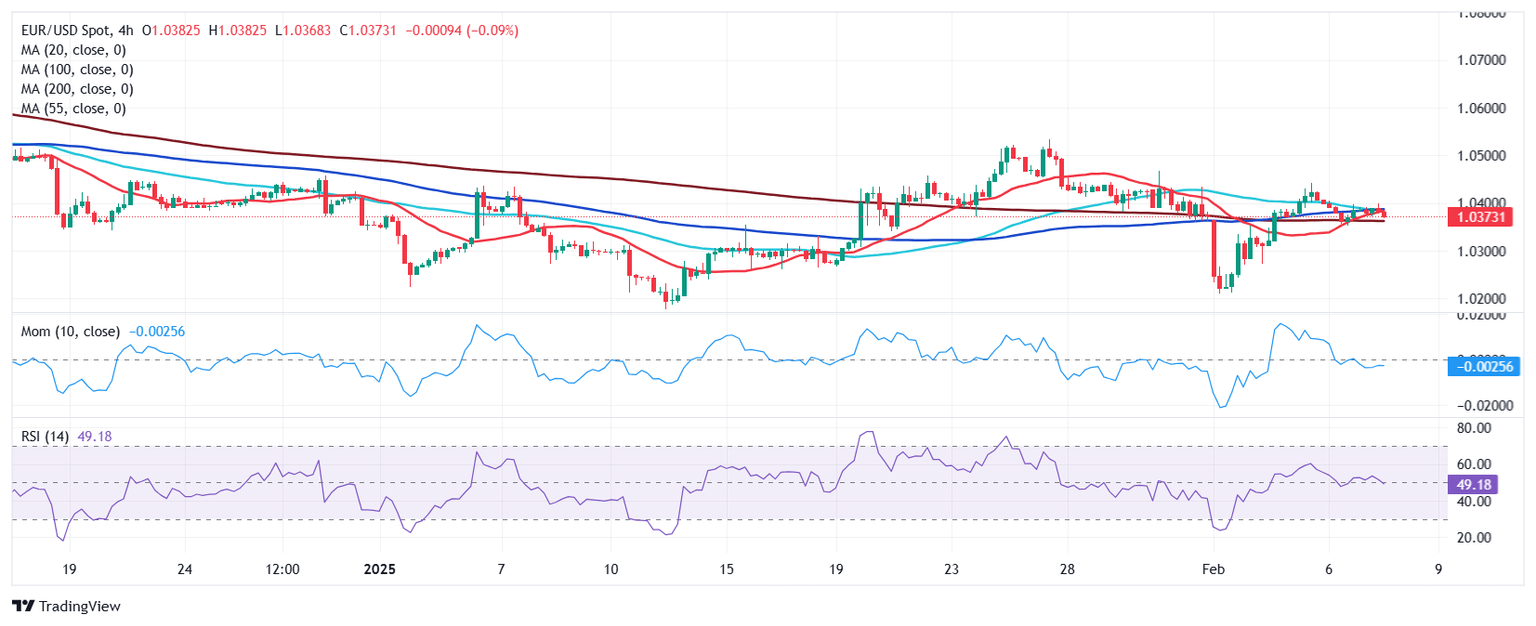
From a technical point of view, the EUR/USD pair is at risk of falling further. In the weekly chart, the pair develops below all its moving averages, with the 20 Simple Moving Average (SMA) heading firmly south below the 100 and 200 SMAs, in line with sellers’ dominance. The 20 SMA currently develops at around 1.0590, providing a strong dynamic resistance. Meanwhile, technical indicators in the mentioned time frame maintain their bearish slopes within negative levels, and after correcting oversold conditions, favoring lower lows ahead.
The daily chart shows EUR/USD battles around a mildly bullish 20 SMA, while the 100 SMA accelerates lower far above the current level, while below a mildly bearish 200 SMA. All moving averages hint at increased selling interest and another leg lower in the upcoming days. Finally, technical indicators also support a bearish continuation, as per heading south within negative levels.
Initial support comes at 1.0350, followed by the 1.0300 threshold. A break below the latter exposes the weekly low at 1.0210, en route to January’s monthly bottom at 1.0177. Further slides put parity in sight.
Should the Euro gain upward traction, resistance comes at the 1.0450 price zone, followed by January’s monthly high at 1.0532.
Tariffs FAQs
Tariffs are customs duties levied on certain merchandise imports or a category of products. Tariffs are designed to help local producers and manufacturers be more competitive in the market by providing a price advantage over similar goods that can be imported. Tariffs are widely used as tools of protectionism, along with trade barriers and import quotas.
Although tariffs and taxes both generate government revenue to fund public goods and services, they have several distinctions. Tariffs are prepaid at the port of entry, while taxes are paid at the time of purchase. Taxes are imposed on individual taxpayers and businesses, while tariffs are paid by importers.
There are two schools of thought among economists regarding the usage of tariffs. While some argue that tariffs are necessary to protect domestic industries and address trade imbalances, others see them as a harmful tool that could potentially drive prices higher over the long term and lead to a damaging trade war by encouraging tit-for-tat tariffs.
During the run-up to the presidential election in November 2024, Donald Trump made it clear that he intends to use tariffs to support the US economy and American producers. In 2024, Mexico, China and Canada accounted for 42% of total US imports. In this period, Mexico stood out as the top exporter with $466.6 billion, according to the US Census Bureau. Hence, Trump wants to focus on these three nations when imposing tariffs. He also plans to use the revenue generated through tariffs to lower personal income taxes.
Premium
You have reached your limit of 3 free articles for this month.
Start your subscription and get access to all our original articles.
Author
Valeria Bednarik
FXStreet
Valeria Bednarik was born and lives in Buenos Aires, Argentina. Her passion for math and numbers pushed her into studying economics in her younger years.