EUR/USD Weekly Forecast: US Dollar in trouble as Warsh chickens out
- The Federal Reserve kept rates unchanged despite Warsh's tough words against inflation.
- Focus remains on the war in the Middle East, while US employment data may add noise.
- EUR/USD shows signs of near-term bullish life, long-term bearish case firmly in place.

The EUR/USD pair closes July with modest gains near the 1.1500 mark, adding over 1.1% in the last trading week. Price action throughout the month was dull to say the least as investors remained clueless, although the pair managed to hit 1.1530 ahead of the close. The lack of action was compounded by persistent uncertainty, centered on developments in the Middle East and the United States (US) Federal Reserve’s (Fed ) monetary policy path.
Regarding the first, an escalation of the US-Iran war spurred US Dollar (USD) demand at the beginning of the week after continued tit-for-tat attacks around the Strait of Hormuz, which, by the way, is once again closed. Mood improved early in the week amid a pause in attacks and headlines suggesting a fresh round of negotiations.
Renewed war headlines, however, were quickly overshadowed by the US Fed monetary policy announcement on Wednesday. The USD plunged after the central bank decided to leave the benchmark rate unchanged, with the split vote leaving it at a range of 3.50%-3.75%. Three regional bank presidents dissented, preferring an immediate 25-basis-point (bps) rate hike: Cleveland's Beth Hammack, Minneapolis's Neel Kashkari, and Dallas's Lorie Logan.
Chairman Kevin Warsh chickens out
The USD collapsed following the Fed’s decision as investors believed Chair Warsh had chickened out. He kept repeating his commitment to curb inflation and to price stability, but the Fed left rates unchanged for the fifth consecutive meeting.
Of course, he did not provide clear guidance on the future path of monetary policy, not actually a surprise. And he failed to specify how he intends to resolve five-year-long inflationary pressure despite affirming that there is no “soft” inflation target.
“We are on the job, we will deliver, we are focused like a laser on making sure we can do it, but the suggestion that we're going to be able to do it with our magic wand is one I want to disabuse you and everyone else of,” Warsh said.
Market players did not take well to the myriad empty words and the lack of action. However, bets on a September rate hike have increased after the dust settled. According to the CME FedWatch Tool, the chances of a hike increased to 65% from 55% one week before the Federal Open Market Committee (FOMC) announcement.
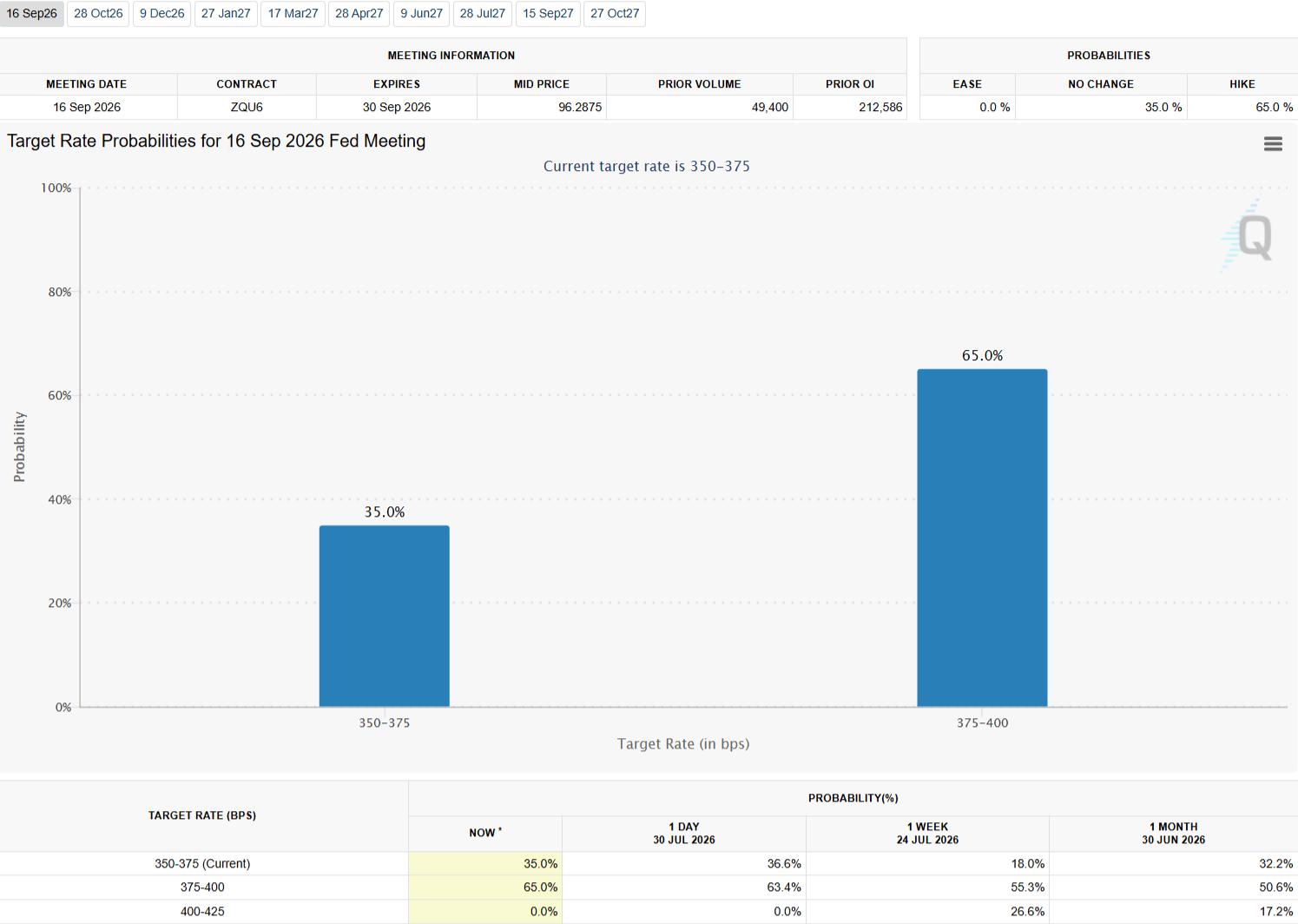
Still, there’s a long way ahead of September, and loads could happen in the way. The focus will remain on data — inflation and employment figures — and Middle East developments.
Meanwhile, the US published the preliminary estimate of the Q2 Gross Domestic Product (GDP), which showed that the economy expanded at an annual rate of 1.5%, missing expectations and below the Q1 reading of 2.1%. Other details of the report showed that the GDP Price Index jumped to 6.3% in Q2 from 3.6% in Q1, while the quarterly core Personal Consumption Expenditures (PCE) Price Index, the Fed’s favorite inflation gauge, increased 3.3% on a yearly basis, matching the market expectation. In June, the core PCE Price Index ticked lower on a yearly basis, to 3.3% from 3.4% in May, still far above the Fed’s 2% goal.
Middle East crisis here to stay
US President Donald Trump said for the umpteenth time on Friday that the war is “going well” and that the US “keeps winning.” No strikes between Washington and Tehran were reported by the end of the week, a short truce that at least was enough to contain fears. Still, unrest leads the region as traffic through the Strait of Hormuz declined to the levels seen before the Memorandum of Understanding (MoU), while Kuwait and Egypt reported Iranian attacks early Friday.
On a positive note, US President Trump announced an historic agreement to secure the disarmament of Hamas, while a senior Hamas official confirmed it to CNN, contingent on Israel upholding its obligations. This is the first time Hamas has agreed to a specific plan to hand over weapons.
The song remains the same: the US demands Iran drops its nuclear program, while Iran requests full control of the critical sea passage. Neither side is willing to give up on those terms.
Euro finds support in data
Data coming from Europe provided support to the Euro: Germany and the Eurozone (EU) released the preliminary estimates of the Q2 GDP. Annualized growth in Germany rose 0.9%, modest yet better than the 0.4% posted in Q1. The EU figure printed at 1%, up from the previous 0.3%.
German inflation met expectations as the preliminary estimate of the July Harmonized Index of Consumer Prices printed at 2.8% YoY, higher than the 2.4% from June. The EU HICP in the same period resulted in 2.5%, in line with expectations and slightly above the previous 2.4%.
Still, financial markets price in roughly a 65% probability that the European Central Bank (ECB) will deliver a 25 bps rate hike at the September meeting. Again, too early to speculate about that.
Regardless, European data was encouraging enough to spook concerns, which ended up helping the Euro on its way north. It should not be a surprise, however, if the Greenback resumes its rally on the back of war-related fears.
What’s next in the docket
The first week of August will be a busy one. Germany will kick-start macroeconomic releases by publishing June Retail Sales, while the US will publish the ISM Manufacturing Purchasing Managers Index (PMI) on Monday. The ISM Services PMI will be out on Wednesday, while EU June Retail Sales are scheduled for Thursday.
S&P Global, alongside local banks, will release the final estimates of the July PMIs for major economies throughout the week.
Midweek, the focus will turn to employment as the US releases June JOLTS Job Openings, the July ADP Employment Change report, and July Challenger Job Cuts ahead of the July Nonfarm Payrolls (NFP) report scheduled for Friday. The US is expected to have added 91K new jobs in the month, up from the 57K added in June, while the Unemployment Rate is foreseen at 4.3%, up from the 4.2% posted in June.

EUR/USD Technical Outlook:
From a technical perspective, based on the daily chart, EUR/USD has partially recovered its bullish poise. The pair has run past a now mildly bullish 20-day Simple Moving Average (SMA) at 1.1430, although it remains below the 100-day and 200-day simple SMAs at 1.1568 and 1.1631, respectively, keeping the broader backdrop bearish despite the latest bounce. The 14-day Relative Strength Index (RSI) indicator turned lower but stands at 58, while the Momentum indicator holds flat above its midline, suggesting that buying interest has improved, though not enough to confirm a trend change.
In the weekly chart, EUR/USD maintains a mildly bearish near-term bias, holding below the 20-week SMA at 1.1565 while still trading above the 100- and 200-week SMAs at 1.1311 and 1.1032, respectively. Technical indicators have rotated higher, but remain below their midlines, reflecting the latest advance yet far from suggesting a bullish extension ahead.
On the topside, initial resistance is at the 100-day SMA near 1.1568, with the 200-day SMA at around 1.1631 as the next significant barrier if buyers extend the advance. On the downside, immediate support emerges at the 20-day SMA at 1.1424, where a break would expose a deeper pullback toward the June low at 1.1324.
(The technical analysis of this story was written with the help of an AI tool. Know more.)
Fed credibility questions underpin USD SSA spreads as EUR and GBP seen outperforming
According to TD Securities, recent price action has seen "US swap spreads have tightened, and the yield curve has steepened," reshaping relative value across rates and credit markets. The bank argues that "questions around the Fed's credibility are supportive for USD SSA G-spreads," and, in this context, it "look[s] for front-end EUR and GBP to outperform vs USD" as investors reassess opportunities along the front end of major curves.
Author

Valeria Bednarik
FXStreet
Valeria Bednarik was born and lives in Buenos Aires, Argentina. Her passion for math and numbers pushed her into studying economics in her younger years.