EUR/USD Weekly Forecast: Buyers took a step back, waiting to add at lower levels
- The US Federal Reserve kept the benchmark interest rate unchanged, as expected.
- Germany’s spending boost passed Congress and provided support to the Euro.
- EUR/USD could correct further south once below the 1.0800 threshold.

The EUR/USD pair shed some ground in the week, but not before reaching a fresh multi-month high of 1.0954. It settled closer to the 1.0800 threshold, as the US Dollar (USD) ended up benefiting from the Federal Reserve (Fed) monetary policy announcement.
Federal Reserve maintains the status quo
The Greenback started gathering momentum early on Wednesday, as markets turned cautious ahead of the central bank’s announcement. The USD seesawed between gains and losses within the decision but ended up surging amid prevalent trade-war global concerns and extreme oversold conditions forcing some profit-taking.
As widely anticipated, the Fed kept its benchmark interest rate between 4.25% and 4.50%, and still foresees two rate cuts coming in 2025. Officials also announced they would scale the quantitative tightening program. The Fed will now allow just $5 billion in maturing proceeds from Treasuries to roll off each month, down from $25 billion. It left a $35 billion cap on mortgage-backed securities unchanged.
“Uncertainty around the economic outlook has increased,” the accompanying statement read. “The Committee is attentive to the risks to both sides of its dual mandate.”
The Summary of Economic Projections (SEP) or dot plot showed that policymakers altered their views on growth and inflation, seeing the first lower and the second higher.
However, Chairman Jerome Powell said that less economic growth and higher inflation in 2025 somewhat offset each other after noting that a good part of higher inflation expectations comes from tariffs. Finally, he noted that the impact of tariffs on inflation could be “transitory,” bringing a bit of relief to financial markets.
“We’re not going to be in any hurry to move,” Fed Chair Powell added.
Germany takes centre stage in Europe
The Euro (EUR), on the other hand, benefited from headlines coming from Germany throughout the first half of the week. The head of the Social Democratic Party (SDP) Lars Klingbeil, addressed the Bundestag to unlock up to €1 trillion in new spending to boost the country’s defence and invest in infrastructure on Monday.
The German Bundesrat, the upper house of parliament, voted for a major fiscal package on Tuesday, with 513 votes in favor and 207 votes against. The reform includes changes to the long-standing debt brake rule and a €500 billion infrastructure and climate fund. The package still needs additional approvals, yet plans are moving in the right direction.
It’s worth adding, however, that Germany’s need to boost defence and infrastructure spending is a response to the decision of the United States (US) President Donald Trump to retrieve support for Ukraine in its war against Russia.
Geopolitical woes weigh on sentiment
Geopolitical jitters added to the market’s dismal mood. On the one hand, Israel resumed its military offensive in the Gaza Strip, ending the ceasefire amid claims that Hamas did not release the remaining hostages.
On the other hand, US President Trump spoke with his Russian counterpart, Vladimir Putin, and also with Ukrainian leader Volodymyr Zelenskyy, about a partial ceasefire in the Russia-Ukraine war. Russia agreed to halt attacks on energy plants but continued to launch massive drone attacks on its neighbour country. Tensions between the two nations continue despite efforts from Trump, who keeps pursuing taking advantage of rare mineral production in Eastern European countries.
Ukraine and the US agreed on a comprehensive agreement to develop Ukraine's critical mineral resources as soon as possible. In fact, Trump said a deal will be signed “very shortly.” Rare minerals are used in the manufacturing of electronics, batteries and magnets, among other things. Additionally, Trump offered to take over Ukrainian nuclear power plants to “protect” them. The idea surprised Kyiv authorities and Zelenskyy rejected it, claiming that nuclear plants were state-owned and could not be privatized.
Macroeconomic calendar hitting up
Data coming from the US was mixed yet scarce. Retail Sales were up a modest 0.2% in February, missing expectations of 0.7%. The NY Empire State Manufacturing Index plunged to -20 in March from the previous 5.7. However, weekly unemployment claims were slightly better than anticipated, printing at 223K, while the Philadelphia Fed Manufacturing Survey improved to 12.5 from 18.1 in February.
The German ZEW Survey showed a better sentiment, although persistent concerns about the current situation. The index surged to 51.6 in March from 26 in February, while for the EU, it came in at 39.8 in March versus 24.2 in February. The Current Situation Index improved to -87.6 in the same period, slightly better than February’s -88.5 but below the expected -80.5.
Additionally, the EU confirmed the Harmonized Index of Consumer Prices (HICP) at 2.3% YoY in February, slightly below the preliminary estimate of 2.4%.
In the upcoming days, the macroeconomic calendar will be a bit more interesting. The Hamburg Commercial Bank (HCOB) and S&P Global will release the preliminary estimates of the March Purchasing Managers’ Index (PMI) for all major economies.
Multiple US Fed officials will be on the wires, given that the blackout period ended with the Fed’s announcement.
The US will release the final estimate of the Q4 Gross Domestic Product (GDP), expected to be confirmed at 2.3%, February Durable Goods Orders, and the Personal Consumption Expenditures (PCE) Price Index for the same month.

EUR/USD technical outlook
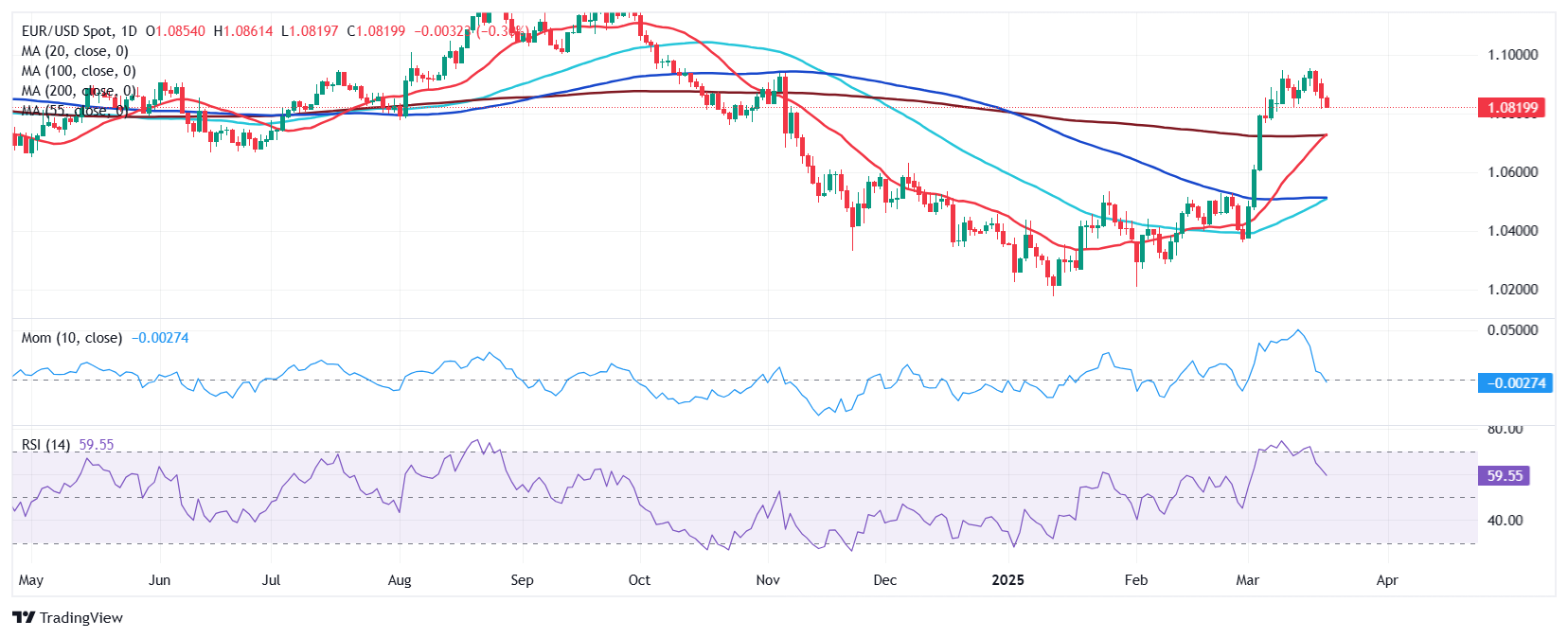
The EUR/USD pair met sellers for a second consecutive week in the 1.0950 neighborhood and seems poised to correct lower, although the bearish potential remains well-limited. The weekly chart shows the pair is battling around a mildly bearish 200 Simple Moving Average (SMA), still unable to break above it. At the same time, EUR/USD develops well above directionless 20 and 100 SMAs. Technical indicators, in the meantime, remain within positive levels, although they have lost their upward strength.
Technical readings in the daily chart offer a similar picture. The EUR/USD pair develops above all its moving averages, with a firmly bullish 20 SMA about to cross above a flat 200 SMA after largely surpassing an also directionless 100 SMA. Technical indicators, in the meantime, corrected extreme overbought conditions and head south within positive levels, still far above their midlines.
The 1.0800 threshold is the immediate support ahead of the aforementioned 200-day SMA, followed by December’s peak at 1.0629. A run beyond 1.0890, on the other hand, exposes the psychological 1.1000 mark, ahead of the 1.1080 region. Further gains should open the door for a test of the September 2024 high at 1.1213.
Tariffs FAQs
Tariffs are customs duties levied on certain merchandise imports or a category of products. Tariffs are designed to help local producers and manufacturers be more competitive in the market by providing a price advantage over similar goods that can be imported. Tariffs are widely used as tools of protectionism, along with trade barriers and import quotas.
Although tariffs and taxes both generate government revenue to fund public goods and services, they have several distinctions. Tariffs are prepaid at the port of entry, while taxes are paid at the time of purchase. Taxes are imposed on individual taxpayers and businesses, while tariffs are paid by importers.
There are two schools of thought among economists regarding the usage of tariffs. While some argue that tariffs are necessary to protect domestic industries and address trade imbalances, others see them as a harmful tool that could potentially drive prices higher over the long term and lead to a damaging trade war by encouraging tit-for-tat tariffs.
During the run-up to the presidential election in November 2024, Donald Trump made it clear that he intends to use tariffs to support the US economy and American producers. In 2024, Mexico, China and Canada accounted for 42% of total US imports. In this period, Mexico stood out as the top exporter with $466.6 billion, according to the US Census Bureau. Hence, Trump wants to focus on these three nations when imposing tariffs. He also plans to use the revenue generated through tariffs to lower personal income taxes.
Author

Valeria Bednarik
FXStreet
Valeria Bednarik was born and lives in Buenos Aires, Argentina. Her passion for math and numbers pushed her into studying economics in her younger years.