EUR/USD Weekly Forecast: ECB turned out dovish, what will the Fed do next?
- The European Central Bank maintained its monetary policy unchanged, sounding mostly dovish.
- The United States Federal Reserve will announce its decision on monetary policy next week.
- EUR/USD keeps signaling a bearish breakout, but investors remain cautious.

The US Dollar was the overall winner this past week, with EUR/USD falling towards the 1.0800 mark on Friday. A slew of United States (US) macroeconomic data and the European Central Bank (ECB) monetary policy announcement were behind the pair’s decline.
Investors started the week with optimism, as the earning season in the US reflected the country’s economic resilience. Most big names reported better-than-expected results, leading to record highs on Wall Street. The upbeat tone of equities and the absence of relevant macroeconomic releases throughout the first half of the week limited demand for the USD and kept major pairs within familiar levels.
Clearer clues emerged
Optimism persisted, but the US Dollar surged on Thursday following the release of the preliminary estimate of the Q4 Gross Domestic Product (GDP). The Bureau of Economic Analysis (BEA) reported that the economy grew at an annualized pace of 3.3% in the three months to December, much better than the 2% anticipated. Furthermore, the Core Personal Consumption Expenditures – Price Index (PCE) held at 2% for a second consecutive quarter, far from the peak of 6% reached in mid-2021.
At the same time, the ECB announced it left rates unchanged, as widely anticipated. The interest rate on the main refinancing operations and the interest rates on the marginal lending facility and the deposit facility remain unchanged at 4.50%, 4.75% and 4.00%, respectively.
The accompanying document showed that “The Governing Council is determined to ensure that inflation returns to its 2% medium-term target in a timely manner” and that “future decisions will ensure that its policy rates will be set at sufficiently restrictive levels for as long as necessary,” repeating the well-known message. Furthermore, President Christine Lagarde reiterated that it would be premature to talk about rate cuts, although she was mostly dovish, weighing down the Euro. Lagarde said rapid wage growth was already showing signs of slowing in the Eurozone, adding that “the disinflation process is at work.” Regardless, and after the dust settled, money markets increased bets on rate cuts, with expectations of a 50 basis points (bps) reduction by June and a 140 bps by the end of the year.
Finally on Friday, the US unveiled the December Core Personal Consumption Expenditure – Price Index. The annualized figure posted 2.9%, easing from 3.2% in November and below the 3% expected. MoM, Core PCE inflation rose 0.2%, as expected.
At the end of the week, the US Dollar gave back some of its weekly gains amid risk appetite, as growth and inflation-related figures maintained investors in optimistic mode. Still, it is worth noting the American economy is much healthier than the European one. There is little doubt the US dodged a recession, and even the chance of a soft landing has fallen. Across the Atlantic, however, the EU economy is still in contraction mode. Financial markets opt to trade on sentiment, but it won’t take long until the US Dollar imposes its established strength.
Fed, Payrolls and GDP in the docket
The focus now shifts to the Federal Reserve (Fed). The US central bank will announce its decision on monetary policy next Wednesday, with financial markets hoping for additional clarity on rate cuts. The Federal Open Market Committee (FOMC) will most likely opt to maintain key interest rates at current levels at the conclusion of its upcoming meeting on January 31.
The Fed has held rates steady since last July, following aggressive tightening measures to combat inflation. Ever since, the central bank has been cautious about signaling a pivot in the monetary policy, although the dot plot released in December anticipates three potential rate cuts this year. Speculation hovers around the odds for a March cut. Such odds fluctuate with macroeconomic figures and Fed officials’ words, although authorities have been mute these last few days amid the blackout period before the meeting.
Following this week’s figures, market players bet there is a 50% chance of a rate cut in March, according to the CME FedWatch Tool.

Beyond the Fed´s announcement, the next week will bring several critical figures that could set the tone for EUR/USD. On Tuesday, Germany and the Eurozone will publish the preliminary estimates of the Q4 Gross Domestic Product (GDP). The EU economy is expected to have contracted by 0.1% in the three months to December, somehow reflecting the poor economic conditions and reaffirming Lagarde’s cautious stance.
Next, Germany will unveil December Retail Sales and the preliminary estimate of the January Harmonized Index of Consumer Prices (HICP), expected at 3.5% YoY, down from 3.8% final in December. The EU will publish the HICP for the same period one day after, with the index foreseen at 2.9% YoY, unchanged from its previous reading.
Across the pond, the US will offer the January ISM Manufacturing PMI and close the week with the January Nonfarm Payrolls report. At the time, analysts expect the country to add 162K in the month, while the Unemployment Rate is foreseen to remain unchanged at 3.7%.

EUR/USD technical outlook
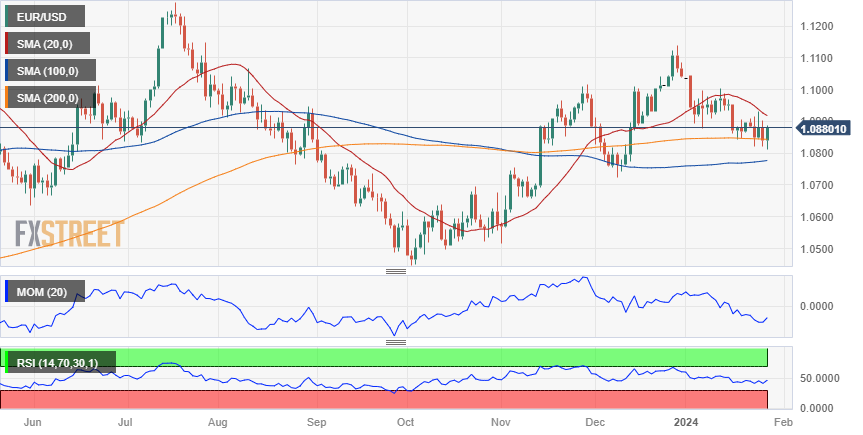
From a technical perspective, the weekly chart for the EUR/USD pair shows that the risk remains skewed to the downside. The pair is posting a third consecutive lower low and lower high, further retreating from the peak set late in December at 1.1139. A long-term slump is still unclear, but buyers seem out of the picture for now.
In the weekly chart, the pair trades between directionless moving averages, which reflect the absence of a certain directional interest. A flat 200 Simple Moving Average (SMA) holds at around 1.1140, reinforcing the mid-term resistance area, while the 20 SMA provides support at around the 1.0800 threshold. Finally, technical indicators in the same chart gain downward traction but remain within positive levels. The Relative Strength Index (RSI) indicator outpaces the Momentum indicator, as it currently stands at 51, anticipating another leg south without confirming it.
In the daily chart, EUR/USD pierced several times a directionless 200 Simple Moving Average (SMA) at around 1.0845 but quickly returned above it, suggesting buyers are still willing to defend the area around the indicator. Still, the 20 SMA continues to gain downward traction well above the current level. Finally, technical indicators remain lifeless within negative levels, skewing the risk to the downside without clearly confirming so.
Buyers may give up if the pair breaches the 1.0800 mark, with scope then to test the next round level at 1.0700. If the latter gives up, 1.0640 is the next relevant level to watch. On the flip side, sellers defend the upside at around 1.0900, with bulls having better chances once EUR/USD overcomes 1.0960. Beyond the latter, the recovery can extend towards the 1.1020/40 price zone.
Economic Indicator
United States Fed Interest Rate Decision
The Federal Reserve (Fed) deliberates on monetary policy and makes a decision on interest rates at eight pre-scheduled meetings per year. It has two mandates: to keep inflation at 2%, and to maintain full employment. Its main tool for achieving this is by setting interest rates – both at which it lends to banks and banks lend to each other. If it decides to hike rates, the US Dollar (USD) tends to strengthen as it attracts more foreign capital inflows. If it cuts rates, it tends to weaken the USD as capital drains out to countries offering higher returns. If rates are left unchanged, attention turns to the tone of the Federal Open Market Committee (FOMC) statement, and whether it is hawkish (expectant of higher future interest rates), or dovish (expectant of lower future rates).
Read more.Author

Valeria Bednarik
FXStreet
Valeria Bednarik was born and lives in Buenos Aires, Argentina. Her passion for math and numbers pushed her into studying economics in her younger years.