EUR/USD Weekly Forecast: US federal shutdown and French turmoil triggering panic trading
- United States government shutdown fueled risk aversion, and hence, the US Dollar.
- Political turmoil in France put pressure on the Euro, despite confident ECB.
- EUR/USD trades at its lowest in almost two months, with growing selling interest.

The EUR/USD pair edged lower and bottomed at 1.1542 on Thursday, ending the week in the red in the 1.1570 price zone on Friday. The US Dollar (USD) surged on the back of risk aversion, triggered by political woes on both shores of the Atlantic.
France Prime Minister resigns
Markets kicked off Monday with some worrisome headlines coming from France. Prime Minister (PM) Sébastien Lecornu resigned less than a day after his cabinet was announced. The political crisis in France began over a year ago, when President Emmanuel Macron called for snap parliamentary elections, claiming France’s government needed “a clear majority in serenity and harmony.” However, the election ended with a big increase in far-right lawmakers and a hung parliament. The voting "brought more division to the National Assembly rather than solutions for the French people," Macron acknowledged a few months later.
Lecornu is the fifth PM to resign amid the inability to pass a budget through Parliament to bear with France's massive debt, which now exceeds €3 trillion, equivalent to approximately 114% of its Gross Domestic Product (GDP).
Macron asked Lecornu to remain in office and try to form a coalition government, but he failed miserably. In fact, far-right leader Marine Le Pen clearly stated that she would thwart any action by a new government, calling for fresh snap elections. The news negatively affected the Euro (EUR).
Japan’s leadership boost US Dollar demand
In the meantime, the US Dollar (USD) received an unexpected boost from Japanese headlines. The Japanese ruling Liberal Democratic Party (LDP) elected Sanae Takaichi, a 64-year-old lawmaker, positioning her to become Japan's first female Prime Minister. The news heavily weighed on the JPY, with the USD/JPY pair gaping roughly 300 pips up at the weekly opening and pushing the Greenback higher across the board. The JPY plummeted on speculation that Takaichi would vow to increase federal spending and a looser monetary policy.
By the end of the week, however, her future as PM was put in doubt after Japan’s ruling coalition broke up on Friday. The LDP holds the largest majority of seats, but it’s short of a majority. For the past 26 years, it has formed a coalition with the Komeito party, which ended after the head of Komeito, Tetsuo Saito, said the LDP failed to provide sufficient answers regarding political funding issues. The JPY recovered modestly with the news, but the broad USD keeps USD/JPY up by roughly 500 pips by the end of the week.
United States government remains closed
And of course, the United States (US) government shutdown that began on October 1 continued. Throughout the week, the Senate has met multiple times to vote on a funding bill, to no avail. Early in the week, US President Donald Trump warned about looming massive federal layoffs, blaming Democrats for the matter. Financial markets fared relatively well with the fact that the US government is on pause until Thursday, when the latest round of failed votes in Congress triggered panic and sent the USD sharply up.
In the meantime, the Federal Open Market Committee (FOMC) released the Minutes of the September meeting. The USD suffered a temporary setback afterwards, as the document showed policymakers are split on how to proceed next. For a slim majority, ten out of nineteen members favor two more interest rate cuts before the year's end. The decision to trim the benchmark interest rate by 25 basis points (bps) was pretty much unanimous amid a weakening labor market.
“Participants expressed a range of views about the degree to which the current stance of monetary policy was restrictive and about the likely future path of policy,” the document added. “Most judged that it likely would be appropriate to ease policy further over the remainder of this year.”
Data and missing data said much
Given the US government shutdown, the American macroeconomic calendar remained pretty much empty. Beyond the FOMC meeting Minutes, the US published the October Michigan Consumer Sentiment Index on Friday, which edged lower to 55 from 55.1 in September, although better than the market expectation of 54.2. The report also showed that the 1-year Consumer Inflation Expectation ticked down to 4.6% from 4.7% in September, and the 5-year Consumer Inflation Expectation remained unchanged at 3.7%.
The Eurozone reported that retail sales were up 0.1% on a monthly basis in August, meeting expectations. German factory Orders fell by 0.8% in the same month, better than the -2.7% from July, although worse than the 1.4% anticipated. Industrial Production in the country fell by 4.3% also in August, worsening from the 1.3% advance posted in the previous month.
Beyond data, the macroeconomic calendar had plenty of policymakers' speeches. European Central Bank (ECB) President Christine Lagarde testified before the European Parliament's Economic and Monetary Affairs Committee on Monday and declared that the ECB achieved its disinflation targets, repeating that the central bank is “in a good place.” Her optimistic words were not enough to overshadow the ruling dismal mood.
The upcoming days will bring the final estimate of the September German Harmonized Index of Consumer Prices (HICP), while the country will release the October ZEW Survey on Economic Sentiment. As for the Eurozone, the calendar will feature little of relevance, with August Industrial Production and the Trade Balance for the same month being the most relevant figures.
In the US, there is a caveat: If the federal government remains shut down, the most relevant figures will not be released. The absence of fresh statistics is among the main reasons for the recent USD surge on risk aversion, as investors grow worried about how this lack of information could affect the October Federal Reserve (Fed) monetary policy decision. The macroeconomic calendar should include Consumer Price Index (CPI) and Producer Price Index (PPI) updates, alongside Retail Sales and weekly unemployment figures. None of those will out unless the US Senate agrees on a funding bill to reopen the government.
It is worth noting that on October 15, the government is due to pay military salaries, who continue to work amid their critical role in national security. Legislation would need to pass by Monday to process paychecks in time, and at this point, it seems unlikely. The US takes pride in its support for the military, so a weekend news with a partial funding bill is not out of the table.

EUR/USD technical outlook
From a technical perspective, the weekly chart for the EUR/USD pair hints at growing downward momentum. The pair broke below its 20 Simple Moving Average (SMA) for the first time since early in March, suggesting bears are gaining confidence. The SMA has lost most of its upward momentum and currently provides resistance in the 1.1640 area. The same chart shows the 100 and 200 SMAs lack directional strength, but are over 500 pips below the current level. Finally, technical indicators head firmly south, but only the Momentum indicator crossed below its 100 level. Still, the bearish potential grew with the Relative Strength Index (RSI) indicator decreasing to around 53.
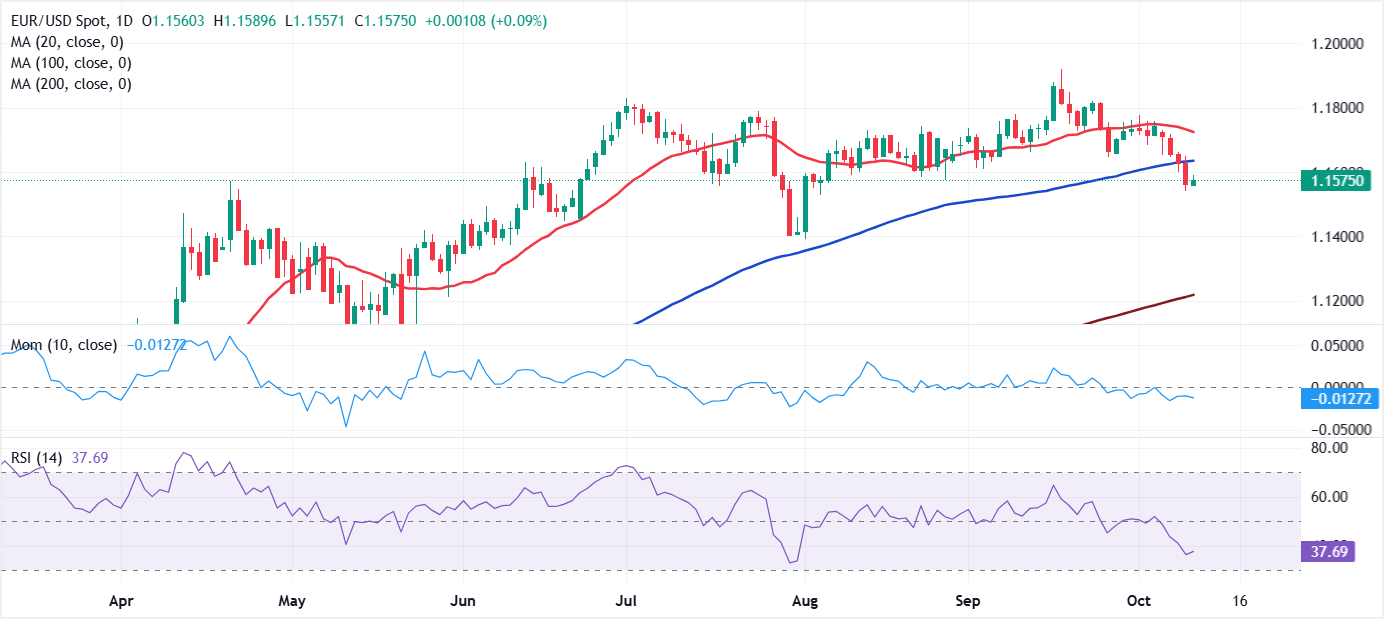
The daily chart shows that EUR/USD currently develops below its 20 and 100 SMAs, with the largest one providing dynamic resistance at around 1.1630. Technical indicators, in the meantime, extended their slides and approached oversold readings, holding nearby with uneven directional strength.
Overall, the risk skews to the downside with immediate support in the 1.1520 price zone. Once below it, the August monthly low at 1.1391 is the next level to consider, en route to the 1.1300 threshold. Immediate resistance comes at the 1.1630/50 price zone, followed by the 1.1750 mark. Gains beyond the latter expose 1.1830.
Risk sentiment FAQs
In the world of financial jargon the two widely used terms “risk-on” and “risk off'' refer to the level of risk that investors are willing to stomach during the period referenced. In a “risk-on” market, investors are optimistic about the future and more willing to buy risky assets. In a “risk-off” market investors start to ‘play it safe’ because they are worried about the future, and therefore buy less risky assets that are more certain of bringing a return, even if it is relatively modest.
Typically, during periods of “risk-on”, stock markets will rise, most commodities – except Gold – will also gain in value, since they benefit from a positive growth outlook. The currencies of nations that are heavy commodity exporters strengthen because of increased demand, and Cryptocurrencies rise. In a “risk-off” market, Bonds go up – especially major government Bonds – Gold shines, and safe-haven currencies such as the Japanese Yen, Swiss Franc and US Dollar all benefit.
The Australian Dollar (AUD), the Canadian Dollar (CAD), the New Zealand Dollar (NZD) and minor FX like the Ruble (RUB) and the South African Rand (ZAR), all tend to rise in markets that are “risk-on”. This is because the economies of these currencies are heavily reliant on commodity exports for growth, and commodities tend to rise in price during risk-on periods. This is because investors foresee greater demand for raw materials in the future due to heightened economic activity.
The major currencies that tend to rise during periods of “risk-off” are the US Dollar (USD), the Japanese Yen (JPY) and the Swiss Franc (CHF). The US Dollar, because it is the world’s reserve currency, and because in times of crisis investors buy US government debt, which is seen as safe because the largest economy in the world is unlikely to default. The Yen, from increased demand for Japanese government bonds, because a high proportion are held by domestic investors who are unlikely to dump them – even in a crisis. The Swiss Franc, because strict Swiss banking laws offer investors enhanced capital protection.
Author

Valeria Bednarik
FXStreet
Valeria Bednarik was born and lives in Buenos Aires, Argentina. Her passion for math and numbers pushed her into studying economics in her younger years.

















