EUR/USD Price Forecast: The hunt for the 200-day SMA
- EUR/USD rebounds sharply, reclaiming the 1.1500 barrier and beyond.
- The US Dollar reverses part of its recent sharp advance as geopolitics weigh.
- The Fed and ECB meetings grab all the attention later in the week.

Since being turned down from the yearly highs near the 1.2100 level in late January, the short-term outlook for EUR/USD has been becoming worse and worse. The pair's recent break below the important 200-day Simple Moving Average (SMA) also signals that there may be further downward moves in the near future.
Following a deep sell-off to multi-month lows near the 1.1400 neighbourhood last week, EUR/USD manages to regain some composure, reclaiming the key 1.1500 hurdle and above in quite an auspicious start to the week.
The marked rebound in spot follows a renewed and quite strong retracement in the US Dollar (USD) as tensions in the Middle East seem to have given way to hopes that the US and other nations could help reopen the key Strait of Hormuz sooner rather than later.
Meanwhile, the US Dollar Index (DXY) has rapidly abandoned its recent tops well north of the psychological 100.00 barrier to retest the 99.70-99.60 band amid quite a strong decline in US Treasury yields across various time frames.
Fed: steady policy, optionality intact
A “hold” decision from the Federal Reserve (Fed) at the March 18 meeting is now almost fully priced in, although markets still anticipate around 26 basis points of easing by year-end.
At its previous meeting, the Federal Open Market Committee (FOMC) appeared noticeably more comfortable with the broader economic backdrop. Growth continues to hold up well, employment risks are no longer seen as deteriorating, and while inflation remains somewhat elevated, the sense of urgency surrounding it has clearly faded.
Chair Jerome Powell said that policy is in a "good place" and that choices would continue to be made meeting by meeting. He said that tariffs are still causing inflation noise, but he also pointed out that prices are still coming down in the services sector. Powell also made it clear that a rate rise is not the most likely outcome, and neither is a quick shift toward rate decreases.
The Minutes reinforced that balanced stance. Rate cuts remain possible if inflation continues to cool, although hikes have not been ruled out should price pressures prove more persistent than expected. In short, the Fed remains firmly data dependent.
ECB: patient stance as disinflation slowly progresses
The European Central Bank (ECB) is also widely expected to leave interest rates unchanged at Thursday’s meeting.
In her latest remarks, President Christine Lagarde struck a calm but cautious tone. Inflation is still projected to return to the 2% target over the medium term, although services inflation remains under close scrutiny, and further easing is expected to extend into 2026.
Lagarde also highlighted resilient wage growth, a still-solid labour market and stable investment dynamics across the euro area. At the same time, she reiterated that while the ECB closely monitors the euro (EUR), it does not target the exchange rate.
Markets currently price roughly 37 basis points of tightening by year-end, while a hold at the March meeting is widely seen as a foregone conclusion.
For now, the ECB appears broadly comfortable with its current policy stance while continuing to emphasise a cautious, data-dependent approach.
EUR positioning: bullish bias softens at the margin
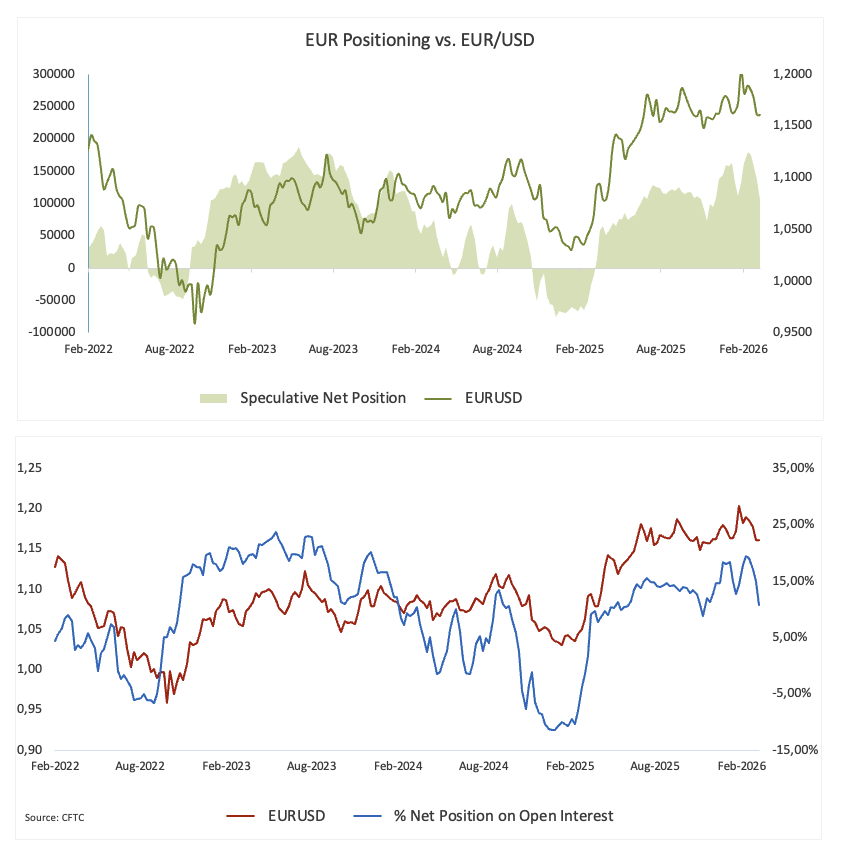
The most recent statistics from the Commodity Futures Trading Commission (CFTC) reveal that speculative posture in the single currency changed a lot in the week leading up to March 10.
Indeed, speculators cut their net long exposure to around 105.1K contracts, which means that huge speculative accounts are cutting down on their bullish bets.
At the same time, open interest rose to about 969.4K contracts, which shows that more people are becoming involved in the market.
The way these two things work together conveys a strong message: net longs fell dramatically, although open interest grew, suggesting that fresh holdings entered the market while existing longs were decreased, rather than just closing out their positions.
At the end of the day, the positioning background is still net long EUR overall, although confidence seems to be fading a little bit.
From a positional point of view:
First, the euro's bullish structure is still in place. Net longs over 100K contracts still show that speculative accounts have a positive medium-term bias.
Second, the change seems to be more of an intentional repositioning than merely collecting profits. The increase in open interest shows that new positions were created while others were cut, which shows that the market is changing.
Third, the way the euro is positioned is becoming more vulnerable to changes in the US story. Speculative exposure is still higher than it has been in the past, so any additional rise in the US Dollar might lead to more position changes.
To sum up, the bullish feeling around the EUR seems to be slowing down rather than changing direction completely. The market is still set up for the EUR to stay strong, but there is less room for error.
What's next?
Near term: the US Dollar will continue to set the tone for pair as markets deal with trade uncertainty and continuing geopolitical concerns. Meanwhile, all eyes are on the choices made by central banks, as the Fed and the ECB will meet on Wednesday and Thursday, respectively.
Risks: If tensions in the Middle East keep growing, the US Dollar's status as a safe haven may become even stronger, which might weigh further on risk-associated assets. If the pair stays below the 200-day SMA for a long time, it will be more likely to make a greater correction.
Technical corner
In the daily chart, EUR/USD trades at 1.1519. The near-term bias is mildly bearish as spot holds below the 55- and 100-day Simple Moving Averages (SMAs), which cap the upside near 1.17. The 200-day SMA edges higher around 1.17 but price trades beneath it, reinforcing a corrective tone rather than a full trend reversal. The Relative Strength Index (RSI) recovers toward 36 from oversold territory, suggesting fading but still dominant selling pressure, while the rising Average Directional Index (ADX) above 34 signals a strengthening bearish trend backdrop.
Immediate resistance stands at 1.1578, aligned with recent congestion, followed by the stronger barrier at 1.1766 near the clustered SMAs. A daily close above 1.1766 would be needed to ease downside pressure and open the way toward 1.2082. On the downside, initial support emerges at 1.1491, with a break exposing 1.1469 and then 1.1392. A sustained move below 1.1469 would extend the current down leg and confirm bears in control toward the lower support band.
(The technical analysis of this story was written with the help of an AI tool.)
Bottom line: the Dollar still calls the tune
For now, EUR/USD is being driven far more by developments in Washington than by events in Frankfurt.
Until the Fed’s policy trajectory becomes clearer, or the euro area shows signs of a stronger cyclical rebound, rallies in the pair are likely to remain limited. At this stage, the US Dollar remains firmly in the driving seat.
Euro FAQs
The Euro is the currency for the 20 European Union countries that belong to the Eurozone. It is the second most heavily traded currency in the world behind the US Dollar. In 2022, it accounted for 31% of all foreign exchange transactions, with an average daily turnover of over $2.2 trillion a day. EUR/USD is the most heavily traded currency pair in the world, accounting for an estimated 30% off all transactions, followed by EUR/JPY (4%), EUR/GBP (3%) and EUR/AUD (2%).
The European Central Bank (ECB) in Frankfurt, Germany, is the reserve bank for the Eurozone. The ECB sets interest rates and manages monetary policy. The ECB’s primary mandate is to maintain price stability, which means either controlling inflation or stimulating growth. Its primary tool is the raising or lowering of interest rates. Relatively high interest rates – or the expectation of higher rates – will usually benefit the Euro and vice versa. The ECB Governing Council makes monetary policy decisions at meetings held eight times a year. Decisions are made by heads of the Eurozone national banks and six permanent members, including the President of the ECB, Christine Lagarde.
Eurozone inflation data, measured by the Harmonized Index of Consumer Prices (HICP), is an important econometric for the Euro. If inflation rises more than expected, especially if above the ECB’s 2% target, it obliges the ECB to raise interest rates to bring it back under control. Relatively high interest rates compared to its counterparts will usually benefit the Euro, as it makes the region more attractive as a place for global investors to park their money.
Data releases gauge the health of the economy and can impact on the Euro. Indicators such as GDP, Manufacturing and Services PMIs, employment, and consumer sentiment surveys can all influence the direction of the single currency. A strong economy is good for the Euro. Not only does it attract more foreign investment but it may encourage the ECB to put up interest rates, which will directly strengthen the Euro. Otherwise, if economic data is weak, the Euro is likely to fall. Economic data for the four largest economies in the euro area (Germany, France, Italy and Spain) are especially significant, as they account for 75% of the Eurozone’s economy.
Another significant data release for the Euro is the Trade Balance. This indicator measures the difference between what a country earns from its exports and what it spends on imports over a given period. If a country produces highly sought after exports then its currency will gain in value purely from the extra demand created from foreign buyers seeking to purchase these goods. Therefore, a positive net Trade Balance strengthens a currency and vice versa for a negative balance.
Author

Pablo Piovano
FXStreet
Born and bred in Argentina, Pablo has been carrying on with his passion for FX markets and trading since his first college years.