EUR/USD Price Forecast: Next on the downside comes 1.1700
- EUR/USD comes under extra pressure, putting 1.1800 to the test on Monday.
- The US Dollar regains extra impulse and advances to multi-day tops.
- The “Warsh” trade continues to lend support to the Greenback.

EUR/USD comes under fresh selling pressure, breaking below the 1.1800 support and extending the leg lower following last week’s multi-year peaks in levels close to the 1.2100 barrier.
Indeed, Monday’s retracement in the pair comes amid the continuation of the strong bounce in the Greenback, at the time when investors keep assessing the recent appointment of Kevin Warsh to lead the Federal Reserve (Fed) from May. That said, the US Dollar Index (DXY) climbs to fresh six-day highs well past the 97.00 hurdle accompanied by rising US Treasury yields across the spectrum.
In addition, caution among traders is expected to kick in ahead of the ECB gathering on Thursday and key US data releases.
Fed: calm confidence, no hurry to move
The Federal Reserve (Fed) left the Fed Funds Target Range (FFTR) unchanged at 3.50%–3.75% at its January meeting, a decision that came as no surprise to markets.
Policymakers sounded a touch more comfortable with the growth outlook, noting that economic activity is still expanding at a solid pace. Inflation was again described as somewhat elevated, and uncertainty remains high, but a key shift was that the Federal Open Market Committee (FOMC) no longer sees downside risks to employment as increasing. The decision passed by a 10–2 vote, with Miran and Waller dissenting in favour of a quarter-point cut.
Chair Jerome Powell reaffirmed at a press conference that the US economy remains robust and that the current policy is appropriate. He noted indications of job market stabilisation, such as slower job growth, indicating weaker labour demand. Powell attributed much of the recent inflation rise to tariff-affected goods, while prices for services continue to decline. He stated that tariff effects will likely peak mid-year and emphasised that policy decisions will be made on a meeting-by-meeting basis, with no rate hikes anticipated as a baseline scenario, given that risks have balanced somewhat.
ECB: in wait-and-see mode, but alert
The European Central Bank (ECB) also held rates steady at its December 18 meeting, striking a calmer and more patient tone that has pushed expectations for near-term cuts further out. Small upgrades to growth and inflation forecasts helped reinforce that stance.
According to the ECB Accounts released last month, officials made it clear there is no urgency to change course. With inflation close to target, they feel they can afford to be patient, even as lingering risks mean flexibility remains essential.
Members of the Governing Council (GC) were keen to stress that patience should not be mistaken for complacency. Policy is seen as being in a “good place” for now, but not on autopilot.
Markets appear to have taken that message on board, as expectations are for rates to be left unchanged on February 5, with just under 5 basis points of easing pencilled in over the year ahead.
Positioning: confidence slowly rebuilding
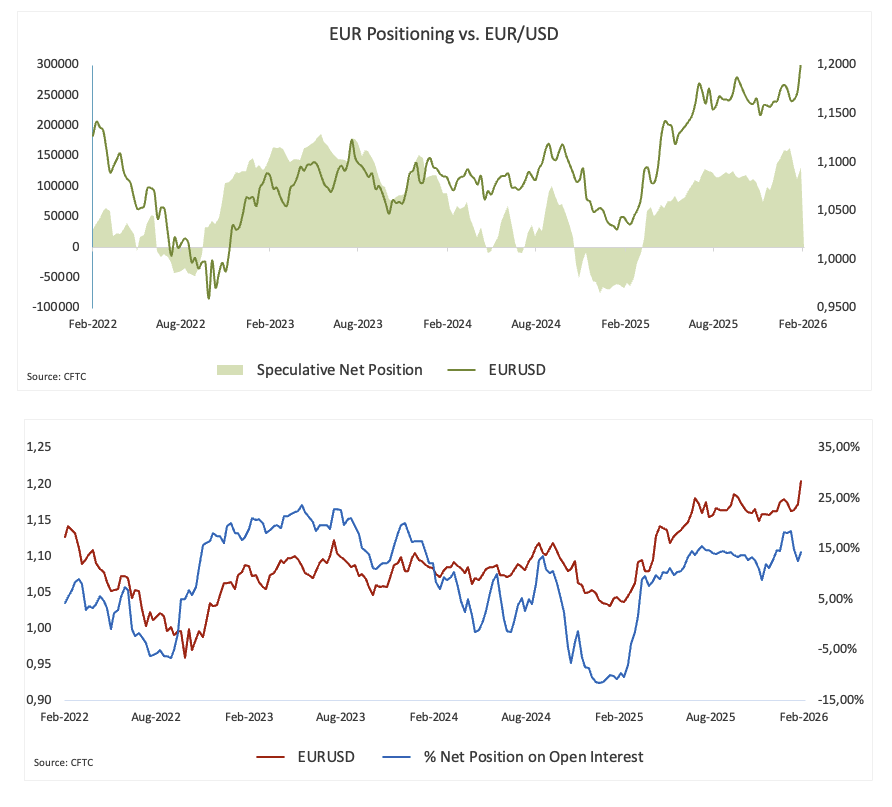
Speculative positioning continues to lean in favour of the single currency, with signs that conviction may be starting to rebuild.
Indeed, Commodity Futures Trading Commission (CFTC) data for the week ending January 27 show non-commercial net long positions rising to two-week highs around 132.1K contracts. At the same time, institutional players added to their short exposure, now sitting near 181.6K contracts.
Open interest also increased meaningfully, climbing to around 929.3K contracts, the highest level in six weeks, suggesting that participation is picking up again, and with it, a tentative return of confidence.
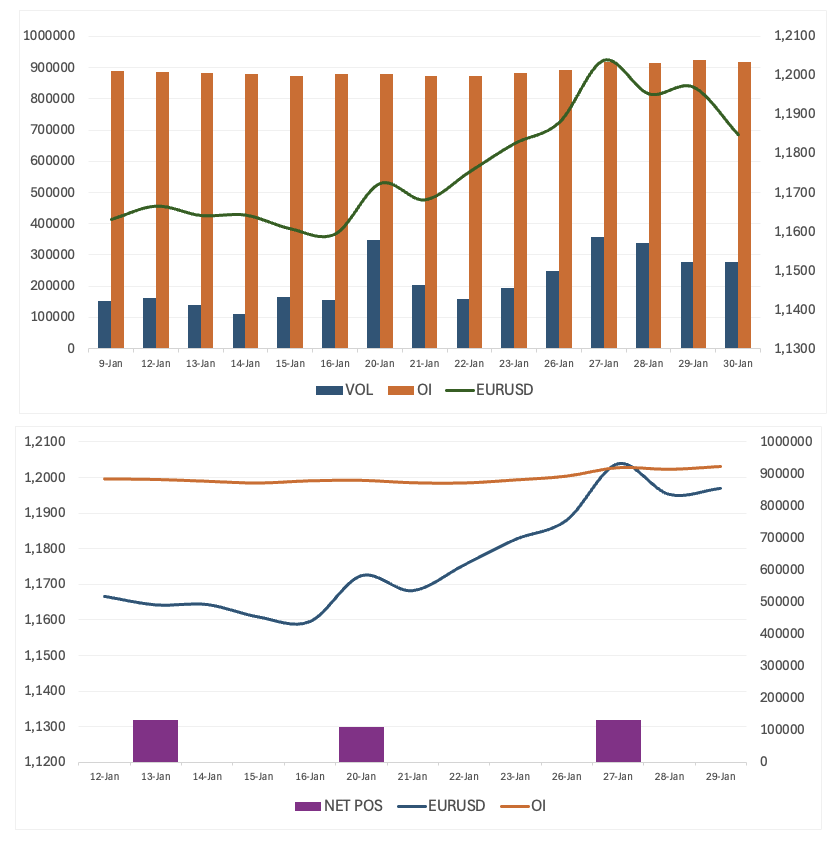
Interestingly, last week’s daily open interest and volume figures appeared to foreshadow the corrective move seen toward the end of the week.
What could steer the next move
Near term: The spotlight is likely to stay firmly on the US Dollar, with markets refocusing on incoming US data, especially from the labour market. In Europe, attention will turn to advance inflation figures, while the upcoming ECB event is unlikely to generate much excitement in the FX galaxy.
Risks: A Fed that stays cautious for longer could quickly swing momentum back in favour of the US Dollar. From a technical perspective, a clean break below the 200-day Simple Moving Average (SMA) would also increase the risk of a deeper and more sustained correction.
Tech corner
The Greenback’s bounce continues to weigh on EUR/USD, which faces its next temporary support at the 1.1700–1.1680 range, where the 55-day and 100-day SMAs sit. South from here emerges the key 200-day SMA at 1.1608, while the loss of this region could open the door to a potential test of the November 2025 floor at 1.1468 (November 5) prior to the August base at 1.1391 (August 1).
On the flip side, immediate resistance comes at the 2026 ceiling at 1.2082 (January 28), followed by the May 2021 peak at 1.2266 (May 25) and then the 2021 high at 1.2349 (January 6).
Also, momentum indicators show that there could be more gains in the near term, although some caution should not be ruled out. That said, the Relative Strength Index (RSI) eases toward the 51 region, while the Average Directional Index (ADX) near 33 indicates a pretty solid trend.
-1770056504555-1770056504557.png)
Bottom line: the US is still calling the shots
For now, EUR/USD is being driven far more by developments in the US than by anything coming out of the euro area.
Until the Fed provides clearer guidance on its 2026 rate path, or the eurozone delivers a more convincing cyclical upswing, any upside is likely to be gradual rather than morph into a clean, decisive breakout.
Euro FAQs
The Euro is the currency for the 20 European Union countries that belong to the Eurozone. It is the second most heavily traded currency in the world behind the US Dollar. In 2022, it accounted for 31% of all foreign exchange transactions, with an average daily turnover of over $2.2 trillion a day. EUR/USD is the most heavily traded currency pair in the world, accounting for an estimated 30% off all transactions, followed by EUR/JPY (4%), EUR/GBP (3%) and EUR/AUD (2%).
The European Central Bank (ECB) in Frankfurt, Germany, is the reserve bank for the Eurozone. The ECB sets interest rates and manages monetary policy. The ECB’s primary mandate is to maintain price stability, which means either controlling inflation or stimulating growth. Its primary tool is the raising or lowering of interest rates. Relatively high interest rates – or the expectation of higher rates – will usually benefit the Euro and vice versa. The ECB Governing Council makes monetary policy decisions at meetings held eight times a year. Decisions are made by heads of the Eurozone national banks and six permanent members, including the President of the ECB, Christine Lagarde.
Eurozone inflation data, measured by the Harmonized Index of Consumer Prices (HICP), is an important econometric for the Euro. If inflation rises more than expected, especially if above the ECB’s 2% target, it obliges the ECB to raise interest rates to bring it back under control. Relatively high interest rates compared to its counterparts will usually benefit the Euro, as it makes the region more attractive as a place for global investors to park their money.
Data releases gauge the health of the economy and can impact on the Euro. Indicators such as GDP, Manufacturing and Services PMIs, employment, and consumer sentiment surveys can all influence the direction of the single currency. A strong economy is good for the Euro. Not only does it attract more foreign investment but it may encourage the ECB to put up interest rates, which will directly strengthen the Euro. Otherwise, if economic data is weak, the Euro is likely to fall. Economic data for the four largest economies in the euro area (Germany, France, Italy and Spain) are especially significant, as they account for 75% of the Eurozone’s economy.
Another significant data release for the Euro is the Trade Balance. This indicator measures the difference between what a country earns from its exports and what it spends on imports over a given period. If a country produces highly sought after exports then its currency will gain in value purely from the extra demand created from foreign buyers seeking to purchase these goods. Therefore, a positive net Trade Balance strengthens a currency and vice versa for a negative balance.
Author

Pablo Piovano
FXStreet
Born and bred in Argentina, Pablo has been carrying on with his passion for FX markets and trading since his first college years.

















