EUR/USD Price Forecast: Further consolidation likely pre-Fed
- EUR/USD traded in a vacillating fashion around the 1.1300 region on Monday.
- The US Dollar remained on the back foot near the 100.00 barrier.
- The US ISM Services PMI unexpectedly improved to 51.6 in April.

The Euro (EUR) strengthened for a second straight session on Monday, with EUR/USD retesting the 1.1360 zone, although losing some upside impulse afterwards, as traders continued to digest the implications of diverging monetary paths between the US and the eurozone, as well as renewed concerns on the trade front.
Meanwhile, the US Dollar Index (DXY) climbed back toward the psychological 100.00 region amid sustained investor caution ahead of the key FOMC event later in the week.
Trade talk takes centre stage, but scepticism persists
The Greenback kicked off its week slightly on the defensive amid renewed trade jitters despite recent hopes of further progress in the US-China trade conflict. But markets remain cautious, wary of recycled rhetoric and the absence of concrete steps toward de-escalation.
This scepticism kept risk appetite in check, even as investors continued to digest Friday’s firm NFP figures, while a better-than-expected gauge from European investors’ morale initially lent support to the single currency.
Central banks chart diverging paths
The monetary policy divide is becoming increasingly pronounced. The Federal Reserve (Fed) is widely expected to keep rates steady at 4.25%–4.50% at its upcoming May 7 meeting.
In his latest event, Chair Jerome Powell stressed that the inflation fight remains incomplete. He also flagged concerns that potential trade tariffs could complicate the path forward, hinting at stagflation risks.
The European Central Bank (ECB), meanwhile, opted for a 25 basis-point cut to 2.25% and struck a noticeably softer tone in its guidance. Markets are now pricing in another ECB cut as early as June—widening the divergence in policy trajectories and putting additional pressure on the euro.
Speculators stay long on the Euro… for Now
Despite the ECB’s dovish pivot, speculative interest in the euro remains firm. CFTC data as of April 29 showed net long positions increased markedly to multi-month tops around 75.8K contracts. Open interest also climbed to levels last seen in September 2024 past the 730K contracts, signalling sustained engagement from both leveraged and commercial players. Commercial hedgers stayed net short at roughly 131K contracts, reflecting cautious sentiment among corporates.

Technical picture
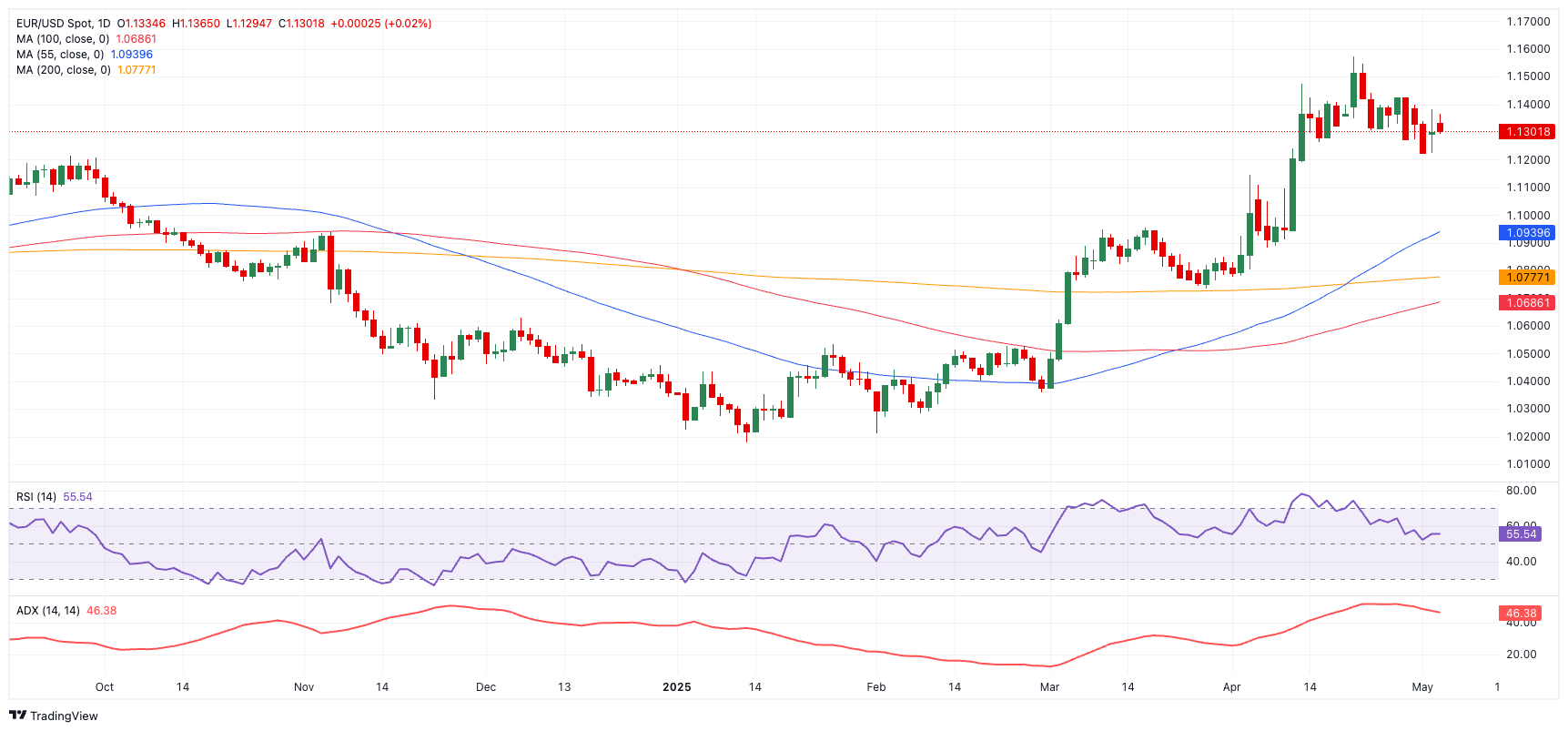
EUR/USD faces key resistance at the 2025 peak of 1.1572, with further hurdles at 1.1600 and the October 2021 high of 1.1692. On the downside, short-term support lies at the 55-day SMA at 1.0944, followed by the 200-day SMA at 1.0782 and March’s swing low at 1.0732.
Momentum indicators remain constructive. The Relative Strength Index (RSI) hovers near 56, suggesting there’s still room for upside, while the Average Directional Index (ADX) around 47 points to a well-established trend.
EUR/USD daily chart
Outlook: Volatility and policy messaging in the driver’s seat
EUR/USD looks set to remain choppy in the near term, with headline risk from US-China trade talks and ECB/Fed guidance likely to dominate price action. With the policy gap widening and macro data painting a mixed picture, any surprises—hawkish or dovish—could sharply reprice expectations.
Author

Pablo Piovano
FXStreet
Born and bred in Argentina, Pablo has been carrying on with his passion for FX markets and trading since his first college years.