EUR/USD Outlook: Seems vulnerable to retest YTD lows, focus remains on FOMC meeting
- Sustained USD buying dragged EUR/USD to near one-month lows during the Asian session.
- Hawkish Fed expectations, the risk-off impulse continued benefitting the safe-haven USD.


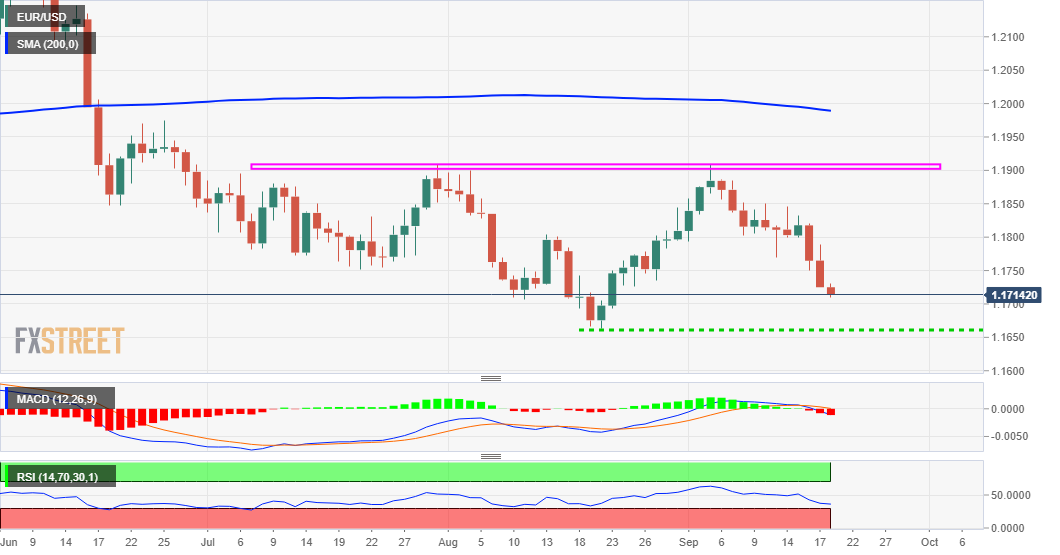
The EUR/USD pair prolonged its recent retracement slide from the highest level since June 29 and dropped to the 1.1700 neighbourhood, or near one-month lows during the Asian session on Monday. The US dollar continued drawing support from expectations for an imminent Fed taper announcement and got an additional boost from the risk-off impulse in the markets. Despite signs of easing inflationary pressures in the US, the recent data pointed to the continuation of economic recovery. The optimism has been fueling speculations that the Fed would begin rolling back its massive pandemic-era stimulus sooner rather than later. This was evident from the recent spike in the US Treasury bond yields, which, in turn, acted as a tailwind for the USD and exerted pressure on the major.
Meanwhile, worries about the fast-spreading Delta variant and a global economic slowdown, along with looming catastrophe at indebted developer China Evergrande, took its toll on the risk sentiment. Investors remain concerned whether China Evergrande Group will be able to make good on its bond interest payment of $83.5 million due on Thursday. Politics added extra uncertainty ahead of this week's Federal elections in Canada and Germany. Apart from this, the re-escalation of tension between China and Western countries, namely the US, UK and Australia, further dented investors' appetite for perceived riskier assets. This was evident from a selloff in the global equity markets, which forced investors to take refuge in traditional safe-haven assets and further benefitted the greenback.
With the USD price dynamics turning out to be an exclusive driver of the pair's ongoing downward trajectory, the market focus will remain glued to a two-day FOMC meeting starting this Tuesday. Investors will look for fresh clues about the likely timing of the asset tapering and interest rate hike. The outcome will play a key role in influencing the greenback in the near term and assist traders to determine the next leg of a directional move for the major. In the meantime, Monday's release of the German Producer Price Index (PPI) will be looked upon for some impetus amid absent relevant market-moving economic data from the US.
Short-term technical outlook
From a technical perspective, a subsequent fall below the 1.1700 mark is likely to find decent support near YTD lows, around the 1.1665 region, which should act as a key pivotal point for traders. Some follow-through selling will mark a fresh bearish breakdown and set the stage for additional weakness. The pair might then accelerate the slide towards testing November 2020 swing lows, around the 1.1600 round-figure mark. The downward trajectory could further get extended towards intermediate support near the 1.1540 region en-route the key 1.1500 psychological mark.
On the flip side, the 1.1750 area now seems to act as an immediate resistance ahead of the 1.1770 and the 1.1800 round figure. A sustained move beyond might trigger a short-covering move and lift the pair further towards the next relevant hurdle near the 1.1850 region en-route the 1.1880 supply zone. This is closely followed by the 1.1900 mark, which if cleared decisively will negate any near-term negative bias. The pair might then aim to surpass an intermediate barrier near the 1.1935-40 region before eventually darting towards the very important 200-day SMA, just ahead of the key 1.2000 psychological mark.
Premium
You have reached your limit of 3 free articles for this month.
Start your subscription and get access to all our original articles.
Author
Haresh Menghani
FXStreet
Haresh Menghani is a detail-oriented professional with 10+ years of extensive experience in analysing the global financial markets.