|

EUR/USD outlook: Euro is consolidating after the biggest one-day advance in a year

EUR/USD

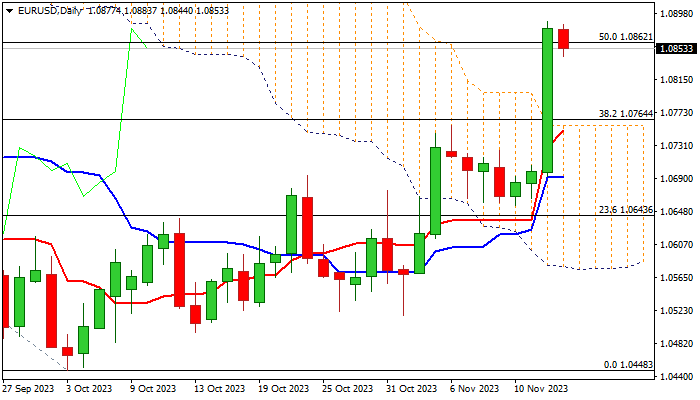
EURUSD edged lower in European trading on Wednesday as traders collected some profits after Tuesday’s 1.7% advance (the biggest one-day gain in one year), sparked by bigger than expected drop in US inflation in October, which deflated dollar

Near-term picture is increasingly bullish after Tuesday’s acceleration surged through few key technical barriers, resulting in close well above thick daily Ichimoku cloud and above 50% retracement of 1.1275/1.0448 downtrend.

Bulls are taking a breather and positioning for fresh push higher, with broken 200DMA (1.0802) to ideally contain dips and offer better buying opportunities for extension towards targets at 1.0959/1.1000 (Fibo 61.8% / psychological).

Broken Fibo 38.2% and daily cloud top (1.0764/1.0759 respectively) mark pivotal supports which should hold extended dips and keep near-term bias with bulls.

Res: 1.0887; 1.0945; 1.0959; 1.1000.
Sup: 1.0802; 1.0764; 1.0756; 1.0700.
EURUSD

Interested in EUR/USD technicals? Check out the key levels

    1. R3 1.1144
    2. R2 1.1016
    3. R1 1.0949
  1. PP 1.0821
    1. S1 1.0755
    2. S2 1.0627
    3. S3 1.056

Author

Slobodan Drvenica

Slobodan Drvenica

Windsor Brokers

Industry veteran with over 22 years’ experience, Slobodan Drvenica joined Windsor Brokers in 1995 when he was an active trader for more than 10 years, managing the trading desk and own account departments.


More from Slobodan Drvenica
Share:

Editor's Picks

USD/JPY bulls pause after hawkish Fed-inspired rally to nearly two-year high

USD/JPY is seen consolidating below its highest level since July 2024, touched the previous day, with intervention fears lending support to the Japanese Yen and capping the upside amid a modest US Dollar downtick. The signing of a US-Iran peace deal to end the war and reopen the Strait of Hormuz undermines the Greenback's reserve-currency status. However, the Fed's projection of a rate increase this year favors USD bulls and should provide a tailwind for the currency pair.

AUD/USD benefits from softer USD as US-Iran deal counters Fed's hawkish tilt

AUD/USD edges higher during the Asian session on Thursday as the US Dollar retreats from its highest level since late March, touched in reaction to the Fed's hawkish tilt the previous day. The US and Iran signed a MoU aimed at ending the war and reopening the Strait of Hormuz, boosting investors' confidence and undermining the safe-haven USD. Furthermore, the RBA's signal that additional rate hikes remain possible, if inflation persists, acts as a tailwind for the Aussie.

Gold scales higher as USD trims post-Fed gains amid US-Iran peace deal

Gold attracts fresh buyers during the Asian session on Thursday, reversing part of the previous day's hawkish Fed-inspired slump to a fresh weekly low. As traders price in the possibility of a Fed rate hike this year, the signing of a US-Iran peace deal – to end the war and reopen the Strait of Hormuz – drags the safe-haven US Dollar away from its highest level since late March. This offers some support to the bullion, though the overnight failure near the 200-day SMA warrants caution for bulls.

Binance founder CZ urges governments to tokenize stock markets and launch sovereign stablecoins

Binance founder Changpeng Zhao has called on governments to tokenize their stock markets and issue sovereign stablecoins, arguing that blockchain technology can expand access to capital markets and increase the global use of national currencies. In an X post on Wednesday, CZ said countries should "tokenize their stocks, allowing worldwide buyers."

The next big AI trade may not be about chips or software
Artificial intelligence has already created some of the biggest winners in modern market history. Chipmakers have surged, data centre construction is booming, and electricity demand forecasts are changing globally.
Why a hawkish RBA is no longer enough to lift the Australian Dollar

The Reserve Bank of Australia delivered more than what markets expected: a hawkish hold that should have supported the Aussie. But markets widely ignored it, focusing instead on slowing economic growth and proving that central bank messaging alone isn’t always enough to drive currencies.