EUR/USD gains: Dollar weighed down by election results

EUR/USD rose to 1.1254 on Thursday. Markets are assessing the implications of the Democrats’ stronger position following the US midterm election results.
A more decisive election outcome reduced political uncertainty and supported gains in global stock markets, typically weakening demand for the dollar as a safe-haven asset. However, shares in companies linked to artificial intelligence came under pressure amid concerns that the Democrats’ increased influence could affect future investment in data centres.
The election results also raised expectations of political gridlock in Washington and eased fears of a possible resumption of US strikes against Iran. Against this backdrop, oil prices fell sharply, reducing inflation risks and further weighing on demand for the dollar as a safe-haven asset.
The market’s focus is now shifting to Friday’s US labour market report. At the same time, investors continue to assess the likelihood of further Fed policy tightening, with the probability of a December rate hike estimated at around 79%.
Technical analysis
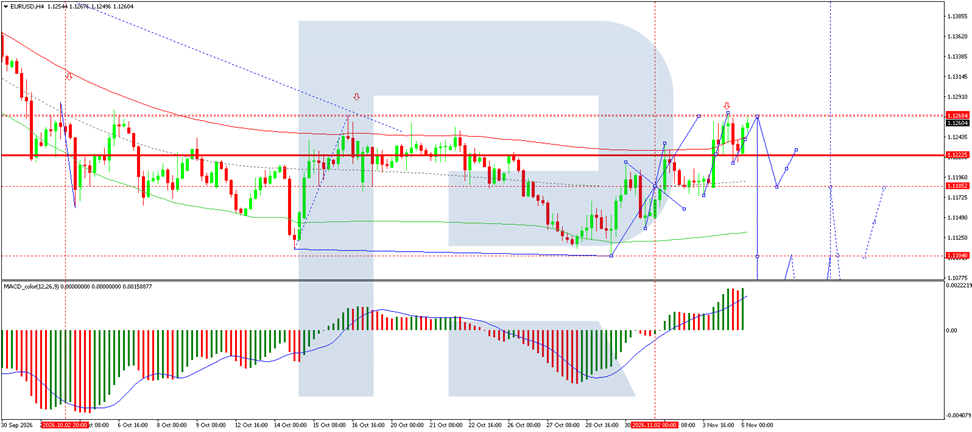
On the H4 EUR/USD chart, the medium-term downward structure remains intact, but the latest move represents a recovery from support at 1.1104. The price has approached resistance at 1.1268, where selling pressure previously emerged. The nearest support is at 1.1223, with the next target for a possible decline at 1.1185. A return to 1.1104 will only become relevant after a close below 1.1185 and will require further development of the downward wave. The MACD indicator is above zero, with its signal line pointing upwards, so it continues to confirm the recovery, while a downward reversal remains the baseline scenario.
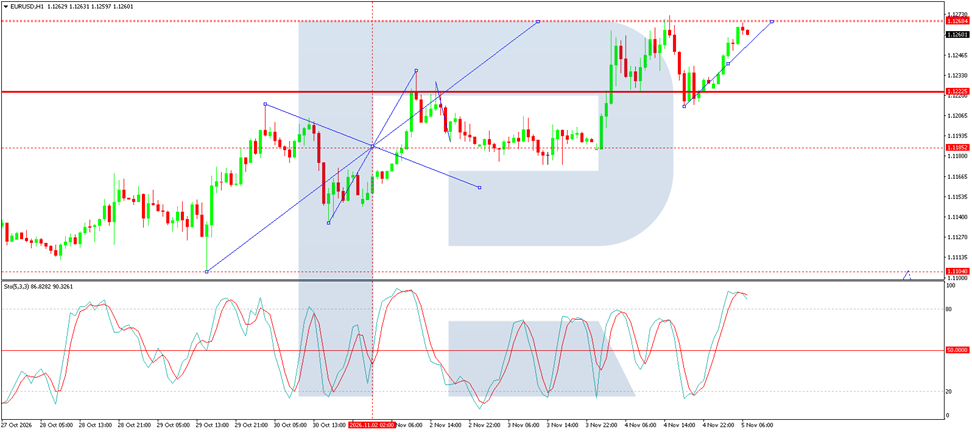
The H1 EUR/USD chart shows a sequence of higher lows and a retest of 1.1268. The Stochastic oscillator is above 80, with its signal lines beginning to turn downwards. This configuration suggests the risk of a local correction but does not confirm a change in direction. The main scenario for the day is a rebound from resistance followed by a decline towards 1.1223. A break below this support would increase the likelihood of a move towards 1.1185. If 1.1223 holds, buyers could retest 1.1268. Sustained consolidation above resistance would invalidate the downside scenario and open the way for a continued recovery towards 1.1291. Price action at the range boundaries will determine the priority scenario. Until a confirmed breakout occurs, multidirectional fluctuations remain likely during the upcoming trading session.
Conclusion
EUR/USD has gained ground as the dollar comes under pressure following the US midterm election results, which reduced political uncertainty and boosted global risk appetite. The Democrats’ stronger position has also raised expectations of political gridlock in Washington and eased fears of renewed US strikes against Iran, driving oil prices lower and further reducing demand for the dollar as a safe-haven asset. However, concerns over AI-related investment have weighed on technology shares. Markets now turn to Friday’s US labour market report, with the probability of a December rate hike estimated at around 79%. Technically, the pair is testing resistance at 1.1268 after recovering from 1.1104, with support at 1.1223 and 1.1185. A corrective pullback is possible given the overbought Stochastic, while the medium-term structure remains downward despite the current recovery. A sustained break above 1.1268 would open the way towards 1.1291.
Author

RoboForex Analysis Department
RoboForex
RoboForex Analysis Department provides timely market insights, expert technical analysis, and actionable forecasts across forex, commodities, indices, and equities.