EUR/USD Forecast: US Dollar keeps benefiting from market fears

EUR/USD Current Price: 1.0606
- The focus remains on EU and US inflation updates throughout the week.
- The United States is publishing housing-related data on Tuesday.
- EUR/USD hovering around 1.0600 after hitting a fresh multi-month low.
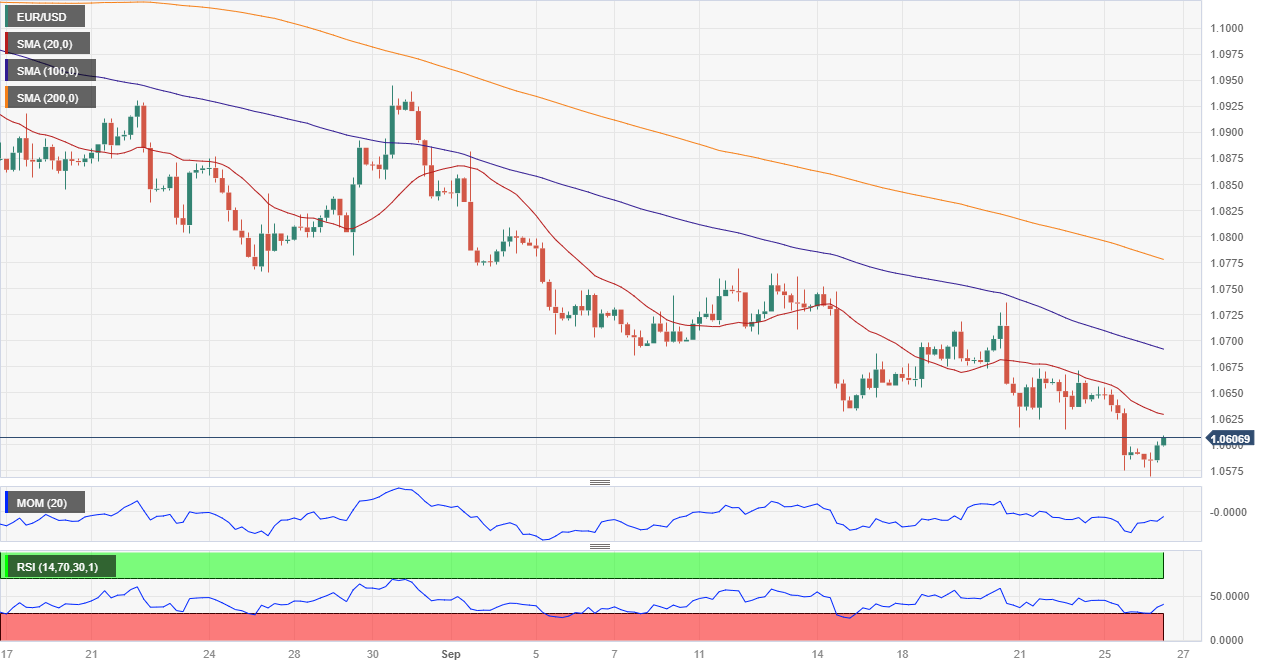
The EUR/USD pair fell to 1.0569 on Tuesday as concerns about continuously tight financial conditions weigh on economic expectations. The US Dollar benefited from the sour sentiment, as stock markets kept giving up yearly gains while government bond yields flirted with record highs. Other than that, speculative interest awaits inflation-related figures from major economies to confirm or deny its concerns.
So far this Tuesday, the calendar has been relatively scarce, with no data from Europe but some housing-related releases from the United States (US). The country will publish the July Housing Price Index and the S&P/Case-Shiller Home Prices Index for the same month. Additionally, the US will release August New Home Sales and September CB Consumer Confidence.
Nevertheless, this week's focus falls on inflation, as Germany, the Euro Zone and the United States will publish updates on price pressures.
EUR/USD short-term technical outlook
The daily chart for the EUR/USD pair shows that bears retain control, as the pair trades at the lower end of its Monday's range will reaching a fresh multi-month low. Technical indicators in the mentioned time frame have turned flat, with the Momentum holding within negative levels and the Relative Strength Index (RSI) indicator barely bouncing from oversold readings. At the same time, EUR/USD is developing below all its moving averages, with the 20 Simple Moving Average (SMA) heading firmly south below the longer ones.
For the near term, the 4-hour chart suggests the ongoing recovery is not enough to change the pair's longer-term direction. Technical indicators corrected oversold conditions but remain well below their midlines. At the same time, the 20 SMA has decelerated its slump but keeps grinding south below bearish longer ones, reflecting sellers' dominance.
Support levels: 1.0565 1.0520 1.0480
Resistance levels: 1.0620 1.0675 1.0720
Author

Valeria Bednarik
FXStreet
Valeria Bednarik was born and lives in Buenos Aires, Argentina. Her passion for math and numbers pushed her into studying economics in her younger years.
















