EUR/USD Forecast: The 1.0800 region holds the downside…for now
- EUR/USD managed to rebound from lows near 1.0800.
- The US economy expanded 3.2% YoY in Q4.
- ECB’s P. Kazimir favoured a rate cut in June.

Following a drop to multi-session lows near 1.0800, EUR/USD managed to stage a marked comeback, almost fully fading that initial knee-jerk and regaining the 1.0840 region on the back of the loss of upside traction in the US Dollar (USD) on Wednesday.
The pair’s recovery came in tandem with the resumption of the selling pressure in the Greenback, which prompted the USD Index (DXY) to return to the sub-104.00 region after hitting six-day highs near 104.30 earlier in the session. The loss of upward bias in the index re-emerged after another revision of the Q4 GDP Growth Rate, which fell short of expectations at 3.2%.
The fluctuating price movements in spot rates also aligned with the corrective decline in US and German yields, all amid ongoing speculation regarding a potential interest rate cut by the Federal Reserve (Fed), possibly as early as June (or beyond).
Meanwhile, expectations for a rate cut at the June 12 event remained firm. According to CME Group's FedWatch Tool, the probability of such action stands at nearly 50%, up from around 13% just a month ago.
The likelihood of the Fed implementing monetary easing gained traction following stronger-than-expected US inflation data in January, supported by robust economic fundamentals and a tight labour market. The release of US inflation figures tracked by the Personal Consumption Expenditures (PCE) later in the week will be central to the ongoing debate.
Similarly, the European Central Bank (ECB) shares the view that the start of the easing cycle may be later than anticipated by investors. ECB Board member Peter Kazimir remarked that headline disinflation is progressing more rapidly than anticipated, yet uncertainties remain regarding the core indicators. He expressed a preference for a rate cut in June, followed by a gradual and consistent cycle of policy easing. Kazimir suggested that while the ECB should recognize the improved inflation outlook, it should refrain from providing forward guidance on rates in March. He noted that the market's pricing of rate cuts is now deemed "more realistic", expressing satisfaction with the recent shift in expectations.
By the same token, Vice President Luis de Guindos affirmed that the recent inflation outlook has been highly favourable, although prices are expected to continue decreasing. He emphasized the importance of ensuring that prices will gradually approach the ECB's 2% goal. De Guindos indicated that if new data confirm the recent assessment, the ECB's Governing Council will adjust its monetary policy accordingly.
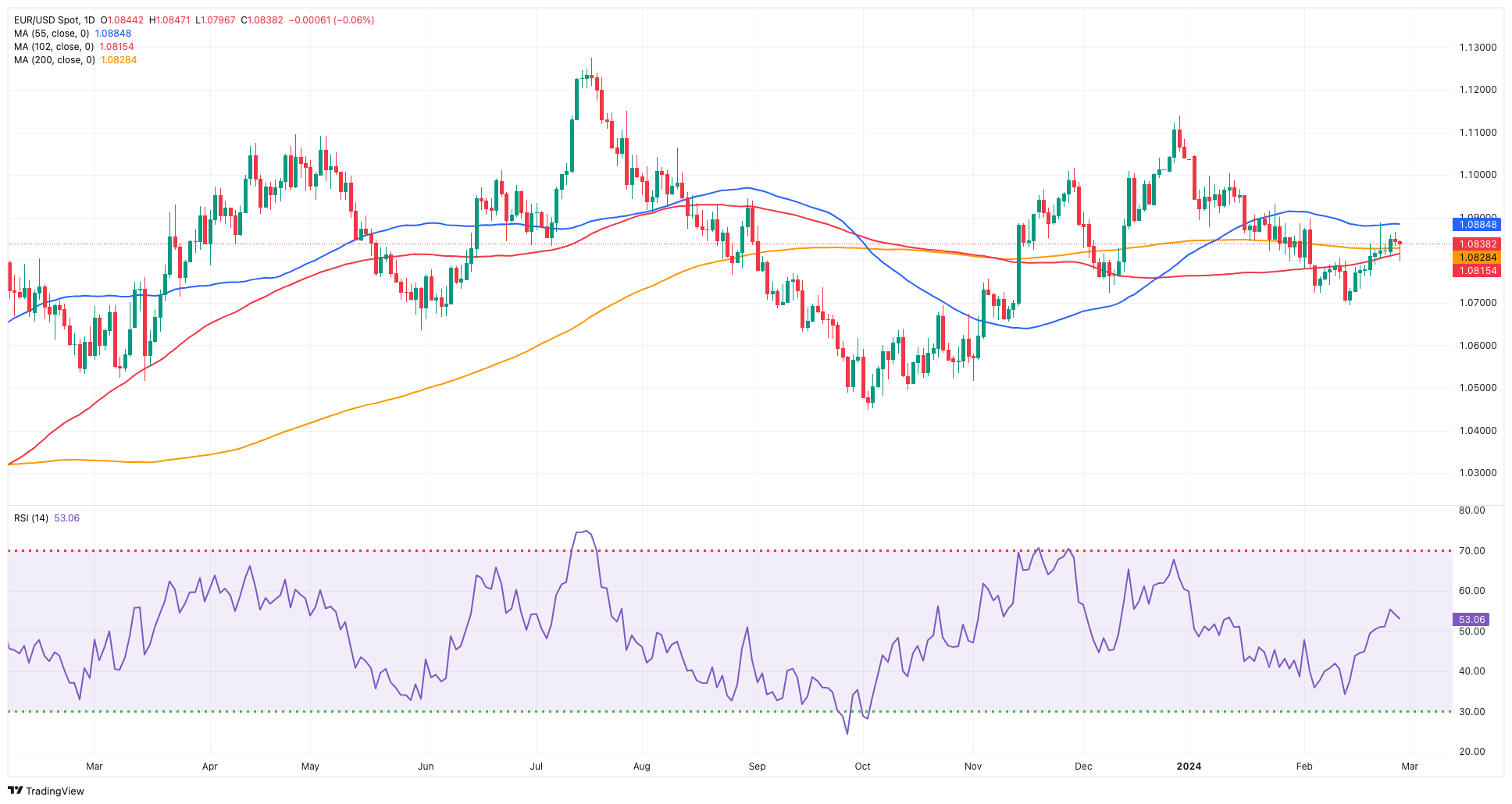
EUR/USD daily chart
EUR/USD short-term technical outlook
The weekly high of 1.0888 (February 22) appears to be supported by the intermediate 55-day SMA (1.0885). The breakthrough of this zone may drive EUR/USD to reach more weekly peaks at 1.0932 (January 24) and 1.0998 (January 11), reinforcing the psychological barrier of 1.1000 and coming ahead of the December 2023 peak of 1.1139 (December 28).
On the downside, if the pair clears the 2024 low of 1.0694 (February 14), it may then hunt the November 2023 bottom of 1.0516 (November 1). The loss of the latter may result in a move to the weekly low of 1.0495 (October 13, 2023), which is below the 2023 low of 1.0448 (October 3) and the round level of 1.0400.
As long as the EUR/USD trades above the 200-day Simple Moving Average (SMA) of 1.0827, the pair's outlook should stay favourable.
Looking at the 4-hour chart, the lethargic uptrend looks to remain in place thus far. The next upward barrier is 1.0888, which comes before 1.0897 and 1.0932. In contrast, initial support emerges at 1.0796 seconded by 1.0761, 10732, and 1.0694. The Moving Average Convergence Divergence (MACD) stayed positive, while the Relative Strength Index (RSI) climbed over 54.
Author

Pablo Piovano
FXStreet
Born and bred in Argentina, Pablo has been carrying on with his passion for FX markets and trading since his first college years.