|premium|

EUR/USD Forecast: Range trading continues post-FOMC Minutes

EUR/USD Current Price: 1.1304

  • US data came in worse than anticipated, with unemployment claims up to 207K.
  • German inflation soared to 5.3% YoY in December, higher than anticipated.
  • EUR/USD maintains its neutral-to-bearish stance seesawing around 1.1300.
The EUR/USD pair bounced from an intraday low of 1.1284 and trades at around 1.1300, as demand for the greenback eased, despite the sour market’s mood persists. The US FOMC Meeting Minutes released Wednesday showed that policymakers are willing to accelerate the pace of tapering, sending the greenback up and stocks down. Asian and European shares remained under pressure after the poor performance of Wall Street.

Data wise, Germany published November Factory Orders, which were up 3.7% MoM, beating expectations. The EU Producer Price Index rose a whopping 23.7% YoY in November, while German inflation was up 5.3% YoY in December. In the US, the November Goods Trade Balance posted a deficit of $-99 billion while weekly unemployment claims rose to 207K in the week ended December 31. The country will publish Factory Orders and the December ISM Services PMI after Wall Street’s opening.

EUR/USD short-term technical outlook

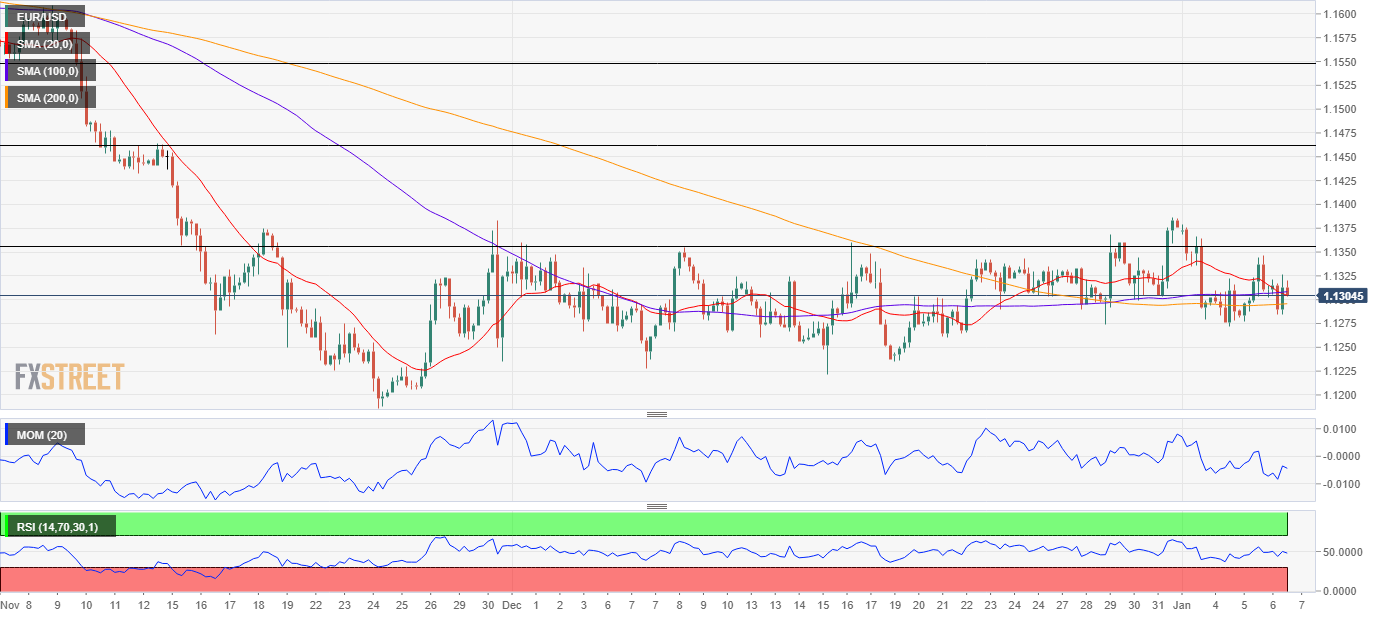
The EUR/USD pair maintains its neutral-to-bearish stance in the near term. The 4-hour chart shows that the price is seesawing around congesting moving averages, all of them confined to a tight 15 pips range. Meanwhile, technical indicators remain directionless around their midlines.

The bullish case could gain strength if the pair breaks above 1.1385, an unlikely scenario at the time being, while bears will have better chances on a break below 1.1220, December monthly low.

Support levels: 1.1260 1.1220 1.1185

Resistance levels: 1.1345 1.1385 1.1410

View Live Chart for the EUR/USD

Premium

You have reached your limit of 3 free articles for this month.

Start your subscription and get access to all our original articles.

Subscribe to PremiumSign In

Author

Valeria Bednarik

Valeria Bednarik was born and lives in Buenos Aires, Argentina. Her passion for math and numbers pushed her into studying economics in her younger years.


More from Valeria Bednarik
Share:

Editor's Picks

AUD/USD eyes 0.7150 barrier nine-day EMA

AUD/USD inches higher after registering modest losses in the previous day, trading around 0.7130 during the Asian hours. The technical analysis of the daily chart indicates that the pair is moving sideways within the rectangle pattern, suggesting a consolidation as neither the bulls nor the bears have enough momentum to take control of the market.

USD/JPY trades below 160.00 intervention threshold; bullish bias intact

The USD/JPY pair attracts some sellers during the Asian session amid fears that authorities will step in again to prop up the Japanese Yen. Furthermore, the Israel-Lebanon truce prompts some profit-taking around the US Dollar and exerts downward pressure on the currency pair.

Gold meets contention near $4,420…for now

Gold extends its recovery past the $4,500 mark per troy ounce on Thursday. The yellow metal’s advance comes amid the resurgence of some selling interest around the, improving risk sentiment, and declining US Treasury yields across the curve.

Bitcoin’s massive storm is back: Why the sell-off is far from over

Bitcoin price action over the last few weeks has felt less like a normal, healthy correction and more like a slow grinding crash that continues to wreak havoc on holdings and trading accounts. And everything suggests that the dramatic crash isn’t over.

Nonfarm payrolls: Testing the limits of Fed policy patience

The upcoming nonfarm payrolls report for May will provide the final update on the US labor market before Kevin Warsh attends his first policy meeting as the new Fed Chair later this month.

Recession on paper: What really moves the Canadian Loonie now?

Statistics Canada handed the headline writers a gift and the analysts a headache. Real GDP shrank 0.1% on an annualized basis in the first quarter, and with the fourth quarter of 2025 revised down to a 1.0% contraction, that is two negative quarters in a row, the textbook definition of a technical recession and Canada's first since the pandemic.