EUR/USD Forecast: Hawkish ECB commentary to help Euro stay resilient
- EUR/USD started to edge higher toward 1.0950 following Monday's subdued action.
- The near-term technical outlook points to a build-up of bullish momentum.
- Hawkish comments from ECB officials could continue to support the Euro.

EUR/USD failed to make a decisive move in either direction to begin the week and closed virtually unchanged on Monday. Early Tuesday, the pair started to stretch higher toward 1.0950. In the absence of high-impact data releases, comments from central bank officials could impact the action.
The US Dollar held resilient against its major rivals on Monday as the benchmark 10-year US Treasury bond yield recovered toward 4% in the first half of the day. As major equity indexes in the US edged higher following a mixed opening in Wall Street, however, the USD failed to gather recovery momentum and allowed EUR/USD to remain within a tight range.
Euro price this week
The table below shows the percentage change of Euro (EUR) against listed major currencies this week. Euro was the strongest against the Japanese Yen.
| USD | EUR | GBP | CAD | AUD | JPY | NZD | CHF | |
| USD | -0.40% | 0.01% | 0.10% | -0.33% | 1.07% | -0.33% | -0.57% | |
| EUR | 0.39% | 0.40% | 0.49% | 0.08% | 1.41% | 0.07% | -0.21% | |
| GBP | -0.01% | -0.41% | 0.10% | -0.33% | 1.06% | -0.33% | -0.58% | |
| CAD | -0.09% | -0.50% | -0.09% | -0.42% | 0.92% | -0.43% | -0.72% | |
| AUD | 0.32% | -0.08% | 0.33% | 0.42% | 1.36% | 0.00% | -0.28% | |
| JPY | -1.08% | -1.44% | -1.06% | -0.94% | -1.33% | -1.35% | -1.63% | |
| NZD | 0.32% | -0.08% | 0.33% | 0.44% | 0.00% | 1.39% | -0.25% | |
| CHF | 0.57% | 0.21% | 0.58% | 0.70% | 0.29% | 1.61% | 0.27% |
The heat map shows percentage changes of major currencies against each other. The base currency is picked from the left column, while the quote currency is picked from the top row. For example, if you pick the Euro from the left column and move along the horizontal line to the Japanese Yen, the percentage change displayed in the box will represent EUR (base)/JPY (quote).
Meanwhile, European Central Bank (ECB) officials continued to push back against the market expectations for a cut in key rates in the first half of next year. ECB policymaker Peter Kazimir said on Monday that the drop in inflation observed in the past few months was not enough to declare victory and move to the next policy stage. Similarly, Governing Council member Yannis Stournaras told Reuters that they need to see inflation staying sustainably below 3% by the middle of next year before cutting interest rates.
In case ECB policymakers reiterate their willingness to be patient before considering a policy pivot, the Euro could preserve its strength in the short term.
On the other hand, Federal Reserve policymakers' mixed tone on the policy outlook makes it difficult for the USD to find demand. Cleveland Fed President told the Financial Times on Monday that markets are a 'bit ahead' of the Fed on rate cuts. San Francisco Fed President Mary Daly, however, argued that rate cuts will be needed next year to prevent over-tightening.
EUR/USD Technical Analysis
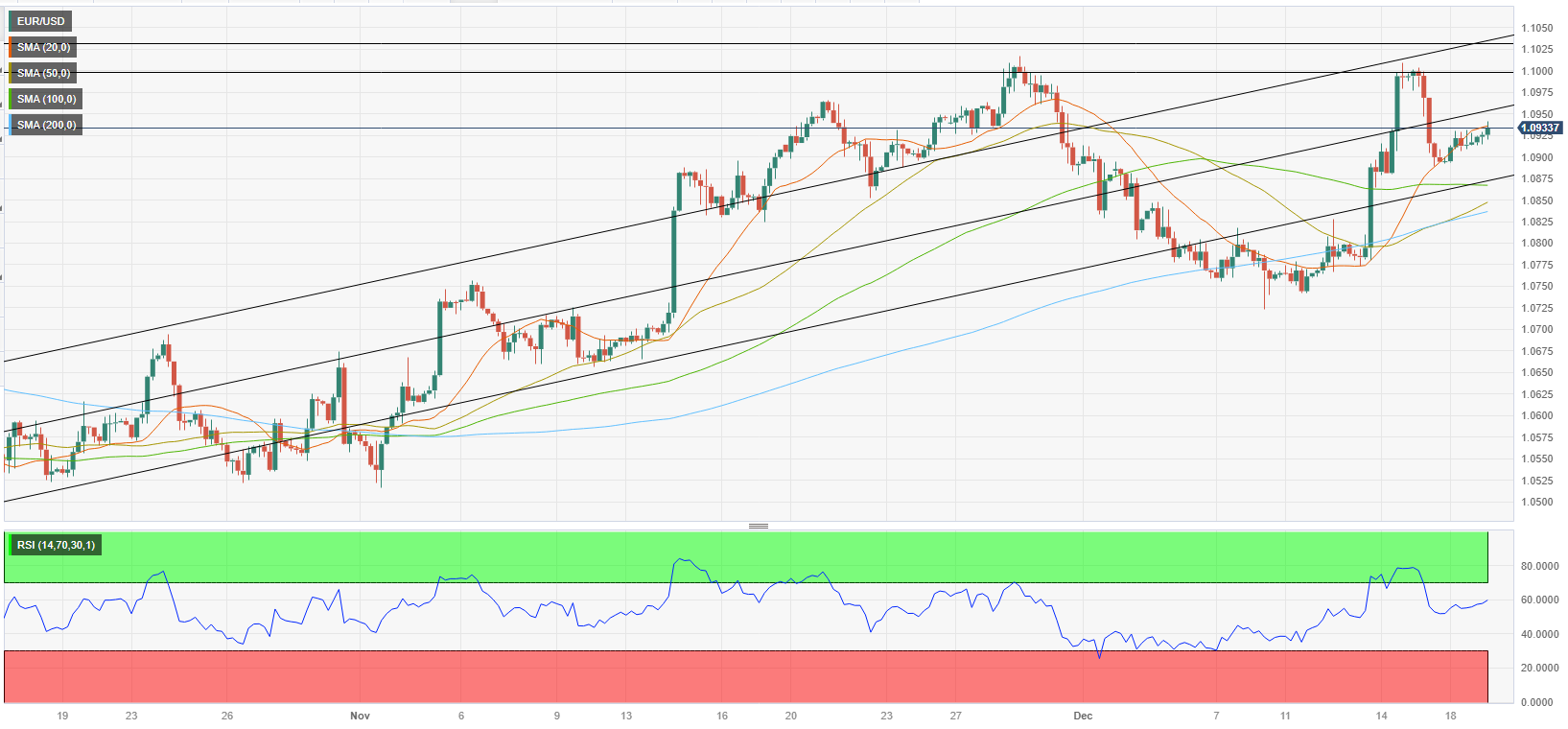
The Relative Strength Index (RSI) indicator on the 4-hour chart advanced toward 60, reflecting a build-up of bullish momentum. EUR/USD faces immediate resistance at 1.0950, where the mid-point of the long-term ascending regression channel is located. With a 4-hour close above that level, the pair could target 1.1000 (psychological level, static level) and 1.1030 (upper limit of the ascending channel).
On the downside, 1.0900 (psychological level, static level) aligns as immediate support before 1.0870 (100-period Simple Moving Average (SMA), lower limit of the ascending channel) and 1.0830 (200-day SMA, 200-period SMA).
Author

Eren Sengezer
FXStreet
As an economist at heart, Eren Sengezer specializes in the assessment of the short-term and long-term impacts of macroeconomic data, central bank policies and political developments on financial assets.















