EUR/USD Forecast: Fears feed in after pressure on Powell propelled it higher
- EUR/USD has been retreating from the highs amid trade pessimism and further headlines are awaited.
- President Trump's pressure on Powell previously pushed the currency pair higher.
- Tuesday's four-hour chart is pointing to a loss of upwards momentum.


"At my meeting with Jay Powell this morning, I protested the fact that our Fed Rate is set too high." – That tweet by President Donald Trump has been weighing on the dollar.
It joined reports that the president pressured Jerome Powell, Chairman of the Federal Reserve in an unscheduled meeting at the White House. Trump added that he wants rates to be lower than competitors, adding "Too strong a Dollar hurting manufacturers and growth."
The Fed's communication emphasized that the bank makes its decisions according to the data and independent of political considerations. While the bank will likely resist Trump's demands, it may be unable to hold back if the economic situation deteriorates due to worsening US-Sino trade relations that the president shapes.
Reports coming out of Beijing suggest that China is skeptical about reaching a broad trade deal with the US. That has also been preventing stocks from extending their gains and also adds some pressure on the US Dollar – as it raises the chances of a rate cut.
The clock is ticking toward the next round of planned US tariffs on China, on December 15. The Asian giant has requested that the US not only refrain from slapping new duties but also removes previous ones.
EUR/USD Today
The US publishes Housing Starts and Building Permits for October. These construction-sector figures are set to show a gradual increase.
Later on, John Williams, President of the New York branch of the Federal Reserve, may shed more light on future monetary policy amid growing trade uncertainty but satisfactory economic performance. Eric Rosengren, his colleague from the Boston Fed – a known hawk – has expressed concern about the bank's recent rate cuts and said that they leave the institution with fewer tools to battle a future recession.
The euro-zone Current Account balance beat expectations with 28.2€ billion in October, but the common currency has shrugged it off and remains focused on US developments.
EUR/USD Technical Analysis
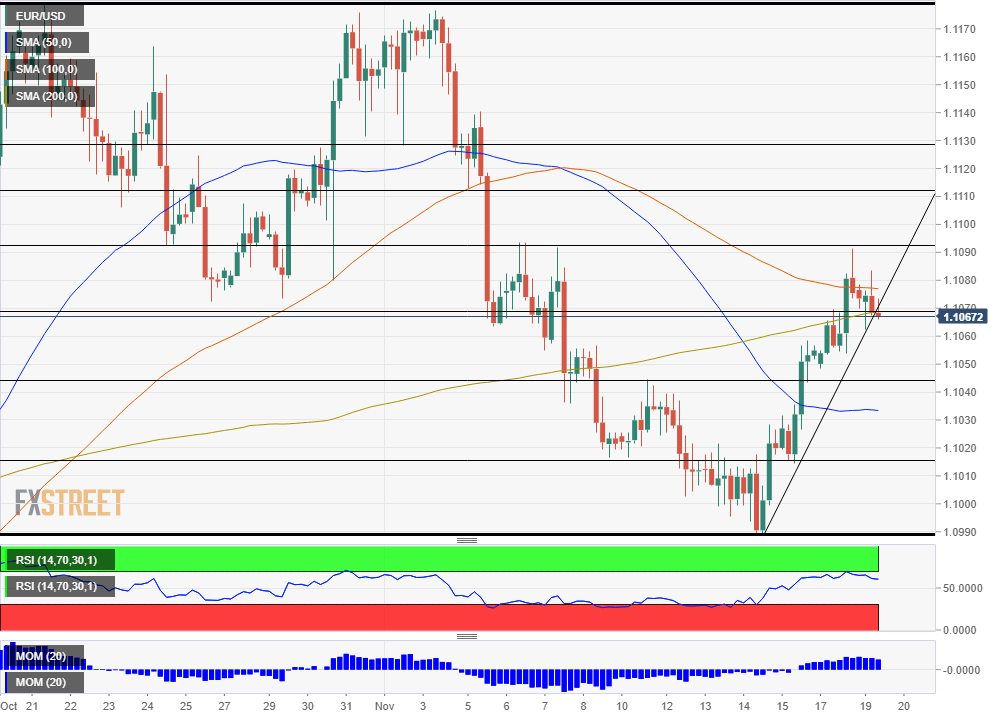
Euro/dollar has retreated from the highs around 1.1090 and momentum on the four-hour chart is waning. Moreover, the currency pair is struggling to hold onto the steep uptrend support line that has been accompanying it since late last week. EUR/USD also lost the 100 Simple Moving Average and struggles to hold onto the 200 SMA.
Overall, the picture is mixed.
Resistance awaits at 1.1090, which was the high point on Monday and also capped euro/dollar in early November. It is followed by 1.1110, a swing low from earlier in the month, and then by 1.1130 and 1.1180.
Support awaits at 1.1070, which provided support twice in late October and held EUR/USD on its way up last week. Next, we find 1.1045, which served as resistance last week, followed by 1.1015, which provided support around the same time. 1.0990, which is November's low point, is next.
Author
Yohay Elam
FXStreet
Yohay is in Forex since 2008 when he founded Forex Crunch, a blog crafted in his free time that turned into a fully-fledged currency website later sold to Finixio.