EUR/USD Forecast: Euro turns bearish following sharp decline
- EUR/USD trades marginally lower on the day below 1.0400 early Friday.
- The technical outlook points to a buildup of bearish momentum.
- Markets await inflation data from Germany and the US.

EUR/USD struggles to stage a rebound and trades below 1.0400 in the European morning on Friday after posting large losses on Thursday. The pair's technical outlook highlights a bearish shift in the short-term bias as market focus shifts to key inflation data releases from Germany and the US.
Euro PRICE This week
The table below shows the percentage change of Euro (EUR) against listed major currencies this week. Euro was the weakest against the US Dollar.
| USD | EUR | GBP | JPY | CAD | AUD | NZD | CHF | |
|---|---|---|---|---|---|---|---|---|
| USD | 0.58% | 0.30% | 0.80% | 1.52% | 2.27% | 2.46% | 0.33% | |
| EUR | -0.58% | -0.37% | 0.05% | 0.75% | 1.67% | 1.68% | -0.42% | |
| GBP | -0.30% | 0.37% | 0.45% | 1.12% | 2.04% | 2.05% | -0.06% | |
| JPY | -0.80% | -0.05% | -0.45% | 0.72% | 1.55% | 1.73% | -0.38% | |
| CAD | -1.52% | -0.75% | -1.12% | -0.72% | 0.69% | 0.93% | -1.16% | |
| AUD | -2.27% | -1.67% | -2.04% | -1.55% | -0.69% | 0.00% | -2.06% | |
| NZD | -2.46% | -1.68% | -2.05% | -1.73% | -0.93% | -0.01% | -2.06% | |
| CHF | -0.33% | 0.42% | 0.06% | 0.38% | 1.16% | 2.06% | 2.06% |
The heat map shows percentage changes of major currencies against each other. The base currency is picked from the left column, while the quote currency is picked from the top row. For example, if you pick the Euro from the left column and move along the horizontal line to the US Dollar, the percentage change displayed in the box will represent EUR (base)/USD (quote).
The US Dollar (USD) gathered strength in the American session on Thursday and triggered a leg lower in EUR/USD as safe-haven flows dominated the action in financial markets.
After suggesting on Wednesday that the 25% tariff package on Mexican and Canadian imports would go into effect on April 2nd, US President Donald Trump clarified on Thursday that they will be imposed on March 4th as initially planned. He further noted that China will also be charged an extra 10% tariff on that date. In response, major equity indexes in the US declined sharply, allowing the USD to outperform its risk-sensitive rivals.
The Consumer Price Index (CPI) in Germany is forecast to rise 2.3% on a yearly basis in February, matching January's increase. A softer-than-forecast inflation reading could hurt the Euro with the immediate reaction.
Additionally, the US Bureau of Economic Analysis (BEA) will publish the Personal Consumption Expenditure (PCE) Price Index data for January. Although this report by itself is unlikely to alter the market pricing of the Federal Reserve's rate outlook in a significant way, a monthly core PCE Price Index increase of 0.4%, or higher, could further boost the USD and weigh on EUR/USD.
EUR/USD Technical Analysis
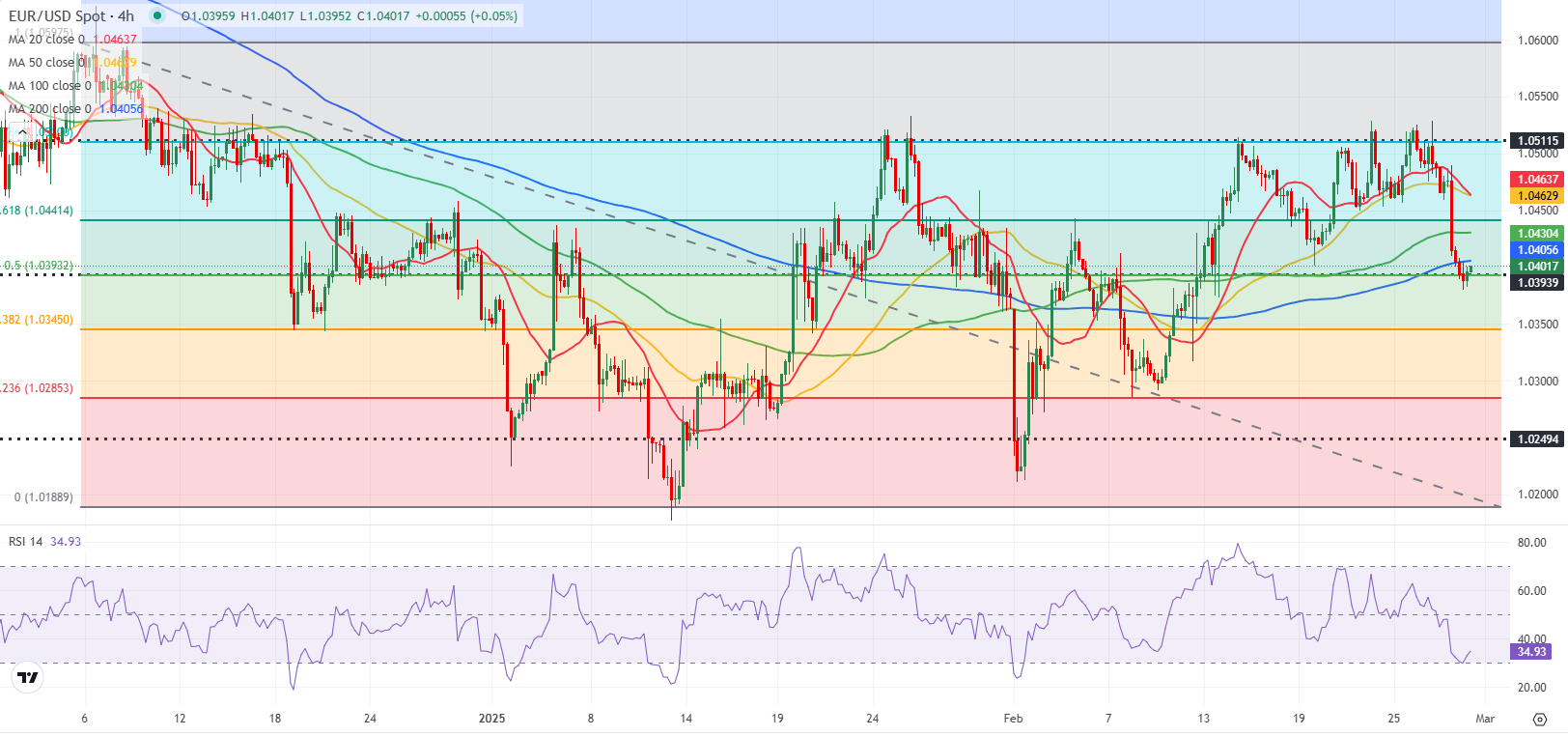
The Relative Strength Index (RSI) indicator on the 4-hour chart stays well below 40 after EUR/USD closed below the 20-day Simple Moving Average (SMA) for the first time in over two weeks on Thursday, reflecting a bearish shift in the short-term outlook.
On the downside, 1.0350 (Fibonacci 38.2% retracement of the latest downtrend) aligns as next support before 1.0300-1.0290 (round level, Fibonacci 23.6% retracement) and 1.0250 (static level). In case EUR/USD stabilizes above 1.0390-1.0400 (Fibonacci 50% retracement, 200-period SMA) and confirms this level as support, 1.0440 (Fibonacci 61.8% retracement) and 1.0500-1.0510 (Fibonacci 78.6% retracement, static level) could be seen as next resistance levels.
Inflation FAQs
Inflation measures the rise in the price of a representative basket of goods and services. Headline inflation is usually expressed as a percentage change on a month-on-month (MoM) and year-on-year (YoY) basis. Core inflation excludes more volatile elements such as food and fuel which can fluctuate because of geopolitical and seasonal factors. Core inflation is the figure economists focus on and is the level targeted by central banks, which are mandated to keep inflation at a manageable level, usually around 2%.
The Consumer Price Index (CPI) measures the change in prices of a basket of goods and services over a period of time. It is usually expressed as a percentage change on a month-on-month (MoM) and year-on-year (YoY) basis. Core CPI is the figure targeted by central banks as it excludes volatile food and fuel inputs. When Core CPI rises above 2% it usually results in higher interest rates and vice versa when it falls below 2%. Since higher interest rates are positive for a currency, higher inflation usually results in a stronger currency. The opposite is true when inflation falls.
Although it may seem counter-intuitive, high inflation in a country pushes up the value of its currency and vice versa for lower inflation. This is because the central bank will normally raise interest rates to combat the higher inflation, which attract more global capital inflows from investors looking for a lucrative place to park their money.
Formerly, Gold was the asset investors turned to in times of high inflation because it preserved its value, and whilst investors will often still buy Gold for its safe-haven properties in times of extreme market turmoil, this is not the case most of the time. This is because when inflation is high, central banks will put up interest rates to combat it. Higher interest rates are negative for Gold because they increase the opportunity-cost of holding Gold vis-a-vis an interest-bearing asset or placing the money in a cash deposit account. On the flipside, lower inflation tends to be positive for Gold as it brings interest rates down, making the bright metal a more viable investment alternative.
Author

Eren Sengezer
FXStreet
As an economist at heart, Eren Sengezer specializes in the assessment of the short-term and long-term impacts of macroeconomic data, central bank policies and political developments on financial assets.