EUR/USD Forecast: Euro stabilizes ahead of US tariff announcements
- EUR/USD trades in a narrow band at around 1.0800 early Wednesday.
- US Pres. Trump will unveil the new tariff regime later in the day.
- The near-term technical outlook fails to offer a directional clue.


EUR/USD registered small losses for the second consecutive day on Tuesday before entering a consolidation phase at around 1.0800 in the European morning on Wednesday.
US Dollar PRICE This week
The table below shows the percentage change of US Dollar (USD) against listed major currencies this week. US Dollar was the strongest against the Swiss Franc.
| USD | EUR | GBP | JPY | CAD | AUD | NZD | CHF | |
|---|---|---|---|---|---|---|---|---|
| USD | 0.32% | 0.19% | -0.16% | -0.01% | -0.28% | -0.32% | 0.53% | |
| EUR | -0.32% | -0.02% | -0.44% | -0.29% | -0.51% | -0.60% | 0.25% | |
| GBP | -0.19% | 0.02% | -0.44% | -0.23% | -0.50% | -0.55% | 0.32% | |
| JPY | 0.16% | 0.44% | 0.44% | 0.14% | -0.09% | -0.13% | 0.60% | |
| CAD | 0.01% | 0.29% | 0.23% | -0.14% | -0.24% | -0.31% | 0.55% | |
| AUD | 0.28% | 0.51% | 0.50% | 0.09% | 0.24% | -0.07% | 0.77% | |
| NZD | 0.32% | 0.60% | 0.55% | 0.13% | 0.31% | 0.07% | 0.85% | |
| CHF | -0.53% | -0.25% | -0.32% | -0.60% | -0.55% | -0.77% | -0.85% |
The heat map shows percentage changes of major currencies against each other. The base currency is picked from the left column, while the quote currency is picked from the top row. For example, if you pick the US Dollar from the left column and move along the horizontal line to the Japanese Yen, the percentage change displayed in the box will represent USD (base)/JPY (quote).
The disappointing macroeconomic data releases from the US made it difficult for the US Dollar (USD) to gather strength on Tuesday and helped EUR/USD find support. Nevertheless, the cautious market stance didn't allow the pair to gain traction.
The ISM Manufacturing Purchasing Managers Index (PMI) dropped to 49 in March from 50.3 in February, showing a contraction in the manufacturing sector's activity. Additionally, JOLTS Job Openings fell to 7.56 million in February from 7.76 million in January.
Later in the day, the ADP Employment Change data will be featured in the US economic calendar. Investors, however, are unlikely to react to this data ahead of US President Donald Trump's tariff announcements on "Liberation Day."
Markets are likely to turn volatile while assessing the Trump administration's new tariff regime and how it could impact the economic outlook. Hence, it might be risky to take a position based on the knee-jerk reaction. Furthermore, volatility could remain high in case US' trading partners, such as the EU, respond by announcing their own tariffs on American goods.
EUR/USD Technical Analysis
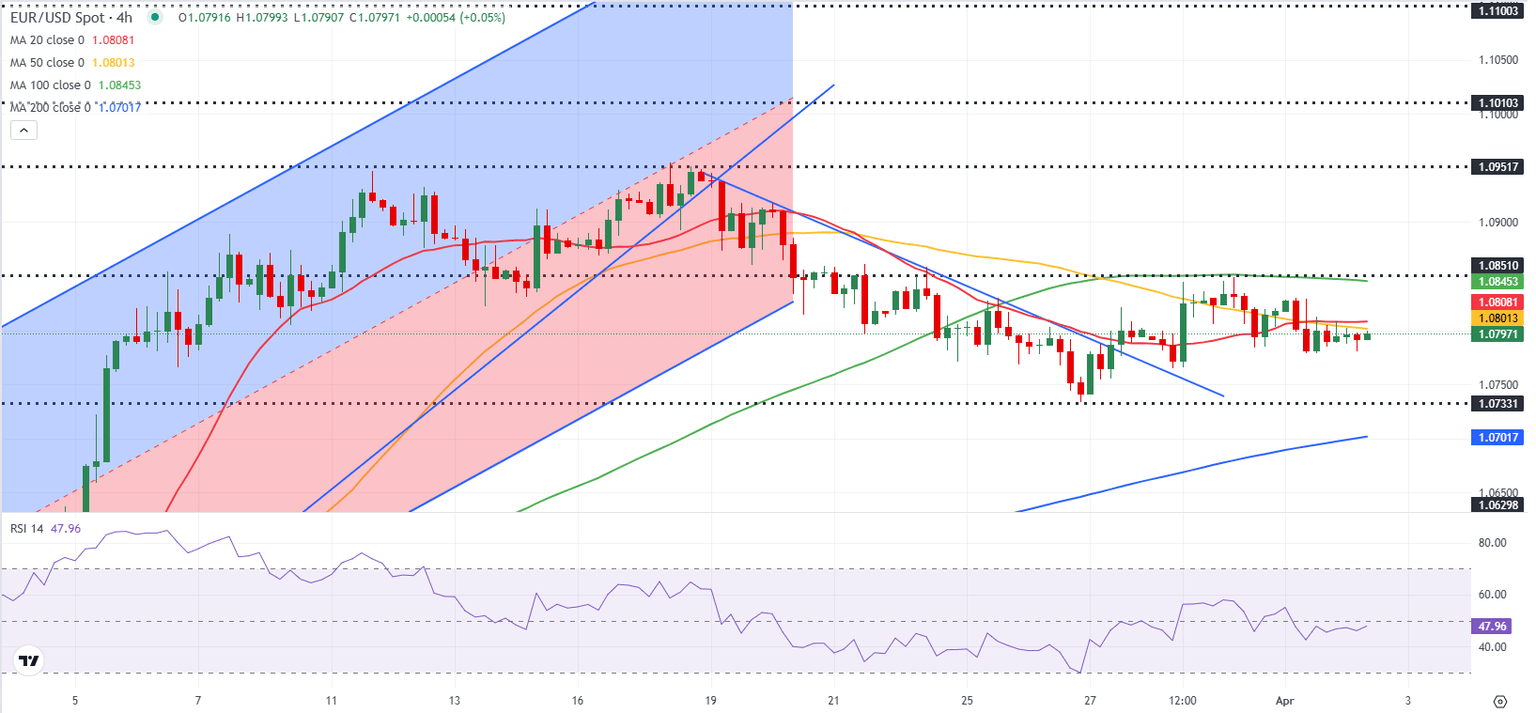
The Relative Strength Index (RSI) indicator continues to move sideways near 50, reflecting a lack of directional momentum in the near term.
In case EUR/USD stays below 1.0800 (round level, static level) and confirms this level as resistance, technical sellers could take action and open the door for an extended slide toward 1.0730 (200-day SMA). On the upside, 1.0840 (20-day SMA) aligns as first resistance before 1.0900 (static level, round level) and 1.0950 (static level).
Tariffs FAQs
Tariffs are customs duties levied on certain merchandise imports or a category of products. Tariffs are designed to help local producers and manufacturers be more competitive in the market by providing a price advantage over similar goods that can be imported. Tariffs are widely used as tools of protectionism, along with trade barriers and import quotas.
Although tariffs and taxes both generate government revenue to fund public goods and services, they have several distinctions. Tariffs are prepaid at the port of entry, while taxes are paid at the time of purchase. Taxes are imposed on individual taxpayers and businesses, while tariffs are paid by importers.
There are two schools of thought among economists regarding the usage of tariffs. While some argue that tariffs are necessary to protect domestic industries and address trade imbalances, others see them as a harmful tool that could potentially drive prices higher over the long term and lead to a damaging trade war by encouraging tit-for-tat tariffs.
During the run-up to the presidential election in November 2024, Donald Trump made it clear that he intends to use tariffs to support the US economy and American producers. In 2024, Mexico, China and Canada accounted for 42% of total US imports. In this period, Mexico stood out as the top exporter with $466.6 billion, according to the US Census Bureau. Hence, Trump wants to focus on these three nations when imposing tariffs. He also plans to use the revenue generated through tariffs to lower personal income taxes.
Premium
You have reached your limit of 3 free articles for this month.
Start your subscription and get access to all our original articles.
Author
Eren Sengezer
FXStreet
As an economist at heart, Eren Sengezer specializes in the assessment of the short-term and long-term impacts of macroeconomic data, central bank policies and political developments on financial assets.