EUR/USD Forecast: Euro shows no signs of a steady recovery
- EUR/USD struggles to hold above 1.1600 in the European session on Thursday.
- The near-term technical shows that the bearish bias remains intact.
- September inflation data from the US could trigger the next big reaction in the pair.


EUR/USD finds it difficult to gather recovery momentum and trades slightly below 1.1600 in the European session on Thursday. The technical outlook suggests that sellers are likely to retain control in the short term.
Euro Price This week
The table below shows the percentage change of Euro (EUR) against listed major currencies this week. Euro was the weakest against the New Zealand Dollar.
| USD | EUR | GBP | JPY | CAD | AUD | NZD | CHF | |
|---|---|---|---|---|---|---|---|---|
| USD | 0.56% | 0.61% | 1.28% | -0.17% | -0.23% | -0.20% | 0.66% | |
| EUR | -0.56% | 0.05% | 0.81% | -0.72% | -0.68% | -0.82% | 0.11% | |
| GBP | -0.61% | -0.05% | 0.51% | -0.78% | -0.73% | -0.87% | 0.04% | |
| JPY | -1.28% | -0.81% | -0.51% | -1.50% | -1.53% | -1.54% | -0.72% | |
| CAD | 0.17% | 0.72% | 0.78% | 1.50% | -0.01% | -0.10% | 0.82% | |
| AUD | 0.23% | 0.68% | 0.73% | 1.53% | 0.01% | -0.14% | 0.78% | |
| NZD | 0.20% | 0.82% | 0.87% | 1.54% | 0.10% | 0.14% | 0.92% | |
| CHF | -0.66% | -0.11% | -0.04% | 0.72% | -0.82% | -0.78% | -0.92% |
The heat map shows percentage changes of major currencies against each other. The base currency is picked from the left column, while the quote currency is picked from the top row. For example, if you pick the Euro from the left column and move along the horizontal line to the US Dollar, the percentage change displayed in the box will represent EUR (base)/USD (quote).
In the absence of high-tier data releases and central bank commentary, EUR/USD failed to make a decisive move in either direction midweek. In the European session on Thursday, the US Dollar (USD) holds its ground as markets assess the latest headlines surrounding the United States (US)-China trade conflict.
Reuters reported early Thursday that the White House is considering a plan to curb an array of exports, which uses software developed by US companies, to China to retaliate against Beijing's latest round of rare earth export restrictions. "If these export controls, whether it's software, engines or other things happen, it will likely be in coordination with our G-7 allies," US Treasury Secretary Scott Bessent said on the matter. Meanwhile, US President Donald Trump adopted an optimistic tone and reiterated that he thinks they will be able to work something out with Chinese President Xi Jinping when they meet in South Korea next week.
Later in the day, the European Commission will publish the preliminary Consumer Confidence Index data for October. Nevertheless, ahead of Friday's highly-anticipated Consumer Price Index (CPI) data from the US, investors could refrain from taking large positions.
EUR/USD Technical Analysis:
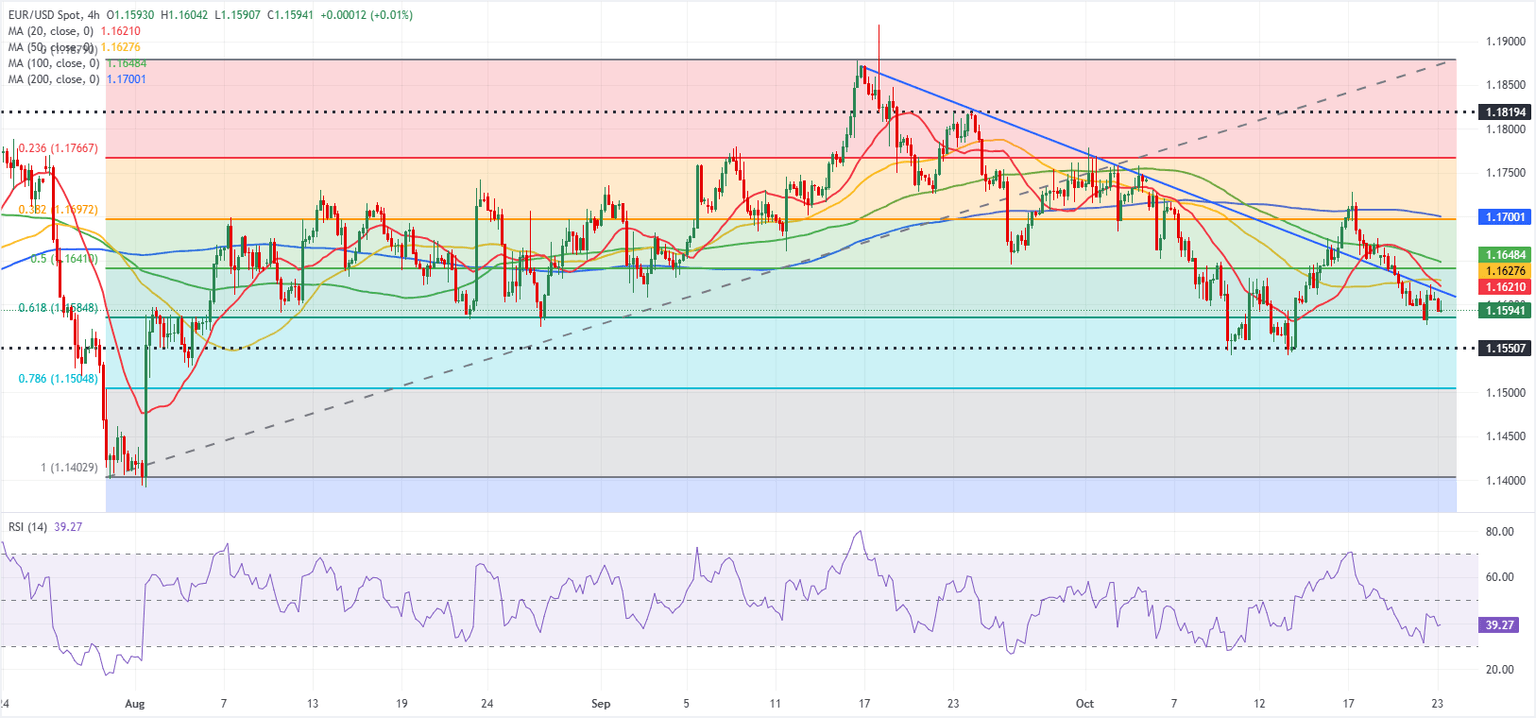
EUR/USD is currently trading at around 1.1592 on the 4-hour chart, below the day opening price by 15 pips, little changed on a daily basis. A bearish 20 SMA slides south below the longer ones, suggesting sellers hold the grip and hinting at additional slides ahead. The 20 SMA stands at 1.1621. Furthermore, the 50 SMA is also soft, easing above the shorter one at 1.1628, while the 100 SMA at 1.1648 and the 200 SMA at 1.1700 edge lower, reinforcing the negative tone. These moving averages sit above spot, layering resistance at 1.1621, 1.1628, 1.1648 and 1.1700. The RSI (14) is at 38.5 and has faded versus prior readings, keeping the intraday bias bearish without entering oversold territory. In addition, a downwards trend line drawn between 1.1872 and 1.1609 currently stands near 1.1613, acting as resistance; a clear break higher would be an early sign of waning bearish pressure.
Measuring the rally between 1.1403 and 1.1879, the 61.8% retracement stands at 1.1585, providing nearby support; below it, the 78.6% retracement is at 1.1505, ahead of the 100% at 1.1403. On the upside, initial resistance emerges at the 50% retracement at 1.1641, followed by the 38.2% level at 1.1697. A failure to hold above 1.1585 would expose 1.1505, while a recovery through the trend-line cap at 1.1613 and the 50% retracement at 1.1641 would ease the downside, opening the path toward 1.1697. Until the RSI turns higher toward its 50 mid-line and price clears the clustered moving-average barriers, downside risks remain in place.
(This content was partially created with the help of an AI tool)
Euro FAQs
The Euro is the currency for the 19 European Union countries that belong to the Eurozone. It is the second most heavily traded currency in the world behind the US Dollar. In 2022, it accounted for 31% of all foreign exchange transactions, with an average daily turnover of over $2.2 trillion a day. EUR/USD is the most heavily traded currency pair in the world, accounting for an estimated 30% off all transactions, followed by EUR/JPY (4%), EUR/GBP (3%) and EUR/AUD (2%).
The European Central Bank (ECB) in Frankfurt, Germany, is the reserve bank for the Eurozone. The ECB sets interest rates and manages monetary policy. The ECB’s primary mandate is to maintain price stability, which means either controlling inflation or stimulating growth. Its primary tool is the raising or lowering of interest rates. Relatively high interest rates – or the expectation of higher rates – will usually benefit the Euro and vice versa. The ECB Governing Council makes monetary policy decisions at meetings held eight times a year. Decisions are made by heads of the Eurozone national banks and six permanent members, including the President of the ECB, Christine Lagarde.
Eurozone inflation data, measured by the Harmonized Index of Consumer Prices (HICP), is an important econometric for the Euro. If inflation rises more than expected, especially if above the ECB’s 2% target, it obliges the ECB to raise interest rates to bring it back under control. Relatively high interest rates compared to its counterparts will usually benefit the Euro, as it makes the region more attractive as a place for global investors to park their money.
Data releases gauge the health of the economy and can impact on the Euro. Indicators such as GDP, Manufacturing and Services PMIs, employment, and consumer sentiment surveys can all influence the direction of the single currency. A strong economy is good for the Euro. Not only does it attract more foreign investment but it may encourage the ECB to put up interest rates, which will directly strengthen the Euro. Otherwise, if economic data is weak, the Euro is likely to fall. Economic data for the four largest economies in the euro area (Germany, France, Italy and Spain) are especially significant, as they account for 75% of the Eurozone’s economy.
Another significant data release for the Euro is the Trade Balance. This indicator measures the difference between what a country earns from its exports and what it spends on imports over a given period. If a country produces highly sought after exports then its currency will gain in value purely from the extra demand created from foreign buyers seeking to purchase these goods. Therefore, a positive net Trade Balance strengthens a currency and vice versa for a negative balance.
Premium
You have reached your limit of 3 free articles for this month.
Start your subscription and get access to all our original articles.
Author
Eren Sengezer
FXStreet
As an economist at heart, Eren Sengezer specializes in the assessment of the short-term and long-term impacts of macroeconomic data, central bank policies and political developments on financial assets.