EUR/USD Forecast: Euro sellers could retain control if 1.0800 is confirmed as resistance
- EUR/USD trades slightly below 1.0800 in the European morning on Thursday.
- The US Dollar continues to gather strength following the Fed policy announcements.
- January inflation report from the Euro area and mid-tier US data releases will be watched closely.

EUR/USD made sharp moves in both directions in the American session on Wednesday before closing the day marginally lower. The pair stays under modest bearish pressure early Thursday and trades below 1.0800 in the European morning.
Euro price today
The table below shows the percentage change of Euro (EUR) against listed major currencies today. Euro was the weakest against the US Dollar.
| USD | EUR | GBP | CAD | AUD | JPY | NZD | CHF | |
| USD | 0.16% | 0.25% | 0.17% | 0.45% | -0.03% | 0.16% | 0.26% | |
| EUR | -0.16% | 0.09% | -0.01% | 0.30% | -0.15% | 0.01% | 0.10% | |
| GBP | -0.25% | -0.09% | -0.10% | 0.22% | -0.24% | -0.09% | 0.01% | |
| CAD | -0.17% | 0.01% | 0.09% | 0.32% | -0.15% | 0.04% | 0.15% | |
| AUD | -0.46% | -0.31% | -0.23% | -0.33% | -0.48% | -0.31% | -0.19% | |
| JPY | 0.01% | 0.14% | 0.22% | 0.14% | 0.46% | 0.17% | 0.26% | |
| NZD | -0.17% | 0.02% | 0.10% | 0.03% | 0.30% | -0.18% | 0.11% | |
| CHF | -0.25% | -0.08% | -0.01% | -0.08% | 0.19% | -0.28% | -0.08% |
The heat map shows percentage changes of major currencies against each other. The base currency is picked from the left column, while the quote currency is picked from the top row. For example, if you pick the Euro from the left column and move along the horizontal line to the Japanese Yen, the percentage change displayed in the box will represent EUR (base)/JPY (quote).
The Federal Reserve (Fed) maintained the key interest rate at 5.25%-5.5% as expected following the January meeting. In the policy statement, the Fed said that it does not expect it will be appropriate to reduce rates until there is greater confidence inflation is moving sustainably toward 2%.
In the post-meeting press conference, Chairman Jerome Powell acknowledged that almost everyone on the Committee believes that it will be appropriate to reduce rates and said that it will likely be appropriate to dial back policy this year. When asked about the possibility of a rate reduction in March, Powell said that the base case scenario didn't suggest that there will be a rate cut at the next meeting. Although Wall Street's main indexes declined sharply following these comments, the benchmark 10-year US Treasury bond yield lost nearly 3% and closed the day below 4%. In turn, the US Dollar outperformed its rivals later in the American session but struggled to gather bullish momentum.
In the European morning on Thursday, the USD stays resilient as the 10-year US yield gains nearly 1%.
Eurostat will release the Harmonized Index of Consumer Prices (HICP) inflation data. On a yearly basis, HICP inflation is forecast to edge lower to 2.8% in January from 2.9% in December. Unless there is a significant divergence from the market consensus, this data is unlikely to trigger a big reaction in the pair.
In the second half of the day, weekly Initial Jobless Claims and ISM Manufacturing PMI data will be featured in the US economic docket. At the press conference, Powell said that they could start lowering rates sooner if they saw an unexpected weakening in the labor market. In case the number of first-time applications for unemployment benefits rise toward 250K, the initial market reaction could trigger a USD selloff. Investors, however, could refrain from betting on a persistent USD weakness ahead of Friday's Nonfarm Payrolls data.
EUR/USD Technical Analysis
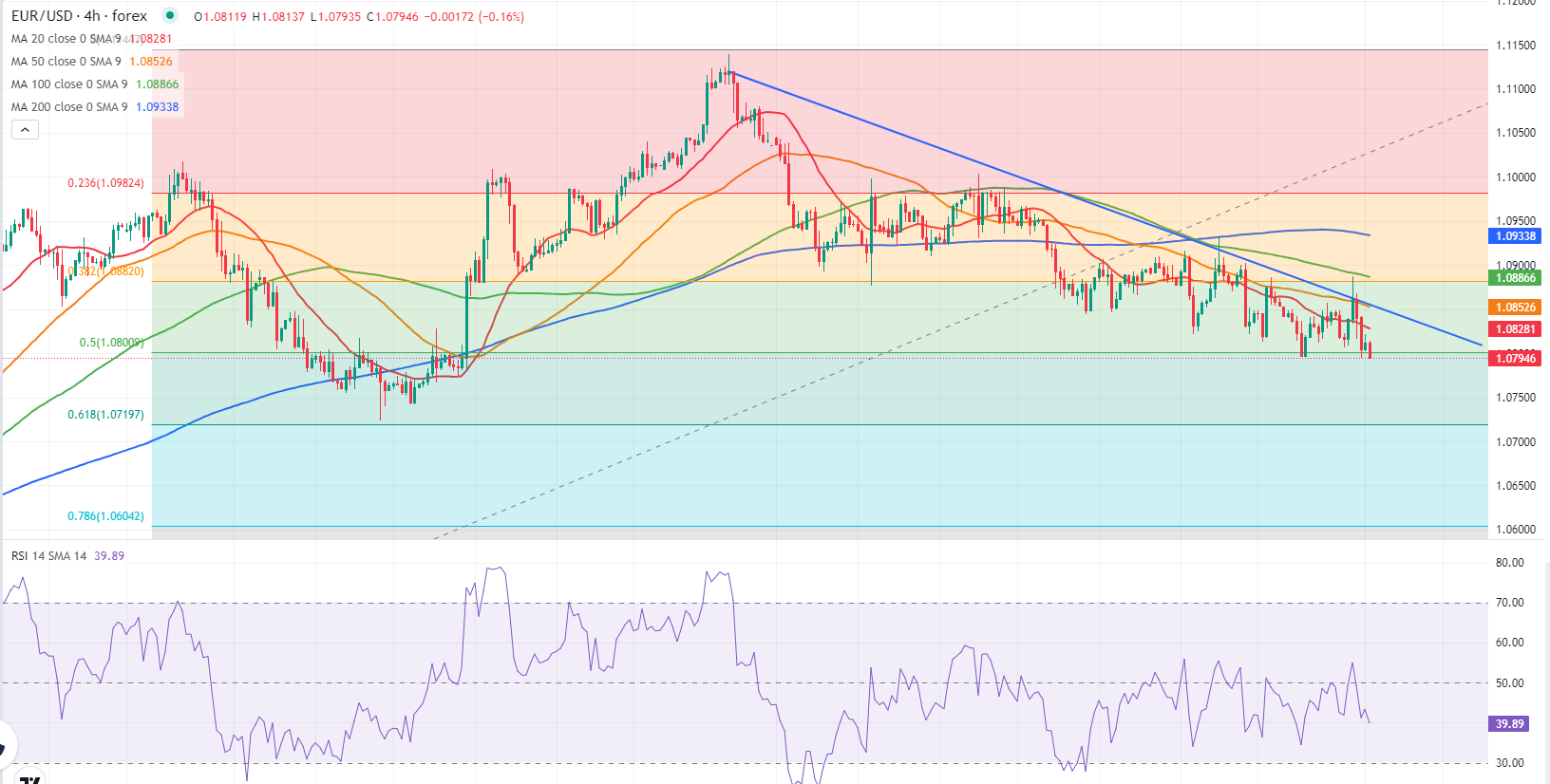
The Relative Strength Index (RSI) indicator on the 4-hour chart stays near 40 and EUR/USD continues to trade below the descending trend line. 1.0800 (Fibonacci 50% retracement of the latest uptrend) aligns as a pivot level for the pair. Once this level is confirmed as resistance, technical sellers could take action and open the door for an extended decline toward 1.0740 (static level) and 1.0700 (Fibonacci 61.8% retracement).
If EUR/USD manages to stabilize above 1.0800, resistances are located at 1.0850 (50-period Simple Moving Average (SMA), descending trend line) and 1.0890-1.0900 (100-period SMA, psychological level).
Author

Eren Sengezer
FXStreet
As an economist at heart, Eren Sengezer specializes in the assessment of the short-term and long-term impacts of macroeconomic data, central bank policies and political developments on financial assets.