Are high fuel prices the fault of the oil companies, or UK energy policy?
There’s been a bit of discourse on social media the past few days about how oil companies are fleecing consumers with the current increases we’ve been seeing in petrol and diesel prices.
It is certainly true that prices always seem to go up like a rocket and come down like a feather, feeding into a narrative that oil companies are evil and as such are profiteering.
As such fuel prices tend to be an emotive subject, however they are also subject to a lot of misinformation when it comes to why prices move the way they do.
There’s also the fact that, while I’m no expert on the energy sector, I do understand numbers, and the narrative that oil companies are evil is becoming a bit of a tired trope, notwithstanding the fact that the industry is subject to a 78% windfall tax, which could get raised further in the upcoming budget.
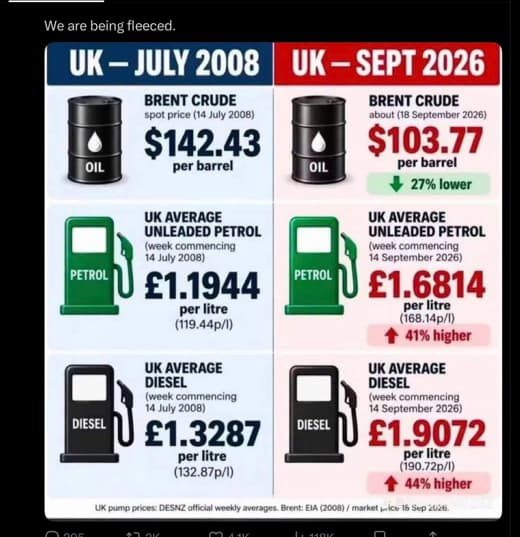
Below is a graphic comparing prices in July 2008, when crude oil prices surged to $147 a barrel, compared to prices now, where they are around $100, and on that basis the argument seems fairly easy to make that the consumer is being fleeced, given that UK pump prices are almost 30p higher now, with an oil price which is lower.
The problem with this argument is that it ignores a huge number of key variables which a simple chart like this cannot illustrate.
Let me try and explain some of the nuances, for want of a better word.
UK fuel price comparison 2008/2026
So, are we being fleeced?
Firstly, the price of crude oil is priced in US dollars, and in July 2008 the value of the pound was at an average of $1.99 as opposed to where it is now at $1.32, so there’s the possibility of an exchange rate differential, which might make a difference on the margin. In this case it doesn’t as the sterling price of crude oil is more or less unchanged at around £74 a barrel.
This means that the main difference in price is likely to have come about by way of the supply chain, and/or government tax and energy policy, and here there are some interesting divergences.
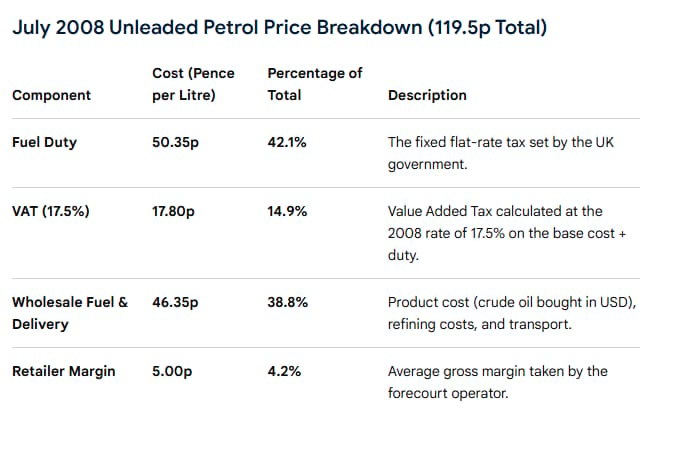
If we look at the price of a litre of fuel in July 2008, the price breakdown is much simpler in terms of the distribution of costs, although I had to use Gemini AI to pull the numbers so there could be a margin for error.
Fuel duty was lower at 50.35p per litre, as was VAT which was only charged at 17.5% of the pump price.
It’s also notable that wholesale fuel and delivery costs were also lower at 46.35p, amounting to 38.8% of the pump price.
On top of that there’s the average retailer gross margin of around 5p, which brings us to around 120p a litre.
July 2008 unleaded petrol price breakdown
Quite a lot has changed since then, which somehow always seems to get overlooked when discussing this issue.
After all, it’s an issue that affects all of us, and annoys me as much as everyone else. The problem is that this anger is somewhat misdirected.
Could the oil companies do more when it comes to keeping prices down?
Probably, but why should they, after all, the main reason fuel prices are so expensive is less to do with the oil companies and more to do with government energy and tax policy, not only here in the UK, but across Europe as well.
Here in the UK the number of refineries that we use to refine petroleum and distillates products has dropped from 9 in 2008 to 4 now.
The 4 remaining refineries in the UK are at Fawley, in Hampshire, Stanlow in Cheshire, Pembroke in Wales and Humber in Lincolnshire.
The other 5 others were Teesside, which was closed in 2009, Coryton in 2012, Milford Haven in 2014, Grangemouth and Lindsey which were closed in 2025.
This means that the UK now imports 55% of its diesel, and almost 90% of its aviation fuel, and yet we aren’t consuming any less of any of it.
This means we’ve done this to ourselves, given that UK refineries face significantly higher domestic carbon taxes and stricter environmental policies than non-European competitors.
Does that mean we are consuming any less than we were then?
No, but to feel better about ourselves successive UK governments decided to contract out our carbon footprint, undermining the energy security of the country in the process.
The other factor driving prices is something called “crack spreads” which is the price difference between crude oil and the petroleum products made from it, which in turn represents the refiner’s gross margin.
The “crack” is a term that the industry uses to break the oil into various component products, which include jet fuel, diesel, gasoline, as well as gases like propane, heating fuels, and other light distillates.
These wholesales costs have surged since 2008, not surprising when you consider that there are fewer refineries now than there were back then, and yet demand has continued to rise steadily.
In 2008 global oil demand ran at around 86m barrels a day, and now sits above 100m barrels a day.
The closure of the Straits of Hormuz isn’t helping, particularly when it comes to diesel prices, which in turn has exerted enormous upward pressure on wholesale costs, as we can see below.
UK fuel price breakdown
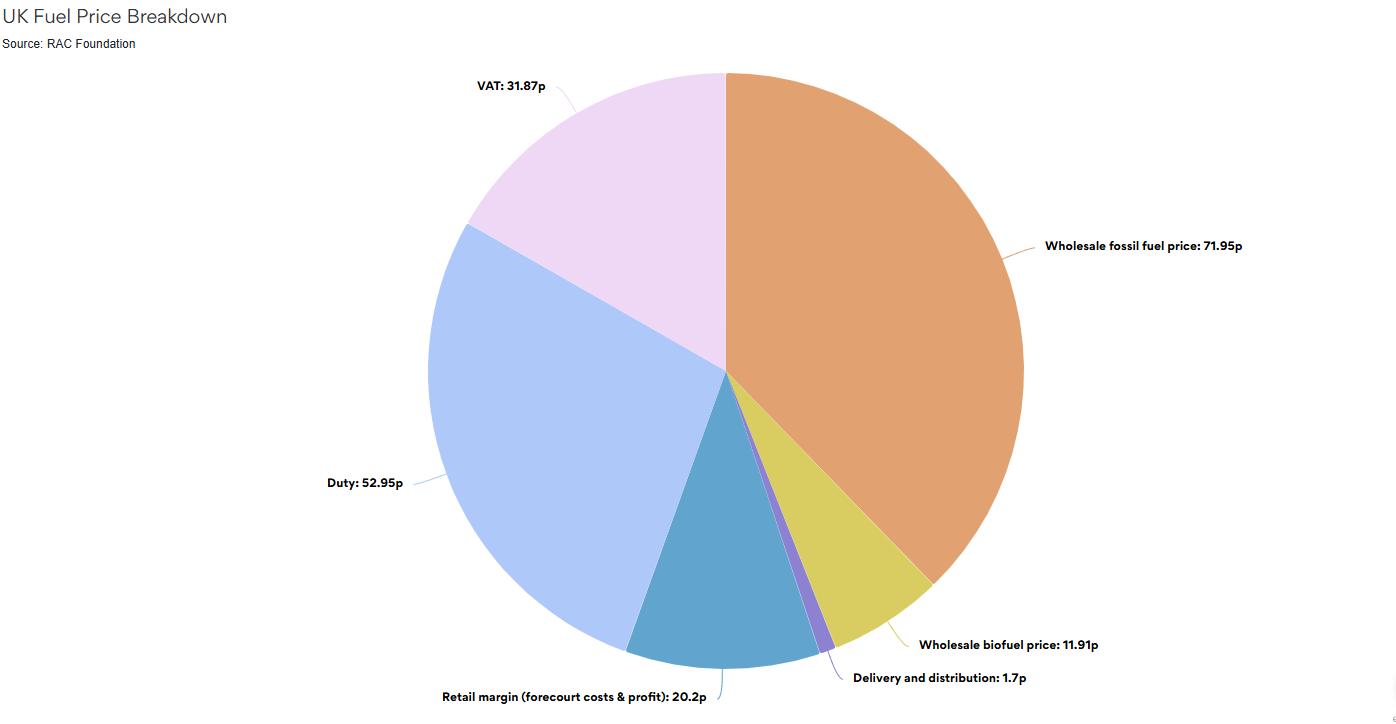
If we compare the wholesale costs of wholesale fuel prices, as well as delivery and distribution, we can see that compared to the 46.35p price in 2008, we’ve seen a combined rise to over 73p per litre.
Add in the additional costs of a biofuel price of 11.91p, and the additional costs start to become even more apparent.
This cost comes under the Renewable Transport Fuel Obligation which adds 3.5p to the cost of a litre of E10 fuel. Fluctuations in crop and ethanol prices can add an additional cost which can vary to as much as 8p per litre.
You then have to add the extra 2.5% the government takes in VAT, which now sits at 20%, and the higher fuel duty levy of 52.95p, and which is due to go up to 55.95p on 1st January 2027, and then again on 1st March 2027 to 57.95p per litre.
Who’s price gouging now?
To sum up, the reason that petrol and diesel prices are so high is less to do with oil companies fleecing us, and more to do with government policy on the climate, the closure of over half our refineries on the altar of Net Zero, and higher fuel duty and VAT.
Perhaps we should channel our anger in a different direction, rather than taking aim at the oil companies all the time, given that it’s been successive UK government’s energy policy that appears to be the driving force behind why petrol and diesel has become so expensive, and is likely to continue to be so.
Author

Michael Hewson MSTA CFTe
Independent Analyst
Award winning technical analyst, trader and market commentator. In my many years in the business I’ve been passionate about delivering education to retail traders, as well as other financial professionals. Visit my Substack here.