EUR/USD Forecast: Euro pullbacks to remain short-lived after ECB
- EUR/USD holds near 1.1750 after posting small losses on Thursday.
- The ECB left key rates unchanged after the July meeting, as expected.
- The near-term technical outlook highlights sellers' hesitancy.


EUR/USD holds its ground and trades at around 1.1750 after closing modestly lower on Thursday. The pair's downside is likely to remain limited in the near term, with the European Central Bank's (ECB) cautious tone on policy-easing supporting the Euro.
Euro PRICE This week
The table below shows the percentage change of Euro (EUR) against listed major currencies this week. Euro was the strongest against the US Dollar.
| USD | EUR | GBP | JPY | CAD | AUD | NZD | CHF | |
|---|---|---|---|---|---|---|---|---|
| USD | -1.05% | -0.55% | -0.63% | -0.43% | -0.94% | -0.88% | -0.78% | |
| EUR | 1.05% | 0.58% | 0.43% | 0.60% | 0.07% | -0.01% | 0.24% | |
| GBP | 0.55% | -0.58% | -0.36% | 0.07% | -0.48% | -0.37% | -0.15% | |
| JPY | 0.63% | -0.43% | 0.36% | 0.20% | -0.28% | -0.30% | 0.02% | |
| CAD | 0.43% | -0.60% | -0.07% | -0.20% | -0.45% | -0.44% | -0.39% | |
| AUD | 0.94% | -0.07% | 0.48% | 0.28% | 0.45% | 0.00% | 0.30% | |
| NZD | 0.88% | 0.00% | 0.37% | 0.30% | 0.44% | -0.00% | 0.22% | |
| CHF | 0.78% | -0.24% | 0.15% | -0.02% | 0.39% | -0.30% | -0.22% |
The heat map shows percentage changes of major currencies against each other. The base currency is picked from the left column, while the quote currency is picked from the top row. For example, if you pick the Euro from the left column and move along the horizontal line to the US Dollar, the percentage change displayed in the box will represent EUR (base)/USD (quote).
The ECB left key rates unchanged after the July meeting, as anticipated, and reiterated in its policy statement that they will follow a data-dependent and meeting-by-meeting approach to determining appropriate monetary policy stance.
In the post-meeting press conference, ECB President Christine Lagarde noted that risks to economic growth remain tilted to the downside but reiterated that they are in a "wait and watch" situation, given the uncertainty surrounding the impact of the EU-US trade relations on inflation dynamics and the economic outlook.
Following the ECB event, J.P. Morgan said that they revised the timing of the next ECB rate cut to October from September. Additionally, Goldman Sachs noted that they no longer forecast another ECB rate reduction in 2025.
Meanwhile, the US Dollar benefited from the upbeat data releases and made it difficult for EUR/USD to gather bullish momentum despite the ECB's hawkish tone on Thursday. The US Department of Labor reported that the weekly Initial Jobless Claims declined to 217,000 from 221,000 in the previous week. This reading came in better than the market expectation of 227,000. Moreover, the S&P Global Composite Purchasing Managers Index (PMI) rose to 54.6 in July's flash estimate from 52.9 in June, highlighting an ongoing expansion in the private sector's business activity at an accelerating pace.
The US economic calendar will feature Durable Goods Orders data for June on Friday. A positive surprise could be supportive for the USD heading into the weekend. Nevertheless, EUR/USD is likely to keep its footing unless there is a significant negative shift in risk mood. At the time of press, US stock index futures were up about 0.15% on the day.
EUR/USD Technical Analysis
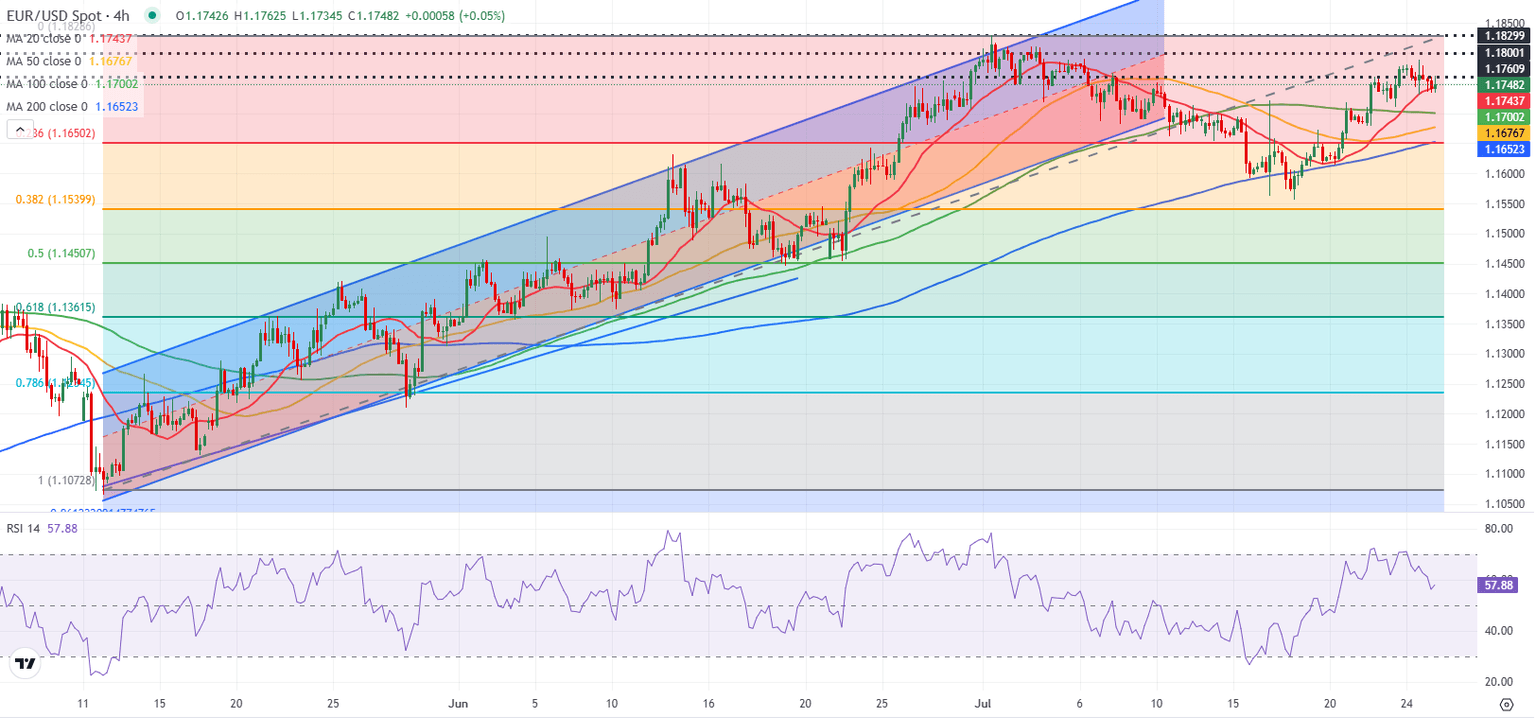
EUR/USD manages to hold slightly above the 20-period Simple Moving Average (SMA) on the 4-hour chart and the Relative Strength Index (RSI) indicator stays near 60, reflecting a lack of bearish pressure.
On the upside, 1.1760 (static level) aligns as an interim resistance level before 1.1800 (static level, round level), 1.1830 (multi-year high set in early July) and 1.1900 (static level, round level). Looking south, the first support level could be spotted at 1.1700 (100-period SMA) before 1.1650 (Fibonacci 23.6% retracement level of the latest uptrend, 200-period Simple Moving Average) and 1.1600 (static level, round level).
ECB FAQs
The European Central Bank (ECB) in Frankfurt, Germany, is the reserve bank for the Eurozone. The ECB sets interest rates and manages monetary policy for the region. The ECB primary mandate is to maintain price stability, which means keeping inflation at around 2%. Its primary tool for achieving this is by raising or lowering interest rates. Relatively high interest rates will usually result in a stronger Euro and vice versa. The ECB Governing Council makes monetary policy decisions at meetings held eight times a year. Decisions are made by heads of the Eurozone national banks and six permanent members, including the President of the ECB, Christine Lagarde.
In extreme situations, the European Central Bank can enact a policy tool called Quantitative Easing. QE is the process by which the ECB prints Euros and uses them to buy assets – usually government or corporate bonds – from banks and other financial institutions. QE usually results in a weaker Euro. QE is a last resort when simply lowering interest rates is unlikely to achieve the objective of price stability. The ECB used it during the Great Financial Crisis in 2009-11, in 2015 when inflation remained stubbornly low, as well as during the covid pandemic.
Quantitative tightening (QT) is the reverse of QE. It is undertaken after QE when an economic recovery is underway and inflation starts rising. Whilst in QE the European Central Bank (ECB) purchases government and corporate bonds from financial institutions to provide them with liquidity, in QT the ECB stops buying more bonds, and stops reinvesting the principal maturing on the bonds it already holds. It is usually positive (or bullish) for the Euro.
Premium
You have reached your limit of 3 free articles for this month.
Start your subscription and get access to all our original articles.
Author
Eren Sengezer
FXStreet
As an economist at heart, Eren Sengezer specializes in the assessment of the short-term and long-term impacts of macroeconomic data, central bank policies and political developments on financial assets.