EUR/USD Forecast: Euro nears break above 1.20, reasons to rise and levels to watch
- EUR/USD is trading close to 1.20, fueled by several encouraging factors.
- New German forecasts and the ISM Manufacturing PMI are awaited.
- Tuesday's four-hour chart is pointing to mildly overbought conditions, while the daily chart shows the next levels to watch.

Who said September is a bad month in markets? The back-to-school month has kicked off with an extension of previous trends – higher stocks and a fall in the dollar.
The main upside driver is the Federal Reserve. The world's most powerful central bank announced it would prioritize reaching full employment at the expense of higher inflation – implying zero interest rates for even longer than previously thought. The Fed's new policy framework has no immediate policy implications but certainly underpins stocks and weighs on the dollar.
Federal Reserve Vice-Chair Richard Clarida – one of the architects of the new policy – clarified that the Fed is currently not considering new measures such as Yield Curve Control or negative borrowing costs in the near future. Staying on the sidelines makes sense after the immense stimulus enacted by the bank earlier this year and the upcoming elections.
However, politics could push the Fed into more action. Democrats and Republicans remain entrenched in their positions about the next fiscal stimulus bill. Some of the coronavirus-related emergency measures lapsed at the end of July and are slowing the recovery. If lawmakers continue dithering, the Fed may step in with more measures.
The ISM Manufacturing Purchasing Managers' Index for August will shed some light on how the world's largest economy is doing – and serve as the first hint toward Friday's jobs report. The headline is forecast to point to growth while the employment component is likely to contract once again.
More Markets are Fed-dependent as ever, reaction to elections could surprise – Interview with Lior Cohen
EUR/USD's rise is also driven by factors outside America. China's independent Caixin Manufacturing PMI beat estimates with 53.1 points in August, showing that the Asian giant continues recovering from the COVID-19 fallout. AstraZeneca, a British pharmaceutical firm, announced the beginning of a broad and 50,000-strong test for its coronavirus vaccine candidate.
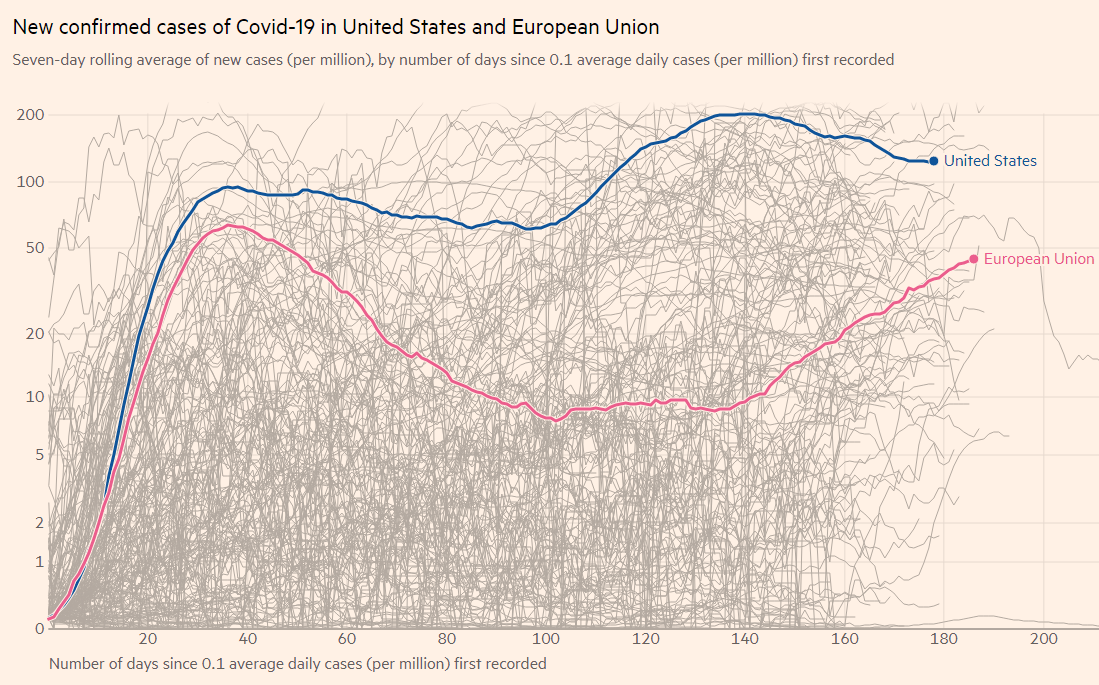
Back in the old continent, manufacturing PMIs are set to show moderate growth in August, with the exception of France, where the initial read came out at 49, reflecting contraction. COVID-19 cases are rising quickly in the eurozone's second-largest economy. Concerns are rising about the fourth-largest, Spain.
As the chart shows, cases are rising in Europe and declining in the US:
Source: FT
In the meantime, Europe's locomotive Germany is powering forward. Economy Minister Peter Altmaier is set to publish an upgraded growth forecast. Reports of the expected announcement are already underpinning the euro.
Overall, the wind is blowing against the dollar and mostly in favor of the euro. Concerns about European COVID-19 cases – brewing in the background – could change that bias, but that may take time.
EUR/USD Technical Analysis
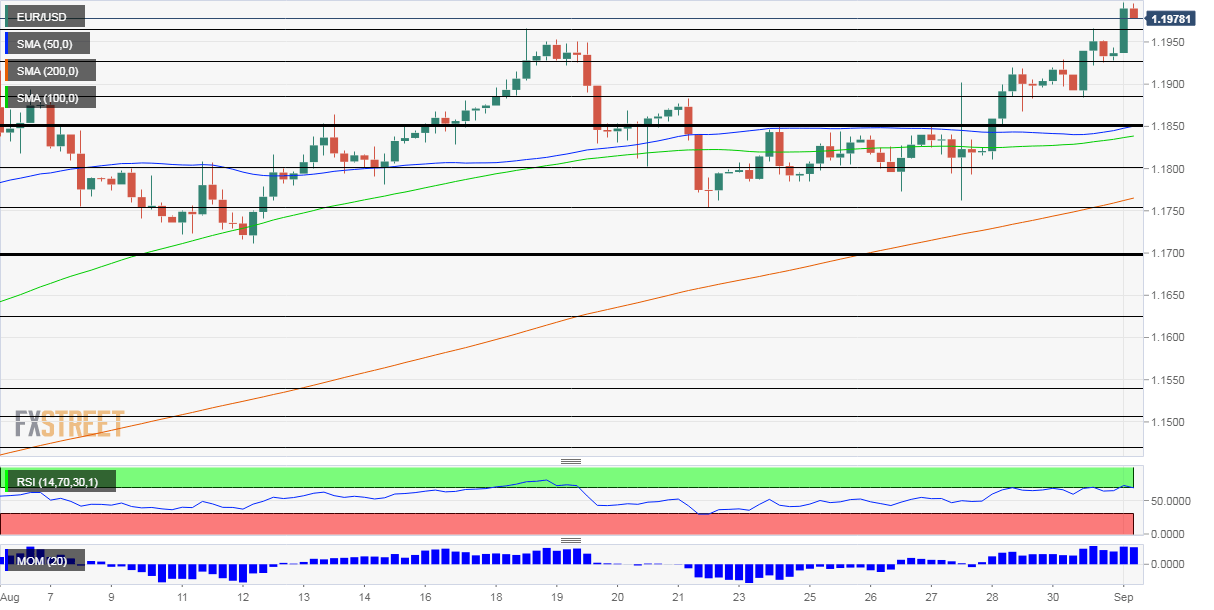
Euro/dollar is benefiting from upside momentum on the four-hour chart and is trading above the 50, 100, and 200 Simple Moving Averages. On the other hand, the Relative Strength Index is around 70 – indicating overbought conditions.
Support is at 1.1965, the mid-August peak, and it is followed by 1.1930, a separator of ranges. Further down, 1.1880 provided some support and a critical line to watch is 1.1850 – which was a stubborn cap and also where the 50 SMA hits the price.
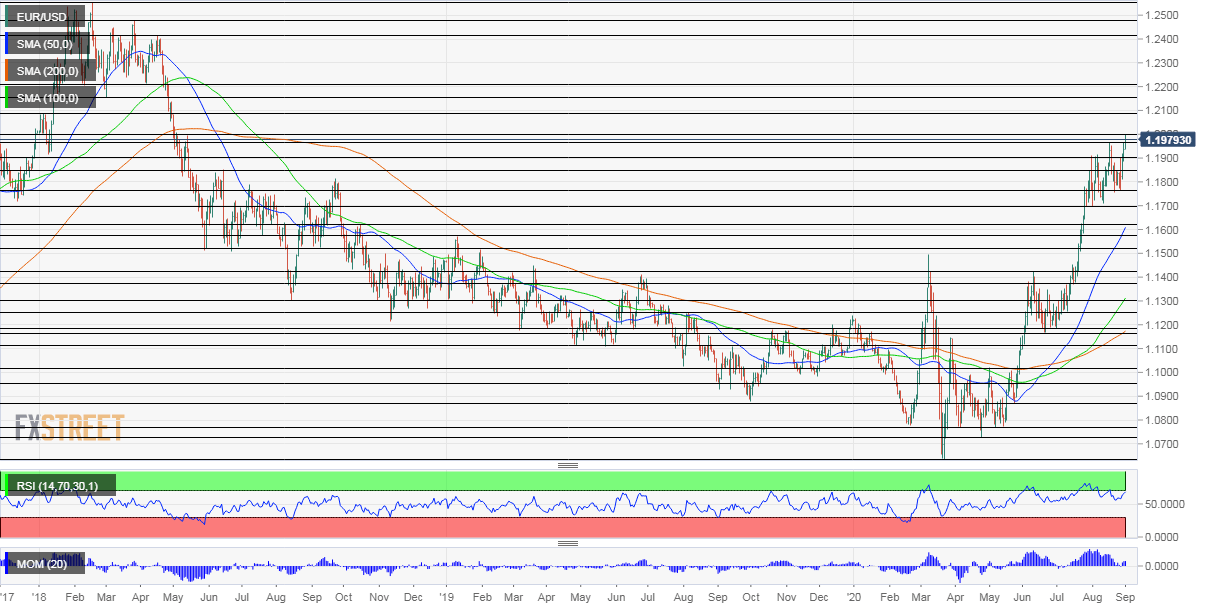
Clear resistance is at 1.20 – a psychologically level that also held EUR/USD back in 2018. To look for higher levels, the daily chart comes handy.
The next level to watch is 1.2090, which capped the currency pair in late 2017. It is followed by 1.2160, a support line from early 2018. The next level to watch is 1.2210, a support line from later in 2018 when EUR/USD traded at higher ground.
The RSI on the daily chart is below 70, allowing for more rises.
More Markets are Fed-dependent as ever, reaction to elections could surprise – Interview with Lior Cohen
Author

Yohay Elam
FXStreet
Yohay is in Forex since 2008 when he founded Forex Crunch, a blog crafted in his free time that turned into a fully-fledged currency website later sold to Finixio.















