EUR/USD Forecast: Euro looks to extend consolidation
- EUR/USD trades in a narrow channel below 1.0800 on Wednesday.
- The near-term technical outlook suggests that the bearish bias remains unchanged.
- 1.0730 aligns as a key technical support level for the pair.

EUR/USD struggled to gather recovery momentum and closed marginally lower on Tuesday. The pair stays relatively quiet early Wednesday and fluctuates in a narrow band below 1.0800.
Euro PRICE This week
The table below shows the percentage change of Euro (EUR) against listed major currencies this week. Euro was the weakest against the Australian Dollar.
| USD | EUR | GBP | JPY | CAD | AUD | NZD | CHF | |
|---|---|---|---|---|---|---|---|---|
| USD | 0.24% | 0.17% | 0.60% | -0.70% | -0.70% | -0.37% | 0.05% | |
| EUR | -0.24% | -0.18% | -0.15% | -0.90% | -0.95% | -0.55% | -0.14% | |
| GBP | -0.17% | 0.18% | 0.41% | -1.35% | -0.81% | -0.37% | -0.07% | |
| JPY | -0.60% | 0.15% | -0.41% | -1.29% | -1.32% | -0.93% | -0.55% | |
| CAD | 0.70% | 0.90% | 1.35% | 1.29% | 0.05% | 0.35% | 0.76% | |
| AUD | 0.70% | 0.95% | 0.81% | 1.32% | -0.05% | 0.41% | 0.80% | |
| NZD | 0.37% | 0.55% | 0.37% | 0.93% | -0.35% | -0.41% | 0.48% | |
| CHF | -0.05% | 0.14% | 0.07% | 0.55% | -0.76% | -0.80% | -0.48% |
The heat map shows percentage changes of major currencies against each other. The base currency is picked from the left column, while the quote currency is picked from the top row. For example, if you pick the Euro from the left column and move along the horizontal line to the US Dollar, the percentage change displayed in the box will represent EUR (base)/USD (quote).
Disappointing consumer sentiment data from the US limited the US Dollar's (USD) gains on Tuesday, helping EUR/USD find support. The Conference Board's Consumer Confidence Index fell to its lowest level since February 2021 at 92.9. The Expectations Index of the survey—which gauges short-term outlooks for income, business, and employment—tumbled 9.6 points to 65.2.
Early Wednesday, the cautious market stance doesn't allow EUR/USD to gain traction. In the second half of the day, the US Census Bureau will publish Durable Goods Orders data for February.
A significant negative surprise could hurt the USD with the immediate reaction. Conversely, the USD is likely to stay resilient against its rivals on an upbeat reading.
Several Federal Reserve (Fed) policymakers will be delivering speeches in the American session. According to the CME FedWatch Tool, markets are currently pricing in about a 90% probability of the Fed leaving the policy rate unchanged in May. Hence, the market positioning suggests that the USD doesn't have a lot of room left on the upside, even if policymakers deliver hawkish remarks.
EUR/USD Technical Analysis
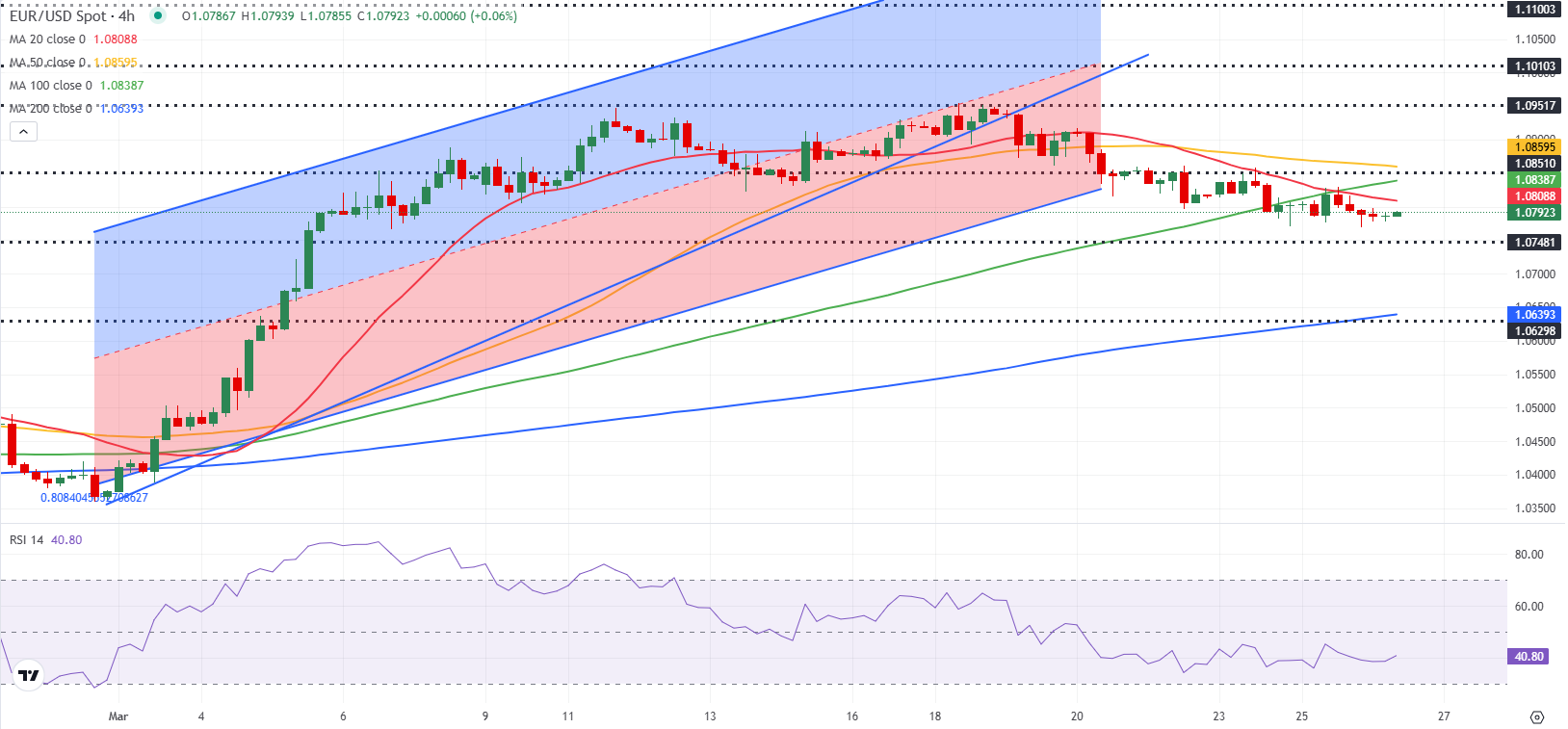
The Relative Strength Index (RSI) indicator on the 4-hour chart moves sideways near 40, reflecting a lack of buyer interest.
On the downside, the 20-day Simple Moving Average (SMA) aligns as interim support at 1.0770 before 1.0730 (200-day SMA). A daily close below the latter could attract technical sellers and open the door for an extended slide toward 1.0630-1.0640 (static level, 200-period SMA).
Looking north, first resistance could be spotted at 1.0800 (static level, round level) ahead of 1.0840-1.0850 (100-period SMA, static level) and 1.0900 (static level, round level).
Economic Indicator
Durable Goods Orders
The Durable Goods Orders, released by the US Census Bureau, measures the cost of orders received by manufacturers for durable goods, which means goods planned to last for three years or more, such as motor vehicles and appliances. As those durable products often involve large investments they are sensitive to the US economic situation. The final figure shows the state of US production activity. Generally speaking, a high reading is bullish for the USD.
Read more.Next release: Wed Mar 26, 2025 12:30
Frequency: Monthly
Consensus: -1%
Previous: 3.1%
Source: US Census Bureau
Author

Eren Sengezer
FXStreet
As an economist at heart, Eren Sengezer specializes in the assessment of the short-term and long-term impacts of macroeconomic data, central bank policies and political developments on financial assets.