EUR/USD Forecast: Euro lacks direction heading into the new year
- EUR/USD stabilized below 1.1100 following Thursday's downward correction.
- Euro is up more than 3% against the US Dollar this year.
- ECB-Fed monetary policy divergence could drive the pair's action in the new year.

EUR/USD reversed its direction and registered daily losses after touching its highest level since late July at 1.1140 on Thursday. The pair trades in a tight channel below 1.1100 early Friday and it might have a difficult time finding direction, with trading conditions thinning out on the last trading day of the year.
The modest recovery seen in the US Treasury bond yields helped the US Dollar (USD) stay resilient against its rivals on Thursday and caused EUR/USD to stretch lower during the American trading hours. Nevertheless, EUR/USD remains on track to post gains for the third straight week and it's up more than 1.5% in December.
Euro price this year
The table below shows the percentage change of Euro (EUR) against listed major currencies this year. Euro was the strongest against the Japanese Yen.
| USD | EUR | GBP | CAD | AUD | JPY | NZD | CHF | |
| USD | -3.19% | -5.46% | -2.54% | -0.55% | 7.17% | -0.02% | -9.77% | |
| EUR | 3.08% | -2.63% | 1.00% | 2.87% | 10.02% | 3.24% | -6.62% | |
| GBP | 5.15% | 2.56% | 3.53% | 5.36% | 12.33% | 5.13% | -4.10% | |
| CAD | 2.48% | -1.02% | -2.80% | 1.89% | 9.47% | 1.69% | -7.06% | |
| AUD | 0.55% | -2.97% | -5.66% | -1.97% | 7.36% | 0.38% | -9.19% | |
| JPY | -7.73% | -11.16% | -13.60% | -10.03% | -7.95% | -8.18% | -18.63% | |
| NZD | 0.03% | -3.15% | -5.44% | -2.53% | -0.38% | 7.02% | -10.27% | |
| CHF | 8.71% | 6.26% | 4.00% | 7.21% | 8.43% | 15.67% | 8.89% |
The heat map shows percentage changes of major currencies against each other. The base currency is picked from the left column, while the quote currency is picked from the top row. For example, if you pick the Euro from the left column and move along the horizontal line to the Japanese Yen, the percentage change displayed in the box will represent EUR (base)/JPY (quote).
In 2023, the Euro gained over 3% against the USD after starting the year at around 1.0700. In early 2024, the monetary policy divergence between the European Central Bank (ECB) and the Federal Reserve (Fed) could drive the pair's action.
Although the US economy is seemingly in a better place than the European economy, markets expect the Fed to pivot its policy by lowering the interest rate by 25 basis points as early as March. According to the CME Group FedWatch Tool, markets are currently pricing in a more than 85% probability that the Fed will cut the policy rate to 5%-5.25% in March.
On the other hand, ECB officials made it clear that they need to see more progress on wage inflation before considering rate reductions. Several policymakers noted that a policy shift was unlikely until June.
In the first couple of months of 2024, inflation and jobs data could shape the Fed and the ECB's policy outlooks.
EUR/USD Technical Analysis
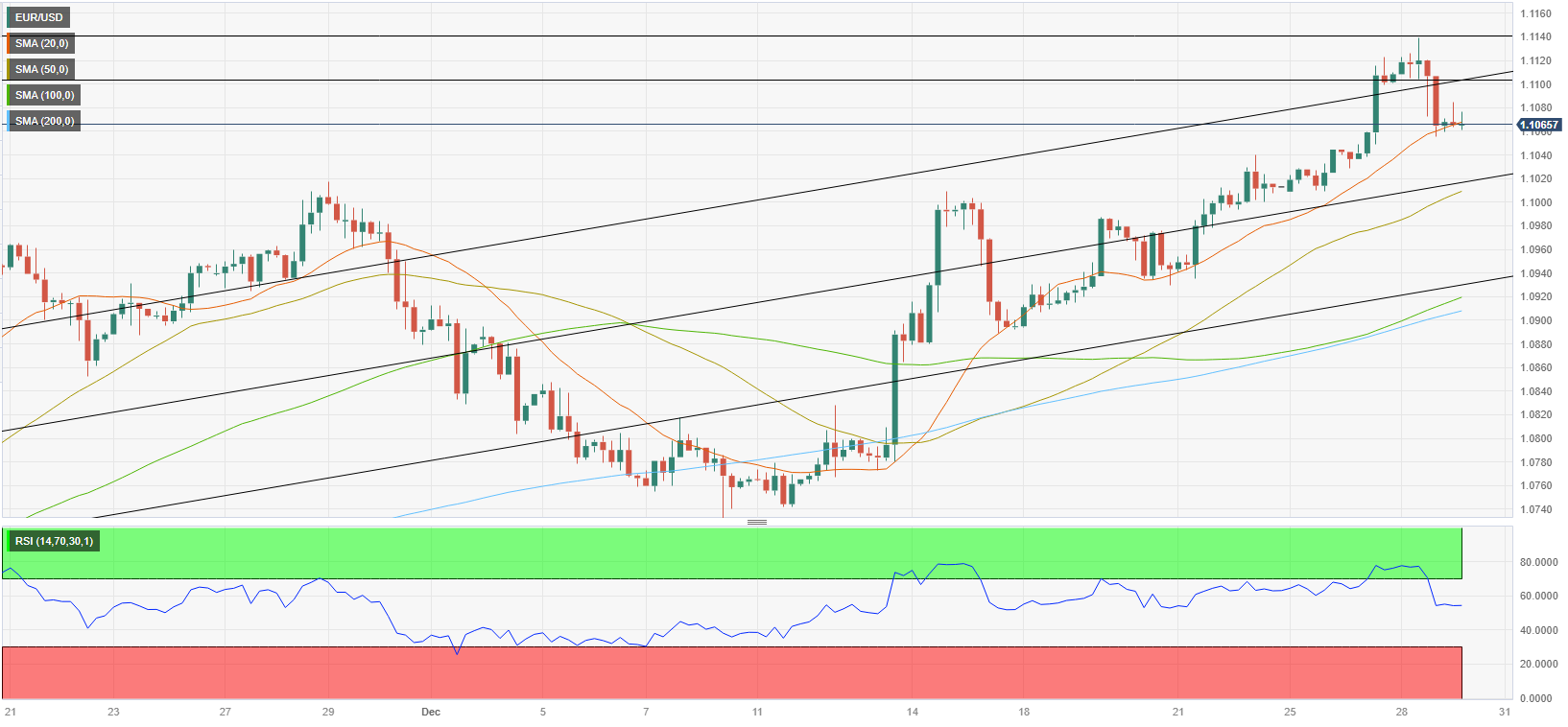
EUR/USD returned within the ascending regression channel and the Relative Strength Index (RSI) indicator on the 4-hour chart turned flat slightly above 50 after rising toward 80 on Thursday. These technical developments suggest that the pair's latest decline was a technical correction and the bullish bias remains intact in the short-term.
On the upside, 1.1100 (psychological level, upper limit of the ascending channel) aligns as first resistance before 1.1140 (static level) and 1.1200 (psychological level, static level).
1.1030 (mid-point of the ascending channel) could be seen as first support before 1.1000 (psychological level, static level) and 1.0940 (lower limit of the ascending channel).
Author

Eren Sengezer
FXStreet
As an economist at heart, Eren Sengezer specializes in the assessment of the short-term and long-term impacts of macroeconomic data, central bank policies and political developments on financial assets.

















