EUR/USD Forecast: Euro could extend correction if 1.0820 support fails
- EUR/USD has lost its traction after having renewed multi-week highs above 1.0900.
- Additional losses could be witnessed in case 1.0820 turns into resistance.
- S&P Global will release PMI surveys for Germany, the Eurozone and the US.

EUR/USD has reversed its direction and declined below 1.0850 after having reached its highest level since early February at 1.0930 on Thursday. The pair's near-term technical outlook points to a loss of bullish momentum ahead.
The broad-based selling pressure surrounding the US Dollar in the first half of the day on Thursday fueled EUR/USD's rally. During the American trading hours, however, the pair lost its traction as Wall Street's main indexes retreated from session highs, helping the USD limit its losses.
Early Friday, US stock index futures trade virtually unchanged on the day, pointing to a neutral risk mood.
Meanwhile, European Central Bank (ECB) policymaker Klaas Knot said on Thursday that he was expecting one more rate hike in May. "Inflation risks are clearly tilted to upside; second round wage effects are increasingly visible," Knot added. As the divergence between the Federal Reserve's and the ECB's outlook become more apparent, EUR/USD's downside is likely to remain as technical corrections, at least in the near term.
S&P Global will release the preliminary March PMI surveys for Germany, the Eurozone and the US. Composite PMIs for all three are expected to stay in expansion territory slightly above 50.
Market participants are likely to pay close attention to comments on wage inflation, especially in the service sector. In case the data for Germany and the Eurozone confirm Knot's comments on wage developments, the Euro could stay resilient against its rivals.
On the other hand, the USD is likely to gather strength ahead of the weekend if PMI surveys point out to an acceleration in salary increases in the private sector. Nevertheless, the market positioning regarding the next Fed policy action is unlikely to be impacted in a significant way, suggesting that the reaction should remain short lived. As of writing, the CME Group FedWatch Tool's probability for one more 25 bps Fed rate hike in May stands at 33.5%.
EUR/USD Technical Analysis
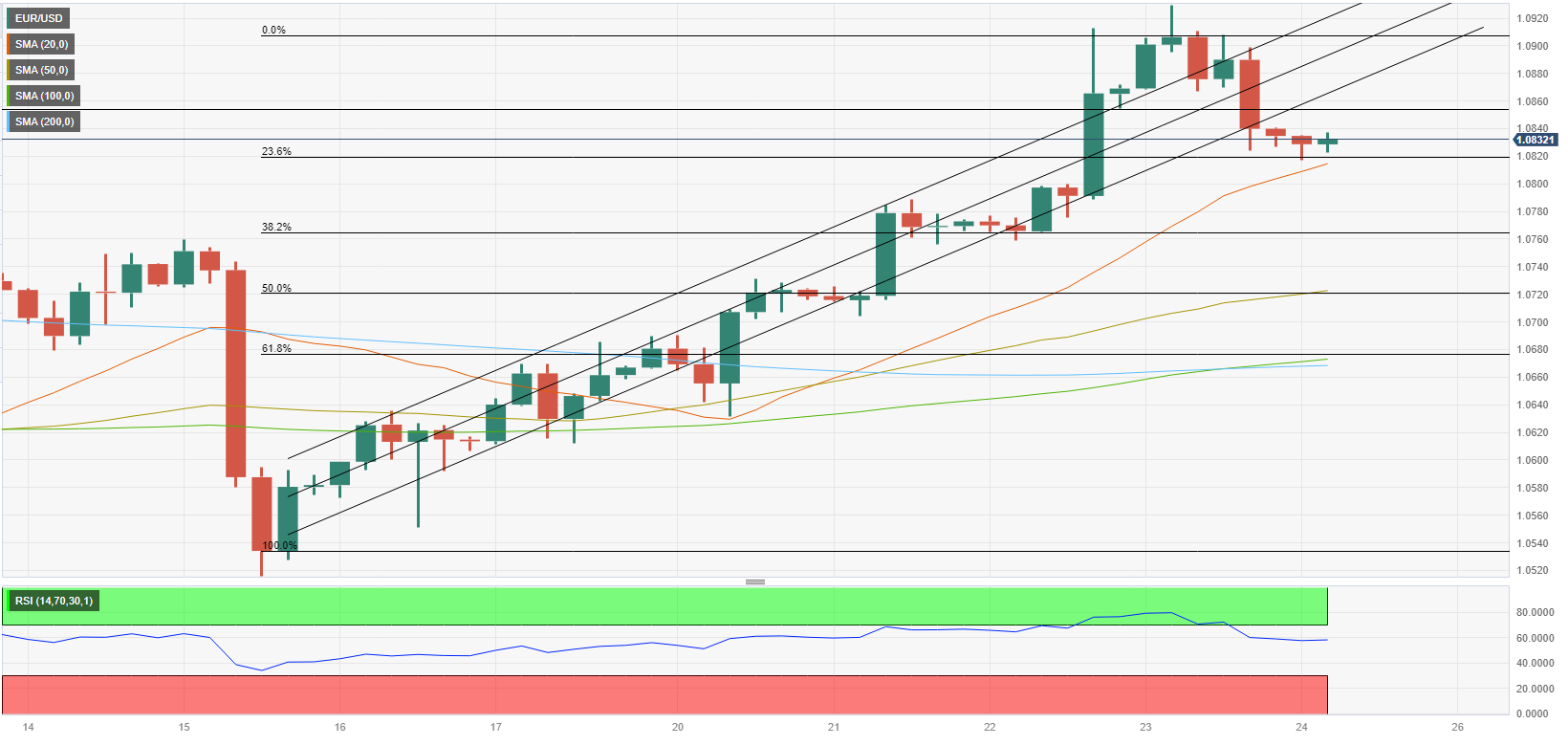
EUR/USD broke below the ascending regression channel and the Relative Strength Index (RSI) indicator on the four-hour chart declined slightly below 60 after having stayed in overbought territory early Thursday, suggesting that buyers have moved to the sidelines.
On the downside, 1.0820 (Fibonacci 23.6% retracement of the latest uptrend, 20-period Simple Moving Average (SMA)) aligns as immediate support. In case the pair falls below that level and starts using it as resistance, the downward correction could extend toward 1.0760 (Fibonacci 38.2% retracement) and 1.0720 (50-period SMA).
First resistance is located at 1.0850 (static level) ahead 1.0900 (psychological level, static level) and 1.0930 (multi-week high set on Thursday).
Author

Eren Sengezer
FXStreet
As an economist at heart, Eren Sengezer specializes in the assessment of the short-term and long-term impacts of macroeconomic data, central bank policies and political developments on financial assets.
















