|

EUR/USD Forecast: Dollar picks up as Treasury yields resume advance

EUR/USD Current Price: 1.2050

  • ECB reportedly said to see no need for drastic action to combat rising bond yields.
  • Markit reported that services output decline for a sixth consecutive month in the EU.
  • EUR/USD is under selling pressure and could pierce the 1.2000 figure.
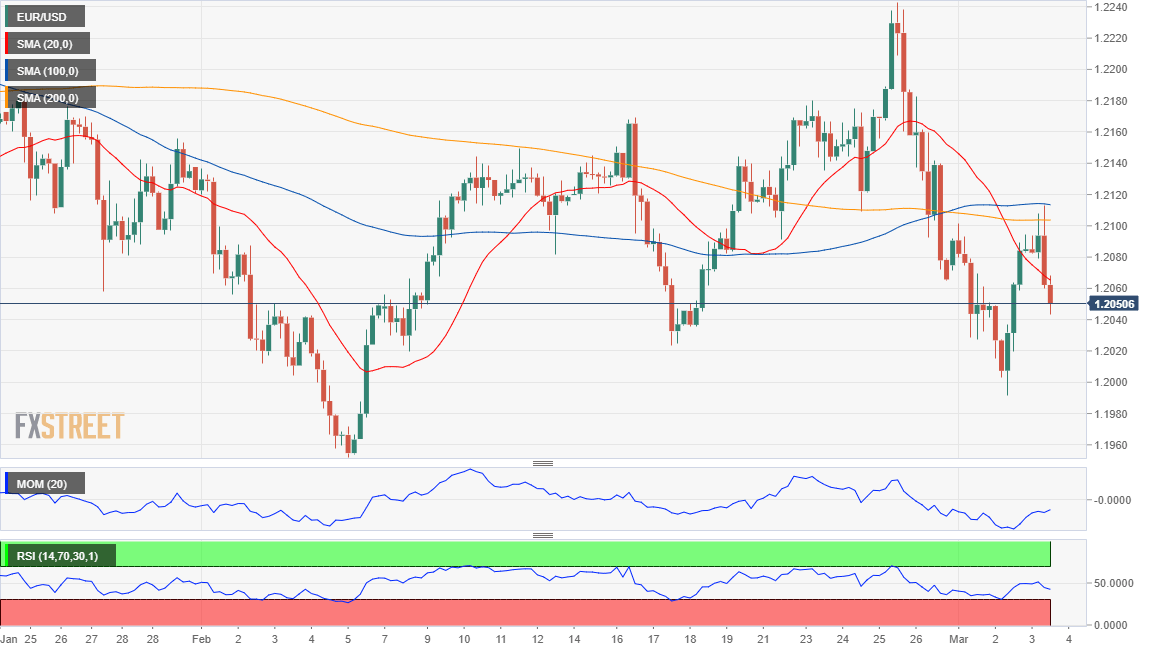
The EUR/USD pair reached 1.2112 but is quickly retreating ahead of the US opening, with the dollar once again founding demand amid higher government bond yields. The pair hit the mentioned daily high after news made the rounds, indicating that the ECB reportedly said that they see no need for drastic action to combat rising bond yields. The same headline boosted US Treasury yields to fresh weekly highs, with that on the 10-year note at fresh weekly highs around 1.47%.

Markit published the February final Services PMIs for the euro area, which showed that output in the sector remained in contraction territory, declining for the sixth consecutive month. The German index was downwardly revised to 45.7, although the final EU figure printed at 45.7, slightly better than previously estimated.

The US has just published the ADP survey on private jobs creation. The report showed that 117K positions were added in February, below the expected 177K. January reading was upwardly revised to 195K from 174K. Markit will also publish the US Services PMI, foreseen at 58.9, while the country will release the official ISM services index, expected at 58.7.

EUR/USD short-term technical outlook

The EUR/USD pair trades in the 1.2050 price zone, poised to extend its decline. The 4-hour chart shows that it met sellers around its 100 and 200 SMA, now back below a bearish 20 SMA. Technical indicators turned south and are back within negative levels indicating increased bearish interest. Further declines are to be expected on a break below 1.2015, the immediate support.

Support levels: 1.2015 1.1970 1.1920

Resistance levels: 1.2065 1.2100 1.2145

View Live Chart for the EUR/USD

Author

Valeria Bednarik

Valeria Bednarik was born and lives in Buenos Aires, Argentina. Her passion for math and numbers pushed her into studying economics in her younger years.


More from Valeria Bednarik
Share:

Editor's Picks

AUD/USD bulls regain control above 0.6950 amid USD retreat

AUD/USD regains traction and extends the previous day's bounce from the weekly low, aiming for 0.7000 in Asia on Friday. The overnight pullback in US bond yields keeps the US Dollar below an 18-month high, which in turn offers some support to the pair. Meanwhile, hawkish RBA expectations also keep the major underpinned.

USD/JPY holds gains near 158.00 after Japan's weak Household Spending data

USD/JPY clings to gains around 158.00 after data showed on Friday that Japan's Household Spending fell for the ninth straight month, undermining the Japanese Yen. Meanwhile, the US Dollar remains depressed as the overnight fall in US bond yields counters a hawkish Fed and geopolitical uncertainties, could cap any downside in the pair.

Gold remains range-bound below $4,200

Gold has given up some ground after an initial bullish attempt to reach weekly highs, returning to below the $4,200 mark per troy ounce on Friday. The US Dollar’s strong upside momentum, combined with rising US Treasury yields across the curve, seems to keep further gains in the yellow metal under scrutiny.

Week ahead: US CPI, France’s budget crisis and Q3 earnings to set the market tone
The US dollar held relatively strong this week, despite the disappointing US jobs report on October 2, which further decreased the probability of a back-to-back rate hike by the Fed at the upcoming gathering on October 28.
CFTC Report: Euro and Aussie shorts expand amid diverging signals

The week in one sentence: Euro and Australian Dollar shorts deepened in the week to October 6, while Yen longs rebuilt. In addition, Coffee buying continued, and Gold exposure remained elevated despite another price decline. Speculators turned more negative on the Euro, increasing the net exposure to around 99.3K contracts.

Has Bitcoin really escaped the macro forces it was built to fight?
Over 17 years ago, Satoshi Nakamoto designed Bitcoin (BTC) on the back of a global financial crisis as an alternative to the global monetary system outside the control of central banks, governments and traditional intermediaries. This raises a key question: has Bitcoin really become independent of the macroeconomic forces it was built to challenge?