EUR/USD Forecast: Buyers hesitate as key resistance stays intact ahead of Fed
- EUR/USD edges lower to the 1.1630 region in the European session on Wednesday.
- The pair failed to clear the key resistance level at 1.1660.
- The Fed is widely anticipated to lower the policy rate by 25 basis points.

After posting small gains for five consecutive days, EUR/USD loses its traction in the European morning on Wednesday and trades below 1.1650. The pair's near-term technical outlook highlights a loss of bullish momentum as investors await the Federal Reserve's (Fed) monetary policy announcements.
Euro Price Today
The table below shows the percentage change of Euro (EUR) against listed major currencies today. Euro was the weakest against the Australian Dollar.
| USD | EUR | GBP | JPY | CAD | AUD | NZD | CHF | |
|---|---|---|---|---|---|---|---|---|
| USD | 0.13% | 0.30% | -0.03% | -0.16% | -0.49% | -0.25% | 0.09% | |
| EUR | -0.13% | 0.17% | -0.18% | -0.29% | -0.61% | -0.38% | -0.04% | |
| GBP | -0.30% | -0.17% | -0.34% | -0.45% | -0.78% | -0.55% | -0.20% | |
| JPY | 0.03% | 0.18% | 0.34% | -0.16% | -0.44% | -0.20% | 0.14% | |
| CAD | 0.16% | 0.29% | 0.45% | 0.16% | -0.34% | -0.09% | 0.25% | |
| AUD | 0.49% | 0.61% | 0.78% | 0.44% | 0.34% | 0.24% | 0.58% | |
| NZD | 0.25% | 0.38% | 0.55% | 0.20% | 0.09% | -0.24% | 0.34% | |
| CHF | -0.09% | 0.04% | 0.20% | -0.14% | -0.25% | -0.58% | -0.34% |
The heat map shows percentage changes of major currencies against each other. The base currency is picked from the left column, while the quote currency is picked from the top row. For example, if you pick the Euro from the left column and move along the horizontal line to the US Dollar, the percentage change displayed in the box will represent EUR (base)/USD (quote).
The bullish opening in Wall Street, followed by a risk rally, highlighted a risk-positive market atmosphere and made it difficult for the US Dollar (USD) to find demand on Tuesday. Early Wednesday, US stock index futures trade mixed, reflecting a cautious mood, which caps EUR/USD's upside.
The Fed is widely anticipated to cut the policy rate by 25 basis points (bps) following the October policy meeting. In case Fed Chair Jerome Powell adopts a dovish tone in the post-meeting press conference, citing possibly worsening conditions in the labor market because of the government shutdown and softer-than-forecast inflation data for September, the USD could come under renewed selling pressure.
On the other hand, EUR/USD could continue to push lower if Powell refrains from committing to further policy easing because of the uncertainty created by the lack of data releases and heightened upside risks to inflation.
On Thursday, the European economic calendar will feature third-quarter Gross Domestic Product (GDP) growth figures for Germany and the Eurozone before the European Central Bank (ECB) announces monetary policy decisions.
EUR/USD Technical Analysis
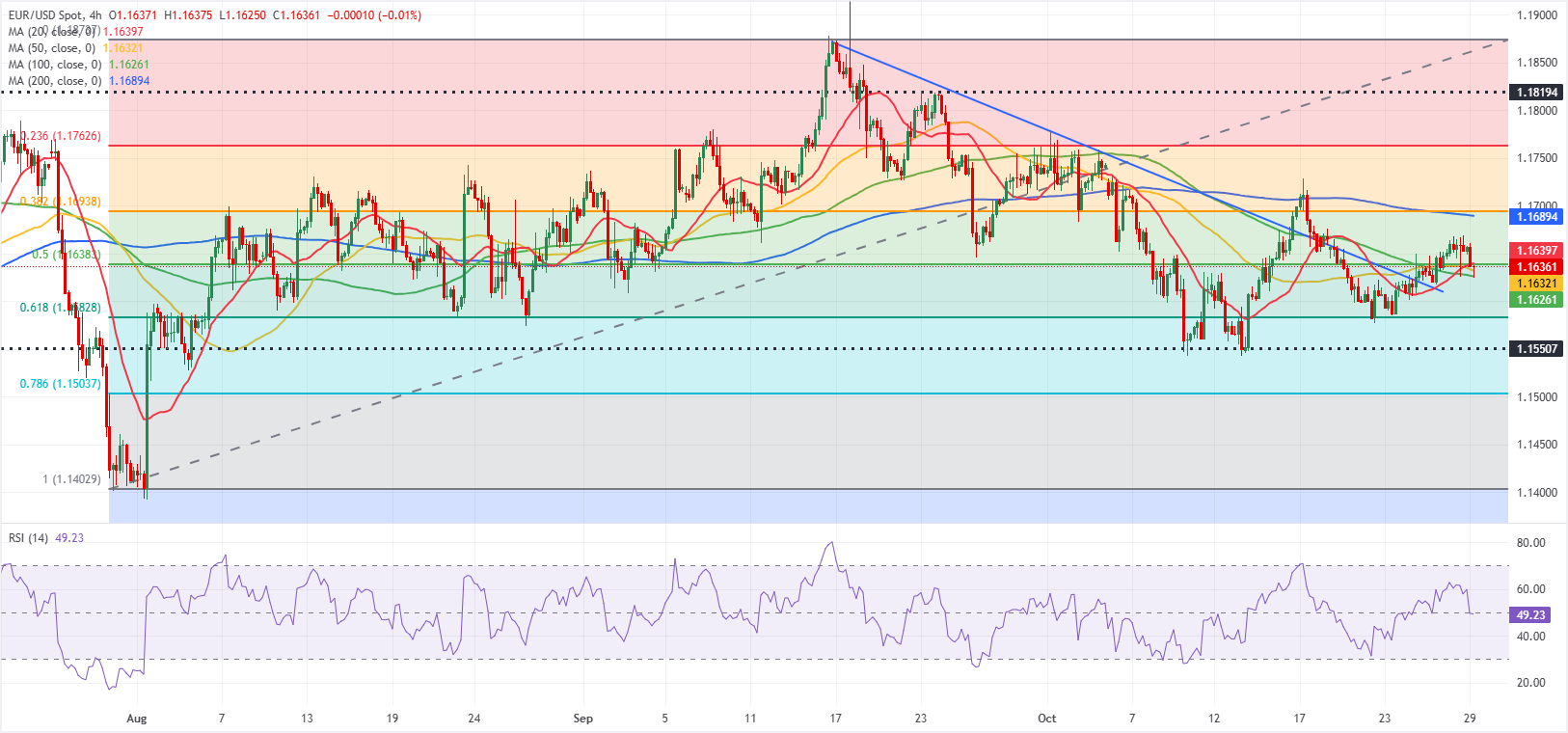
EUR/USD failed to clear 1.1660, where the 100-day Simple Moving Average (SMA) is located, and the Relative Strength Index (RSI) indicator on the 4-hour chart retreated slightly below 50, reflecting buyers' hesitancy.
On the downside, 1.1580 (Fibonacci 61.8% retracement of the latest uptrend), aligns as the next support level before 1.1550 (static level) and 1.1500 (Fibonacci 78.6% retracement). Looking north, resistance levels could be spotted at 1.1660 (100-day SMA), 1.1690-1.1700 (200-period SMA, Fibonacci 38.2% retracement) and 1.1760 (Fibonacci 23.6% retracement).
Fed FAQs
Monetary policy in the US is shaped by the Federal Reserve (Fed). The Fed has two mandates: to achieve price stability and foster full employment. Its primary tool to achieve these goals is by adjusting interest rates. When prices are rising too quickly and inflation is above the Fed’s 2% target, it raises interest rates, increasing borrowing costs throughout the economy. This results in a stronger US Dollar (USD) as it makes the US a more attractive place for international investors to park their money. When inflation falls below 2% or the Unemployment Rate is too high, the Fed may lower interest rates to encourage borrowing, which weighs on the Greenback.
The Federal Reserve (Fed) holds eight policy meetings a year, where the Federal Open Market Committee (FOMC) assesses economic conditions and makes monetary policy decisions. The FOMC is attended by twelve Fed officials – the seven members of the Board of Governors, the president of the Federal Reserve Bank of New York, and four of the remaining eleven regional Reserve Bank presidents, who serve one-year terms on a rotating basis.
In extreme situations, the Federal Reserve may resort to a policy named Quantitative Easing (QE). QE is the process by which the Fed substantially increases the flow of credit in a stuck financial system. It is a non-standard policy measure used during crises or when inflation is extremely low. It was the Fed’s weapon of choice during the Great Financial Crisis in 2008. It involves the Fed printing more Dollars and using them to buy high grade bonds from financial institutions. QE usually weakens the US Dollar.
Quantitative tightening (QT) is the reverse process of QE, whereby the Federal Reserve stops buying bonds from financial institutions and does not reinvest the principal from the bonds it holds maturing, to purchase new bonds. It is usually positive for the value of the US Dollar.
Author

Eren Sengezer
FXStreet
As an economist at heart, Eren Sengezer specializes in the assessment of the short-term and long-term impacts of macroeconomic data, central bank policies and political developments on financial assets.
















