|

EUR/USD Forecast: Bulls about to give up

EUR/USD Current Price: 1.1999

  • Tepid EU services-related figures weigh on the shared currency.
  • US employment sector continues to grow, according to a private-sector survey.
  • EUR/USD trades a few pips above a critical support level at 1.1980.
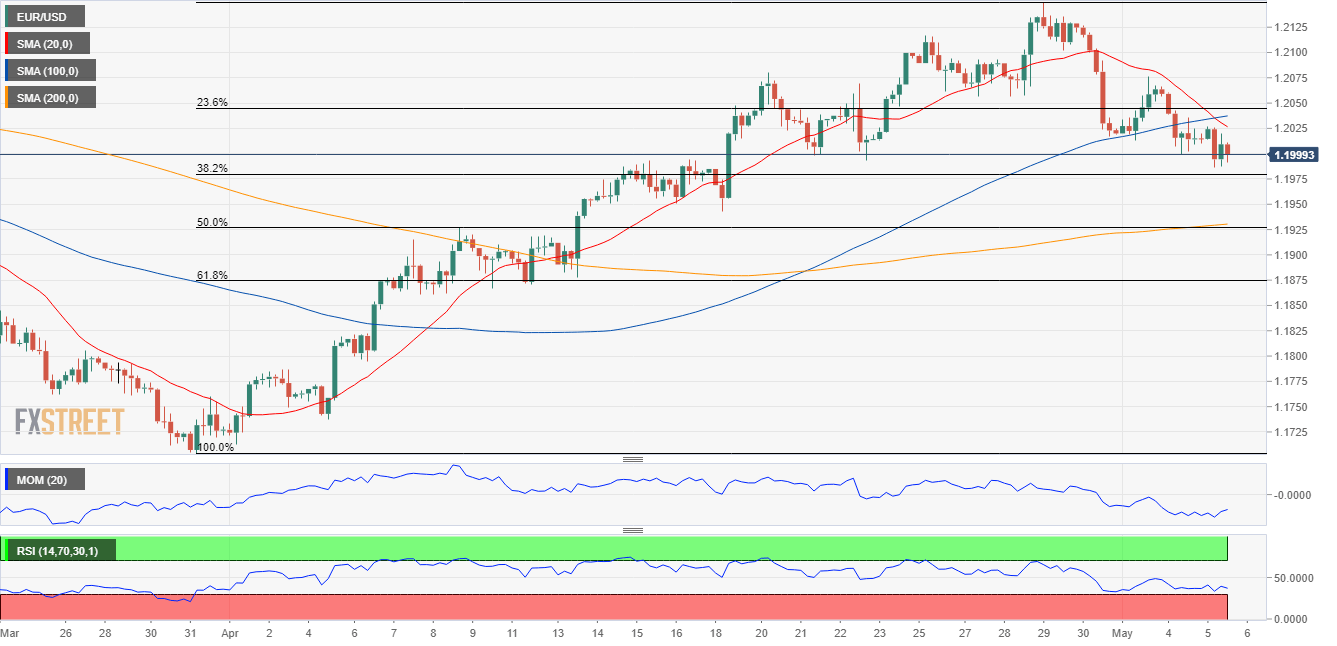
The EUR/USD pair hovers around the 1.2000 price zone, trading near a fresh weekly low of 1.1985. The greenback trades mixed across the board as investors struggle to make up their minds on whether the sentiment or economic comeback should weigh more.

The shared currency is suffering from soft local data, as the April final Markit Services PMI was downwardly revised in Germany to 49.9. The index for the whole EU, however, was confirmed at 50.5 vs the preliminary estimate of 50.3. The US has published the April ADP survey on private jobs’ creation, which improved from  565K to 742K, missing the expected 800K. The focus is now on the April ISM Services PMI, foreseen at 64.3.

EUR/USD short-term technical outlook

The EUR/USD pair trades a handful of pips above the 38.2% retracement of its latest daily advance at 1.1980, the immediate support level. The risk is skewed to the downside in the near-term, with a break below such a level likely confirming a bearish extension. In the 4-hour chart, the pair is trading below the 20 and 100 SMAs, with the shorter one about to cross below the longer one. Technical indicators lack clear directional strength but hold within negative levels.

Support levels: 1.1980 1.1940 1.1900

Resistance levels: 1.2045 1.2090 1.2130

View Live Chart for the EUR/USD

Author

Valeria Bednarik

Valeria Bednarik was born and lives in Buenos Aires, Argentina. Her passion for math and numbers pushed her into studying economics in her younger years.


More from Valeria Bednarik
Share:

Editor's Picks

AUD/USD stays defensive below 0.7150 after Chinese data

AUD/USD remains on the back foot below 0.7150 in the Asian session on Tuesday, close to an over three-week low touched the previous day. US bond yields hold near multi-year highs ahead of the FOMC meeting and oil-driven inflation risks, supporting the US Dollar and weighing on the currency pair. Mixed Chinese activity data for August also fail to inspire the Aussie.

USD/JPY extends gains toward 155.00 amid USD resurgence

USD/JPY keeps pushing higher toward 155.00 early Tuesday, looking for more upside, as traders await the FOMC and BoJ meetings this week. Meanwhile, Fed rate-hike bets and oil-driven inflation risks keep US bond yields near multi-year highs, supporting the US Dollar and the pair. That said, a more hawkish repricing of the BoJ normalization path might continue to underpin the Japanese Yen and could limit USD/JPY's upside. .

$4,275: Gold skating on thin ice as eyes remain on Mideast conflict, Fed

Gold is briefly regaining $4,300 early Tuesday, looking to build on a tepid recovery from six-week troughs near $4,250. Traders are monitoring the widening conflict in the Middle East ahead of the two-day US Federal Reserve monetary policy meeting later in the day.

Bitcoin remains volatile amid CLARITY Act vote – Zcash, Stellar rally

Bitcoin holds steady around $78,000 on Tuesday, sustaining its roughly 2% recovery from the previous day. Broader cryptocurrency market volatility remains elevated ahead of the scheduled CLARITY Act cloture vote on Tuesday. Zcash and Stellar retain bullish momentum, emerging as the top performers over the last 24 hours.

Hard assets are entering their next explosive phase – Are you positioned?
It’s official: Commodities and Hard Assets have become the best-performing asset class of 2026. In a year defined by persistent inflation, geopolitical conflict, rising sovereign debt and intensifying supply disruption, capital is rotating aggressively into the one area governments cannot print and central banks cannot manufacture: scarce physical assets.
Venezuela’s 65-billion-barrel Oil deal could reshape America’s inflation fight
The United States (US) has secured unprecedented access to part of Venezuela’s vast Oil reserves. The timing is particularly significant as the war with Iran is disrupting Middle Eastern supplies, keeping energy prices elevated and reviving concerns about inflation.















