|premium|

EUR/USD Forecast: Bullish levels to watch after devastating US data downs the dollar

  • EUR/USD has advanced after weak US GDP and jobless claims. 
  • The Fed's gloomy stance and Europe's coronavirus advantage may extend the pair's gains.
  • Thursday's four-hour chart is showing that bulls have room to run.

Better than expected but still the worst in history – the US economy fell by 32.9% annualized in the second quarter, better than -34.1% estimated but well within the wide range of expectations. 

In quarterly terms, the world's largest economy squeezed by 9.5% – and that is better than Germany's contraction of 10.1% recorded early in the day. Nevertheless, EUR/USD is rising.

Investors seem to look beyond the second quarter – which ended a month ago – and focus on recent data. Europe is suffering several COVID-19 flareups but is returning to growth. That cannot be said about the US, where weekly jobless claims increased once again.

Initial applications rose to 1.434 million and continuing claims are up above 17 million – in the week when Non-Farm Payrolls surveys are held. Even if America gains jobs in July, the prospects are dim as the death toll from the disease is rising. 

For the full explanation: US GDP Quick Analysis: Could have been worse, but will not improve, winners and losers in markets

EUR/USD has already topped the post-Fed high of 1.1806 and may be ready to extend its gains. New coronavirus figures from the US may weigh heavily on the dollar later in the day.

EUR/USD Technical Analysis
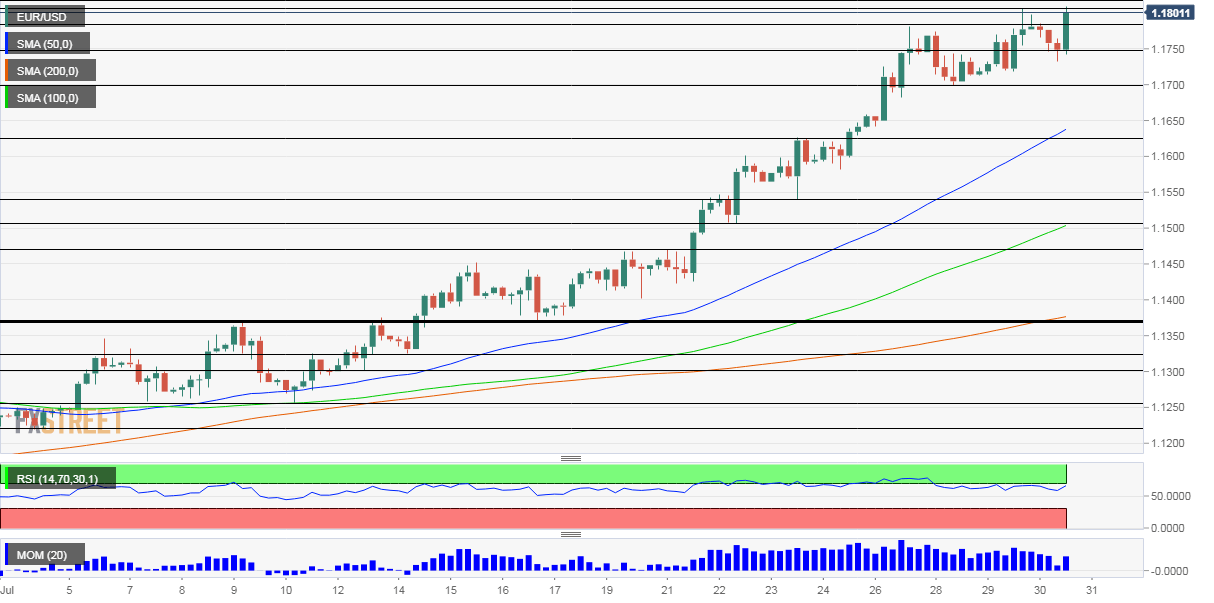
Despite the recent rally, the Relative Strength Index on the four-hour chart remains below the 70 level – outside overbought conditions and allowing the currency pair to continue rising. 

The next level to watch is 1.1820 – a high point in September 2018. Beyond that point, euro/dollar would hit the highest since June 2018 – a two-year peak. The next hurdles are 1.1850 and then only the psychologically significant 1.20 – but that would trigger overbought conditions if it happens too fast.

Momentum remains to the upside and EUR/USD holds above the 50, 100, and 200 Simple Moving Averages. 

Support awaits at 1.1780, 1.1750, and 1.17. 

Premium

You have reached your limit of 3 free articles for this month.

Start your subscription and get access to all our original articles.

Subscribe to PremiumSign In

Author

Yohay Elam

Yohay Elam

FXStreet

Yohay is in Forex since 2008 when he founded Forex Crunch, a blog crafted in his free time that turned into a fully-fledged currency website later sold to Finixio.


More from Yohay Elam
Share:

Editor's Picks

GBP/USD bounces off lows, back above 1.3200

After bottoming out near 1.3160, GBP/USD manages to regain a bit of shine and reclaim the 1.3200 mark and beyond at the end of the week. Stronger-than-expected UK Retail Sales data seem to be helping the British Pound limit its losses, while the chaotic UK political environment keeps the bulls at bay for now.

EUR/USD looks consolidative around 1.1460

EUR/USD stages a modest rebound after slipping to a three-month low below 1.1420 at the end of the week. That said, the pair now looks to consolidate humble gains just above 1.1460 despite growing uncertainty surrounding the next round of US-Iran negotiations, which keeps the US Dollar’s downside contained.

Gold slips back to six-day lows, targets $4,100

Gold retreats for the third consecutive day on Friday, eroding gains seen in the first half of the week and approaching the key $4,100 mark per troy ounce. Indeed, the precious metal continues to face headwinds from the Fed's hawkish stance and renewed uncertainty surrounding the next round of US-Iran negotiations.

Solana extends correction despite ETF inflows, RWA adoption

Solana (SOL) price edges below $70 extending its losses for the fourth straight day this week. The institutional demand for Solana is building, with steady inflows so far this week and Morgan Stanley’s amended S-1 filing for a Solana-focused Exchange-Traded Fund.

The Iran war didn't break the US economy, but what happens next?

Nearly four months after the start of the Iran war, the US economy remains remarkably resilient. While the conflict initially triggered a severe disruption to global energy markets and a sharp rise in Oil prices, recent diplomatic progress between Washington and Tehran has eased concerns about a prolonged supply shock.

Regime change: Inside Kevin Warsh's first move to make the Fed unreadable on purpose

The rate did not move. That was the least interesting thing about Kevin Warsh's first meeting in charge of the Fed. The FOMC held its benchmark at 3.50%-3.75% for the fourth straight meeting, exactly as priced, and then the new chair used his first press conference to dismantle the machinery the market has leaned on for a decade.














