EUR/USD Forecast: Bullish bias remains ahead of key inflation readings from Eurozone and US
- EUR/USD remains under some selling pressure for the second straight day on Thursday.
- Wednesday’s softer German inflation data exerts pressure amid a modest USD strength.
- Traders now look to the flash Eurozone CPI for some impetus ahead of the US PCE data.

The EUR/USD pair extends the previous day’s retracement slide from the 1.1015 area, or its highest level since August 10 and drifts lower for the second successive day on Thursday. The pair drops to the 1.0920 area during the early European session and is pressured by a combination of factors.
Data released on Wednesday showed that German inflation decelerated more than expected in November and fell to 2.3%, or its lowest level since June 2021. Furthermore, core inflation, which excludes volatile food and energy prices, eased to 3.8% in November from 4.3% the previous month, fuelling speculations that the European Central Bank (ECB) might cut interest rates next year. This, in turn, is seen undermining the shared currency. The US Dollar (USD), on the other hand, attracts some follow-through buying and recovers further from a three-and-half-month low touched on Wednesday. This, along with some repositioning trade ahead of the key inflation readings from the Eurozone and the US, turns out to be key factors exerting pressure on the EUR/USD pair.
The downside, however, seems cushioned as traders might refrain from placing aggressive bearish bets around the shared currency in the wake of the hawkish European Central Bank’. ECB Governing Council member Yannis Stournaras cautioned on Wednesday against premature bets on when interest rates will be lowered. This comes on top of minutes of the October ECB monetary meeting published last Thursday, which showed that the governing council is open to increasing interest rates further to safeguard price stability. Hence, the flash Eurozone CPI will play a key role in influencing the Euro and provide some impetus to the EUR/USD pair. The market attention will then shift to the US Personal Consumption Expenditures (PCE) data.
The core PCE Price Index, which is the Federal Reserve's (Fed) preferred benchmark for measuring long-term trends, will be looked upon for confirmation that inflation is slowing and might influence expectations when the central bank could start cutting rates in 2024. Some Fed officials recently suggested that loosening may come earlier if inflation continued to decline. Fed Governor Christopher Waller on Tuesday flagged a possible rate cut in the months ahead. Furthermore, Atlanta Fed President Rafael Bostic on Wednesday said that he believes inflation is coming down. Adding to this, Cleveland Fed President Loretta Mester saw clear progress in getting inflation back to the 2% target, reinforcing speculations that interest rates in the US have peaked.
Moreover, the current market pricing suggests that the Fed may begin easing its monetary policy as early as March 2024. Hence, the crucial inflation data will play a key role in driving the USD in the near term and provide some meaningful impetus to the EUR/USD pair. Heading into the key data risk, the disappointing release of Chinese PMI prints for November tempers investors' appetite for riskier assets and is seen acting as a tailwind for the safe-haven buck.
Technical Outlook
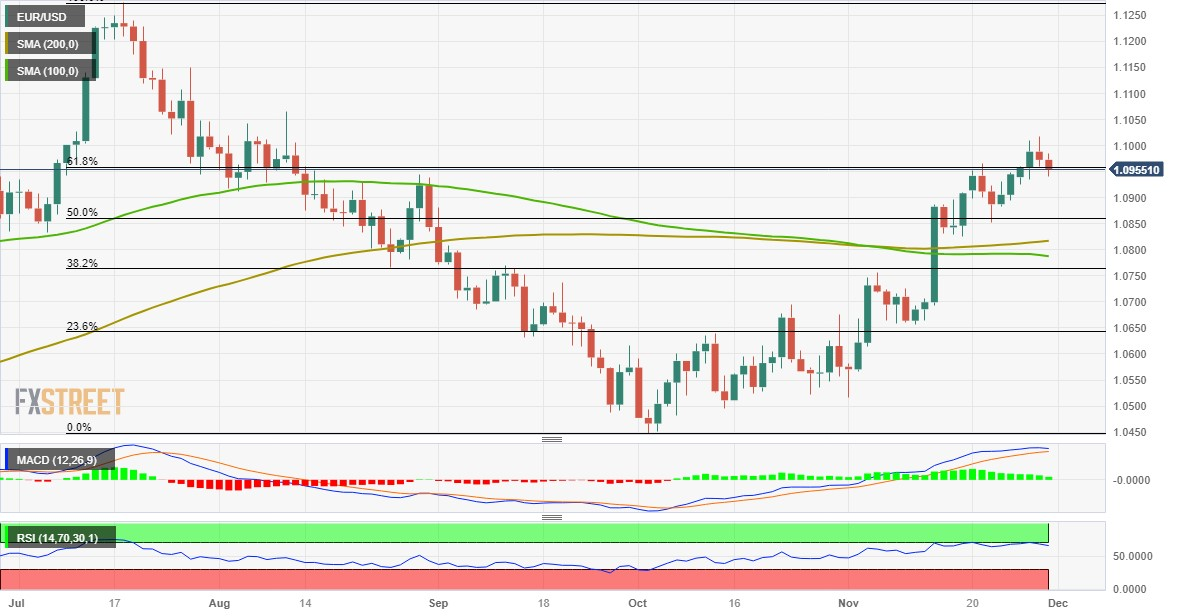
From a technical perspective, failure to capitalize on this week's breakout momentum through the 61.8% Fibonacci retracement level of the July-October downfall warrants some caution for bullish traders. That said, oscillators on the daily chart are holding comfortably in the positive territory. Moreover, the Relative Strength Index (RSI) on the said chart has eased from overbought conditions and supports prospects for the emergence of some dip-buying at lower levels. This, in turn, suggests that the EUR/USD pair is likely to find some support near the 1.0900 mark, which if broken should pave the way for a slide towards the 50% Fibo. level, around the 1.0860 region. Some follow-through selling might expose the 1.0770-1.0765 confluence, comprising the 100-day Simple Moving Average (SMA) and the 38.2% Fibo. level.
On the flip side, bulls might now wait for some follow-through buying and acceptance above the 1.1000 psychological mark before placing fresh bets. The EUR/USD pair might then accelerate the positive move and aim to test the August monthly swing high, around the 1.1065 area. The momentum could get extended further towards the 1.1100 round figure, above which spot prices could climb to the next relevant hurdle near the 1.1150 region (July 27 swing high).
Author

Haresh Menghani
FXStreet
Haresh Menghani is a detail-oriented professional with 10+ years of extensive experience in analysing the global financial markets.