EUR/USD Forecast: Bears maintain the pressure and look for fresh lows

EUR/USD Current price: 1.0811
- The US Dollar extends its post-Federal Reserve rally as a March cut is out of the table.
- The Eurozone confirmed the annual HICP rose 2.8% in January.
- EUR/USD keeps reaching lower lows, in line with another leg south.
The EUR/USD pair hovers around the 1.0800 figure, depressed amid broad US Dollar strength following the Federal Reserve (Fed) monetary policy announcement. The United States (US) central bank decided to leave the interest rate unchanged as widely anticipated. The Federal Open Market Committee (FOMC) statement suffered a large number of changes, dropping the wording related to additional rate hikes and replacing it to carefully assess upcoming data. Also, policymakers remarked they need to gain "greater confidence" that inflation is approaching its 2% goal before cutting rates.
Chairman Jerome Powell offered a press conference following the announcement, saying a March rate cut is not the base case. His words spurred USD demand and sent Wall Street into negative territory. Asian and European stocks partially shrugged off the dismal mood and traded mixed throughout the first half of the day.
Data-wise, the Eurozone unveiled the preliminary estimate of the January Harmonized Index of Consumer Prices (HICP). The annual HICP rose 2.8%, as expected, while the core annualized reading printed at 3.3%, easing from the previous 3.4% but above the 3.2% expected. Across the pond, the US released the January Challenger Job Cuts, which showed US-based employers announced 82,307 cuts in January, much higher than the 34,817 from December.
Later in the day, the country will publish Initial Jobless Claims for the week ended January 26, Q4 Unit Labor Costs and Nonfarm Productivity, and finally, the January ISM Manufacturing PMI. Employment-related figures are relevant ahead of Friday's Nonfarm Payrolls (NFP) report.
EUR/USD short-term technical outlook
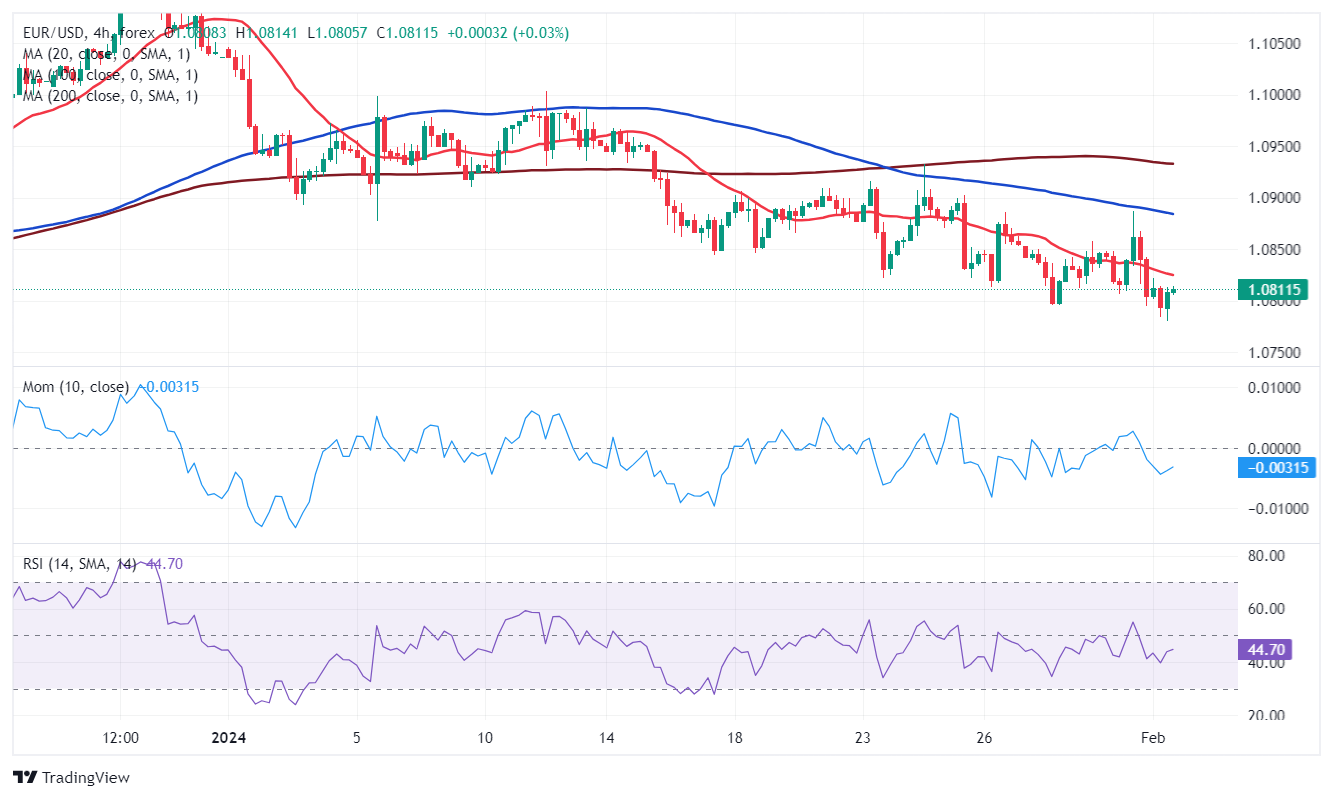
The EUR/USD pair bounced from an intraday low of 1.0779, still trading in the red. The daily chart shows the pair met buyers around a flat 100 Simple Moving Average (SMA) but remains below the 20 and 200 SMAs, with the shorter one maintaining its bearish slope. Technical indicators, in the meantime, head south within negative levels, supporting another leg south.
The 4-hour chart shows that technical indicators are recovering from their early lows, maintaining bullish slopes but still developing in negative territory, limiting the risk of further advances. At the same time, EUR/USD is developing below all its moving averages, which offer bearish slopes and reflect selling interest is still high.
Support levels: 1.0780 1.0745 1.0710
Resistance levels: 1.0845 1.0890 1.0930
Author

Valeria Bednarik
FXStreet
Valeria Bednarik was born and lives in Buenos Aires, Argentina. Her passion for math and numbers pushed her into studying economics in her younger years.