EUR/USD Forecast: Bears maintain the pressure, aim to pierce 1.0800

EUR/USD Current price: 1.0821
- European Central Bank policymakers maintain a cautious stance on rate cuts.
- The macroeconomic calendar is scarce on Monday but is packed this week.
- EUR/USD flirts with fresh January lows, could extend its slide towards 1.0760.
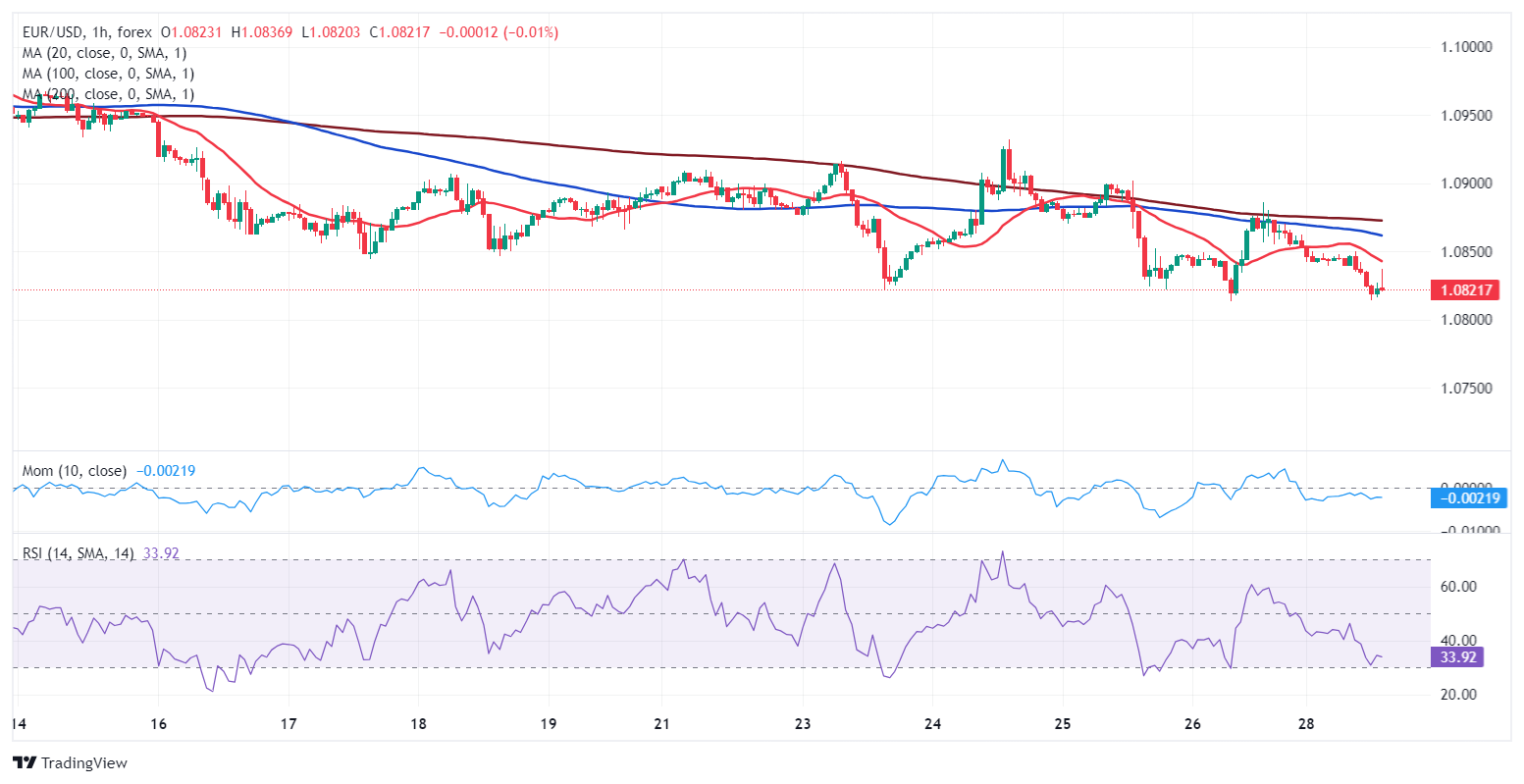
The Euro is the weakest US Dollar rival at the beginning of a new week, as the EUR/USD pair barely holds above the 1.0800 mark. Market participants are pushing bets of a 25 basis points (bps) rate cut in April higher, despite comments from European Central Bank (ECB) officials against such a move.
ECB Governing Council official Peter Kazimir said that a rate cut is more probable in June than in April, adding that signs of disinflation are positive but that there is not enough information to make a confident conclusion. Finally, he noted that the ECB is not behind the curve, it's the market getting ahead of events. Also, Vice-President of the ECB Luis de Guindos said that the central bank will cut rates when policymakers are sure inflation meets the 2% goal. As his colleague, de Guindos, remarked on the good progress in inflation but clarified they are not still there.
Meanwhile, the macroeconomic calendar has little to offer on Monday, with no data from the Eurozone and the United States (US) offering the January Dallas Fed Manufacturing Business Index. However, the week will be packed with first-tier events, including the Eurozone and Germany's Gross Domestic Product, the US Federal Reserve (Fed) monetary policy decision, and the January Nonfarm Payrolls report.
EUR/USD short-term technical outlook
The EUR/USD pair bounced modestly from a fresh January low of 1.0813, as broad US Dollar weakness prevents it from falling further. Technical readings in the daily chart support another leg south. EUR/USD is finding sellers around the 200 Simple Moving Average, located at around 1.0845. The former support has now become resistance. At the same time, the 20 SMA accelerates south above the longer one. Finally, technical indicators remain within negative levels, with neutral-to-bearish strength.
The near-term picture is also bearish. EUR/USD develops below all its moving averages, with the 20 SMA heading firmly south below the longer ones. At the same time, technical indicators develop below their midlines, gaining bearish strength in line with a downward extension, particularly on a break below the 1.0800 threshold.
Support levels: 1.0800 1.0760 1.0720
Resistance levels: 1.0845 1.0890 1.0945
Author

Valeria Bednarik
FXStreet
Valeria Bednarik was born and lives in Buenos Aires, Argentina. Her passion for math and numbers pushed her into studying economics in her younger years.