EUR/USD Forecast: Attempted recovery could get sold into on in the wake of dovish ECB outlook
- EUR/USD stages a modest recovery from a six-month low and is supported by a softer USD.
- The risk-on impulse turns out to be a key factor that prompts profit-taking around the buck.
- Bets for one more Fed rate hike in 2023 favour the USD bulls and might cap gains for the pair.
- The ECB’s dovish rate hike on Thursday also warrants caution before placing fresh bullish bets.


The EUR/USD pair attracts some buying on the last day of a new week and reverses a part of the previous day's downfall to a nearly six-month low touched in the aftermath of the dovish European Central Bank (ECB) rate decision. The ECB opted to hike rates for the 10th straight time, by 25 bps, taking its main rate to an all-time high level of 4% to counter stubbornly high inflation. In the accompanying monetary policy statement, the central bank sent a clear message that the 14-month-long policy tightening cycle could have reached its peak already. Furthermore, the downgrading of CPI and GDP growth forecasts for the coming years – 2024 and 2025 – reaffirmed expectations that further hikes may be off the table for now. The markets were quick to react and are now pricing in the possibility of a rate cut during the first half of 2024, which weighed heavily on the shared currency.
That said, the risk-on impulse prompts some profit-taking around the safe-haven US Dollar (USD), especially after the recent rally to the highest level since March, and assists the EUR/USD pair to edge higher heading into the European session on Friday. The markets turned optimistic after the People’s Bank of China (PBoC) lowered the Reserve Ratio Requirements for local lenders by 25 bps – its second such move this year. This is expected to release more liquidity and potentially shore up growth in the world's second-largest economy, easing recession fears. Adding to this, China reported that Industrial Production and Retail Sales grew more than expected in August, further boosting investors' confidence. That said, the prospects for further policy tightening by the Federal Reserve (Fed) should act as a tailwind for the Greenback and keep a lid on any meaningful recovery for the EUR/USD pair.
The US central bank is widely anticipated to maintain the status quo next week, though the incoming stronger US macro data keeps the door open for one more 25 bps lift-off by the end of this year. The US Census Bureau reported on Thursday that Retail Sales increased by 0.6% in August, outperforming expectations for a 0.2% rise and the previous month's downwardly revised 0.5% print. Adding to this, the US Initial Jobless Claims rose less than expected, to 220K last week as compared to the 217K previous. Furthermore, the US Bureau of Labor Statistics published the US Producer Price Index (PPI), which accelerated to 0.7% in August from the 0.4% previous and the annual rate climbed to 1.6%, faster than the 1.2% projected and 0.8% in July. This, along with sticky consumer inflation, as revealed in the US CPI report on Wednesday, should allow the Fed to keep rates higher for longer.
The aforementioned fundamental backdrop suggests that the path of least resistance for the EUR/USD pair is to the downside and any subsequent move up might still be seen as a selling opportunity. Market participants now look to ECB President Christine Lagarde's scheduled speech for a fresh impetus. Apart from this, the US economic docket – featuring the release of the Empire State Manufacturing Index and Prelim Michigan Consumer Sentiment Index – might influence the USD price dynamics and produce short-term trading opportunities around the major. Nevertheless, spot prices remain on track to register losses for the ninth straight week and seem vulnerable to slide further.
Technical Outlook
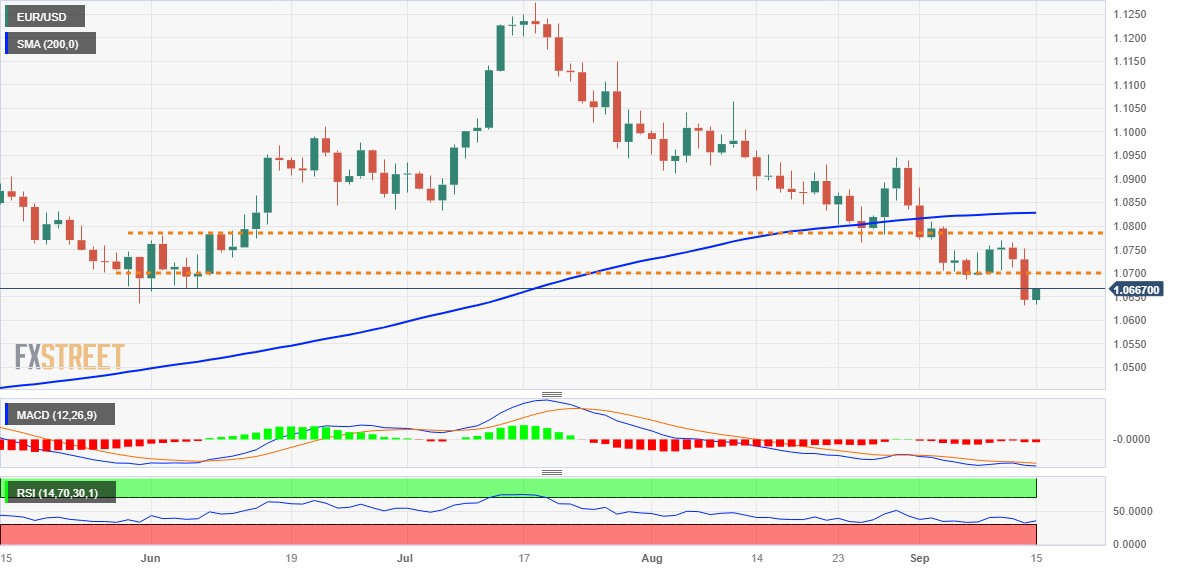
From a technical perspective, the recent breakdown through the very important 200-day Simple Moving Average (SMA), for the first time in 2023, was seen as a fresh trigger for bearish traders. Moreover, oscillators on the daily chart are holding deep in the negative territory and are still far from being in the oversold zone, validating the negative outlook for the EUR/USD pair. Some follow-through selling below the 1.0635-1.0630 area, or the multi-month low touched on Thursday, will validate the bearish outlook and drag spot prices to the 1.0600 round figure. A convincing break below the latter should pave the way for an extension of the downfall towards the next relevant support near the 1.0525 area (March 8 low) en route to the 1.0500 psychological mark and the YTD low, around the 1.0480 region touched in January.
On the flip side, any further recovery is likely to confront resistance near the previous monthly low, around the 1.0685 region. This is closely followed by the 1.0700 mark, above which a bout of a short-covering could lift the EUR/USD pair towards the top end of the weekly range, around the 1.0765-1.0770 area. The next relevant hurdle is pegged near the 1.0800 mark and the very important 200-day Simple Moving Average (SMA) support breakpoint, currently near the 1.0820-1.0825 area. A sustained strength beyond the said barrier should allow spot prices to reclaim the 1.0900 mark, which coincides with the 100-day SMA and cap any further gains. Some follow-through buying, however, will suggest that the pair have formed a bottom and shift the near-term bias in favour of bullish traders.
Premium
You have reached your limit of 3 free articles for this month.
Start your subscription and get access to all our original articles.
Author
Haresh Menghani
FXStreet
Haresh Menghani is a detail-oriented professional with 10+ years of extensive experience in analysing the global financial markets.