|

EUR/USD cracked a critical convergence of support, has lots of room to fall — Confluence Detector

The Technical Confluences Indicator that the recent fall of the EUR/USD was powerful as it breached a critical cluster of support lines at $1.2360. This opens the door to dropping to much lower levels as support lines are few and far between. 

The $1.2360 region is the congestion of the Simple Moving Average 50-1h, the SMA200-15m, the Fibonacci 23.6% one-week, the Fibonacci 38.2% one-month, the Bolinger Band 15m-Upper (Stdv. 2.2), the Fibo 38.2% one-day, the SMA10-4h, and the SMA5 one day.

The pair had some support levels spread out on the way down but worked its way through them. The next confluence of support lines is around $1.2260, which consists of the one-week low and the Pivot Point one-week S1. The one-month low at $1.2210 is next.

In case the pair turns up, there is a lot of resistance to the upside. All in all, the path of least resistance is to the downside.

Here is how it looks on the tool:
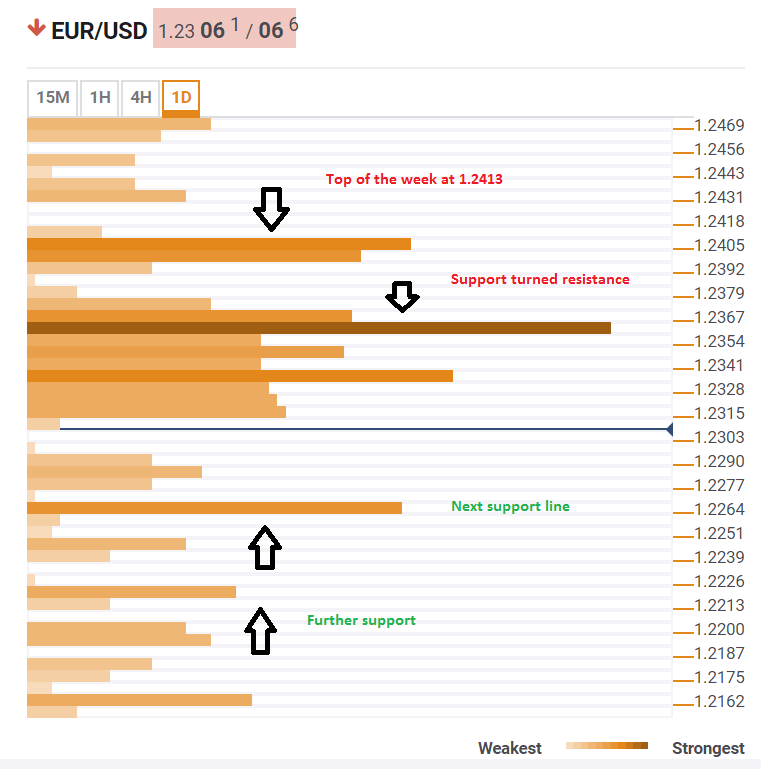
EURUSD Technical confluence analysis April 20 2018

Confluence Detector

The Confluence Detector finds exciting opportunities using Technical Confluences. The TC is a tool to locate and point out those price levels where there is a congestion of indicators, moving averages, Fibonacci levels, Pivot Points, etc. Knowing where these congestion points are located is very useful for the trader, and can be used as a basis for different strategies.

This tool assigns a certain amount of “weight” to each indicator, and this “weight” can influence adjacents price levels. This means that one price level without any indicator or moving average but under the influence of two “strongly weighted” levels accumulate more resistance than their neighbors. In these cases, the tool signals resistance in apparently empty areas.

Learn more about Technical Confluence

Author

Yohay Elam

Yohay Elam

FXStreet

Yohay is in Forex since 2008 when he founded Forex Crunch, a blog crafted in his free time that turned into a fully-fledged currency website later sold to Finixio.


More from Yohay Elam
Share:

Editor's Picks

AUD/USD consolidates above 0.6950 amid risk aversion

AUD/USD consolidates in the Asian session on Thursday, trading just above 0.6950 as traders assess developments in the Middle East crisis. The Pentagon reportedly ordered readiness for potential strikes against Iran. This keeps the geopolitical risk premium in play, which, along with hawkish FOMC Minutes and elevated US bond yields, will likely keep the US Dollar underpinned at the expense of the pair.

USD/JPY slips below 158.00 as USD retreats

USD/JPY returns to the red below 158.00 in the Asian session on Thursday amid speculation that authorities will step in to prop up the Japanese Yen. Meanwhile, the US Dollar eases from near an 18-month high on profit taking, ignoring Wednesday's hawkish FOMC Minutes and the risk of a further escalation of tensions in the Middle East, adding to the pair's pullback.

Gold clings to daily gains; still below $4,150

Gold regains some composure and climbs back to the vicinity $4,150 mark per troy ounce amid decent gains on Thursday. The yellow metal’s recovery follows some loss of momentum in the US Dollar strength and a decent drop in US Treasury yields across the curve.

Crypto Today: Bitcoin, Ethereum, XRP extend sell-off amid ETF outflows
Bitcoin (BTC) extends its decline below $83,000 on Thursday as heightened selling pressure weighs on the market. Leading altcoins, including Ethereum (ETH) and Ripple (XRP), mirror the sector-wide pullback, with ETH dipping under $2,600 and XRP challenging support at $1.40.
ECB expected to pause in October before hiking rates in December – Reuters poll
The European Central Bank (ECB) is expected to leave interest rates unchanged in October before delivering another increase in December, according to a Reuters poll conducted October 5-8. The survey shows that 70 of 73 economists expect the ECB to hold its deposit rate at 2.50% on October 29, while 64 of 73 anticipate a 25-basis-point (bps) hike in December.
The UK 30-year gilt just hit a 1998 high. Is that good or bad for the British Pound?
The yield on the UK's 30-year government bond, or gilt, went through 6% on October 1 for the first time since early 1998, and on Monday the Pound was at its strongest against the Euro since June 2025. The gilt market's 28-year high is mostly someone else's. Since early May, the 30-year gilt yield has risen about 0.15 of a percentage point and the US 30-year about 0.7.