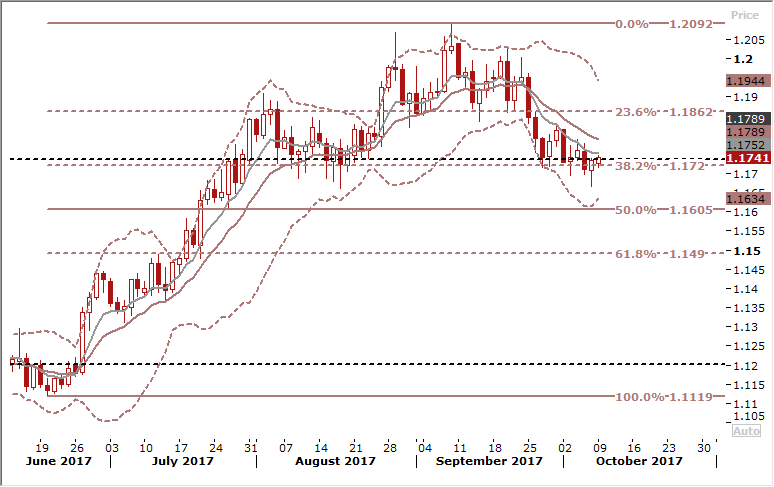
EUR/USD: Bull hammer on daily chart

EUR/USD: Market is downplaying job losses, Fed policymakers point to December rate hike
Macroeconomic overview:
-
U.S. employment fell in September for the first time in seven years as Hurricanes Harvey and Irma left displaced workers temporarily unemployed and delayed hiring, the latest indication that the storms undercut economic activity in the third quarter. The Labor Department said on Friday nonfarm payrolls decreased by 33k jobs last month amid a record drop in employment in the leisure and hospitality sector. The decline in payrolls was the first since September 2010. Leisure and hospitality payrolls plunged 111k, the most since records started in 1939, as employment at restaurants and bars fell 104.7k. There were also decreases in retail and manufacturing employment last month.
-
The unemployment rate hit a more than 16-and-a-half-year low of 4.2% and annual wage growth accelerated to 2.9%. The decrease in the unemployment rate reflected a 906k surge in household employment, which eclipsed a 575k increase in the labor force.
-
The annual increase in wages in September was the largest since December 2016 and followed an upwardly revised 2.7 percent rise in August. The revision to August's annual increase from 2.5 percent raised hope that wage growth was finally picking up.
-
The unemployment rate is now below the Federal Reserve's median average forecast for the fourth quarter.
-
Strong wage gains and shrinking labor market slack left financial markets almost fully pricing in a December interest rate increase from the U.S. central bank.
-
The dollar initially rose against a basket of currencies as investors focused on the jobless rate and wages, before surrendering gains to trade little changed.
-
Boston Fed President Eric Rosengren said the Federal Reserve must respond to "very tight" U.S. labor markets by gradually raising interest rates. "Failing to respond to very tight labor markets with rates remaining negative in real terms could potentially risk unnecessarily shortening the economic recovery," added Rosengren, who does not vote on policy this year but whose views often portend overall Fed policy.
-
"Even though inflation is currently somewhat below our longer-run objective, I judge that it is still appropriate to continue to remove monetary policy accommodation gradually," said New York Fed President William Dudley, whose regular meetings with Fed Chair Janet Yellen bolster his influence among Fed policymakers.
-
While other policymakers largely agreed, they also said they were keeping a close eye on the data, particularly on inflation. And one offered a strong rebuttal, saying the central bank risked a "policy mistake" if it continues raising rates despite inflation data that remains stalled.
-
St. Louis Federal Reserve bank President James Bullard said he is increasingly concerned that his colleagues' "zeal" to raise interest rates despite weak inflation amounts to a policy mistake that harm progress toward the Fed's targets. "The December meeting is going to be too early to make a determination on whether inflation is coming back. I don't see how we can get the data on that. I am getting more concerned that we might make a policy mistake."
-
Atlanta Fed President Raphael Bostic, the newest of the 12 Fed presidents, said that he continues to believe the U.S. central bank should raise interest rates again by the end of the year, though he is "not wedded" to that position and continues to track data closely.
-
And Robert Kaplan, chief of the Dallas Fed, said that inflation is "likely building" given the low unemployment rate, which would make the case for further rate hikes. Though the number of jobs fell in September for the first time in seven years, the unemployment rate fell to 4.2% and hourly wages rose more than expected.
-
Last month, the Fed left rates unchanged and announced the well-telegraphed start to a gradual shrinking of its USD 4.5 trillion balance sheet, which was swollen by massive purchases of Treasury bonds and mortgage-backed securities in the aftermath of the 2007-2009 financial crisis and recession.
-
But market expectations are high that the Fed will hike rates again in December, especially after Fed Chair Janet Yellen outlined why she is fairly confident that inflation, now at 1.4% by the Fed's preferred measure, will rise toward the Fed's 2% target over the medium term. It would be imprudent, she said in late September, to wait until inflation actually reached that target to raise rates. We think that a rate hike is December is a done deal.
Technical analysis and trading signals:
-
Friday closed up on the day after setting a new low, forming a bull hammer. The pair tested 7-day exponential moving average at 1.1752 in Asia, but is a little easier now. We think that there is a risk of upward move as slow stochs uptick and have room to run.
-
A very strong support area is 1.1585/1605.
-
We think that current levels are good opportunity to open long position with stop-loss at 1.1585 or below.
Author

Growth Aces Research Team
Growth Aces
GrowthAces.com is an independent macroeconomic consultancy. They offer you daily forex analysis with forex signals for traders.