EUR/USD at highest level since may: What comes next?

EUR/USD begins the week at 1.1700 – its highest level since May.
The euro is being supported by improving European economic data and dollar weakness following the US Treasury’s decision to expand its bond buyback program.
Business activity in the eurozone continued to expand in August, with Germany’s industrial sector showing the most notable improvement. Meanwhile, consumer inflation expectations edged slightly lower, with the one-year outlook easing to 2.9% from 3.0%. However, inflation remains above the ECB’s target, keeping expectations of further policy tightening intact.
This week, market attention will focus on economic data from both Europe and the US.
On Tuesday, Germany will release the Ifo business climate index, while Friday brings preliminary inflation figures from France. The main event will be Wednesday’s US data releases: core PCE, the second estimate of Q2 GDP, durable goods orders, and personal income and spending.
On Friday, markets will also assess the preliminary annual revision to nonfarm payrolls. Weak US data would increase pressure on the dollar and support EUR/USD, while strong inflation data and other robust readings could help the US currency recover some of its lost ground. The underlying fundamentals for EUR/USD remain moderately positive.
Technical analysis
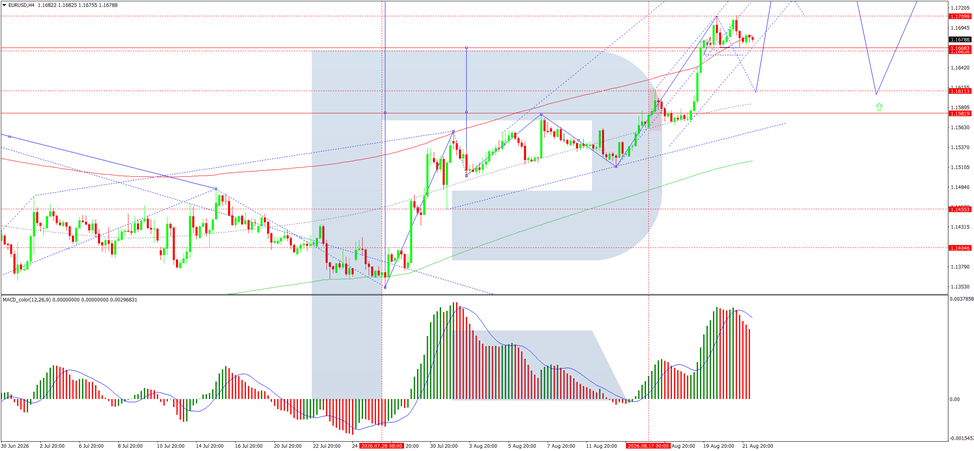
On the H4 chart of EUR/USD, the market continues to trade within a consolidation range around the 1.1668 level, which is nearing completion. An upside breakout would open the way for a corrective move towards 1.1811, followed by a decline to 1.1581. A direct downside breakout would open the way for a move towards 1.1455, with scope for the trend to extend to 1.1400. The MACD indicator supports this scenario, with its signal line above zero but trending downward, reflecting continued bearish momentum.
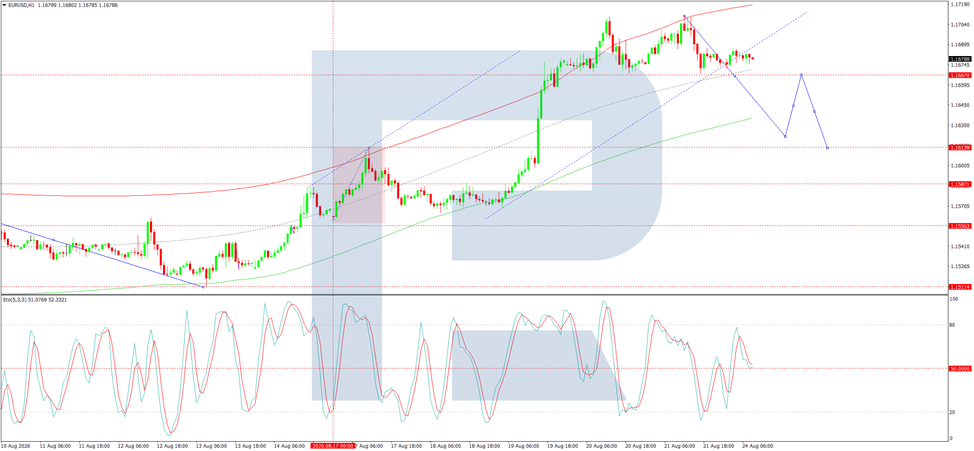
On the H1 chart, the market has moved higher to 1.1710. A consolidation range is currently forming below this level. A move lower towards 1.1622 is expected, with scope for a further decline to 1.1611. The Stochastic oscillator confirms this scenario, with its signal line above 80 and trending downward towards 20, indicating short-term downside pressure.
Conclusion
EUR/USD has climbed to its highest level since May, supported by improving European data and dollar weakness following the US Treasury’s bond buyback announcement. Eurozone business activity, particularly in Germany’s industrial sector, continues to expand, while consumer inflation expectations have moderated slightly, though they remain above the ECB’s target. Markets now face a busy week of economic data, including US PCE, GDP, durable goods orders, and the annual nonfarm payrolls revision, which will provide important signals on the relative strength of the two economies. Technically, an upside breakout could open the way towards 1.1811 before a potential pullback to 1.1581. However, a direct downside breakout would expose 1.1455 and potentially 1.1400. The near-term direction will depend on upcoming data releases and central bank signals.
Author

RoboForex Analysis Department
RoboForex
RoboForex Analysis Department provides timely market insights, expert technical analysis, and actionable forecasts across forex, commodities, indices, and equities.
















