EUR/USD at April lows: What’s next for the pair?

EUR/USD began the new week at 1.1520. The US dollar ended last week with gains of more than 1% following a strong US labour market report. In May 2026, the US economy added 172,000 jobs, significantly above the market forecast of 85,000. The data exceeded expectations, reinforcing confidence in the resilience of the US economy.
The strong employment figures bolstered expectations that the Federal Reserve will maintain its hawkish stance and could even raise interest rates before the end of the year.
Markets have little doubt that the Fed will leave rates unchanged at its next meeting. However, expectations of further policy tightening by the end of 2026 continue to rise.
The situation in the Middle East continues to support the US dollar. Negotiations between the US and Iran have effectively stalled, while renewed tensions have kept oil prices above USD 90 per barrel. Elevated energy prices are increasing inflation risks and boosting demand for the dollar as a safe-haven asset.
Against this backdrop, the euro has come under significant pressure. Energy-related risks facing European economies remain a key factor weighing on the single currency.
Technical analysis
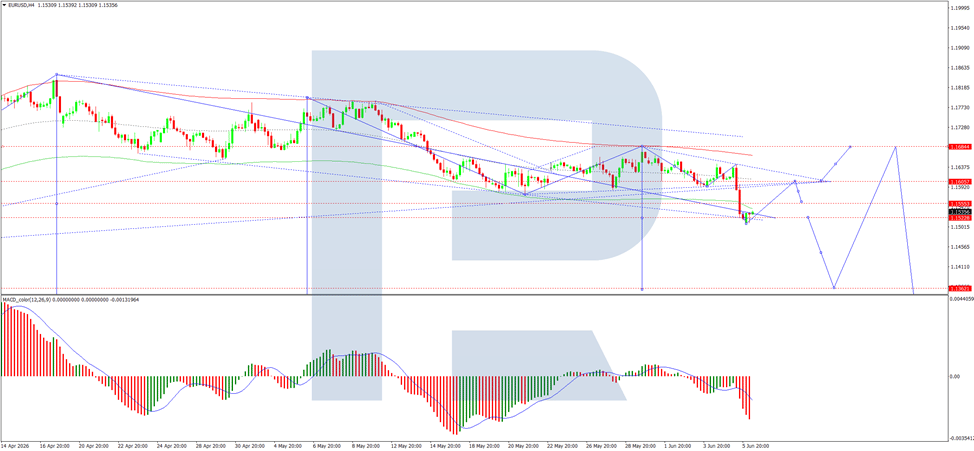
On the H4 chart, EUR/USD is trading within a consolidation range around the 1.1525 level, currently extending between 1.1510 and 1.1538. A breakout to the upside could trigger a corrective move towards 1.1570, while a downside breakout would open the way for a decline towards 1.1444.
The MACD indicator supports the bearish scenario, with its signal line below zero and pointing firmly downwards, indicating sustained downside momentum.
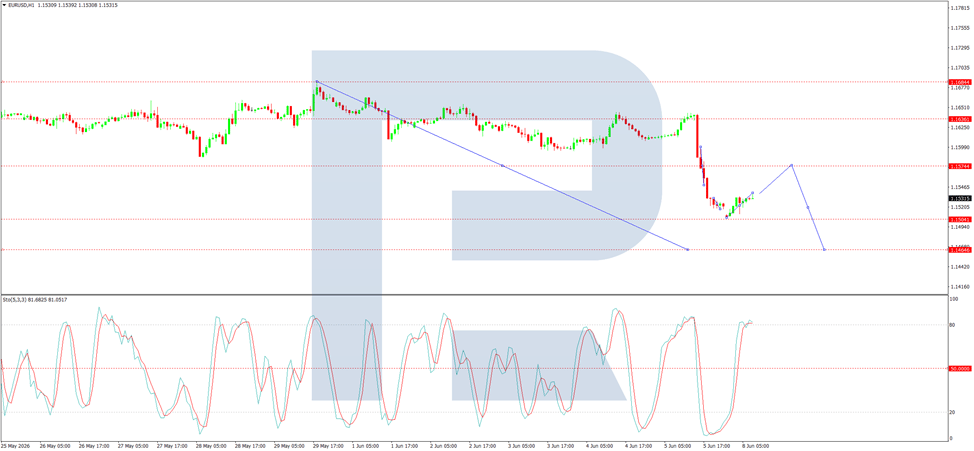
On the H1 chart, EUR/USD has reached 1.1525 and is now consolidating around this level. Further consolidation within the range is expected, with potential extensions towards 1.1500 on the downside and 1.1570 on the upside. After that, a move lower towards 1.1444 remains the preferred scenario.
The Stochastic oscillator confirms this outlook, with its signal line at 80 and turning lower towards 20, signalling growing bearish momentum in the short term.
Conclusion
EUR/USD remains under pressure as strong US economic data, expectations of prolonged restrictive Federal Reserve policy, and geopolitical tensions continue to support the dollar. While a short-term corrective rebound cannot be ruled out, technical indicators suggest that the broader bearish trend remains intact.
Author

RoboForex Analysis Department
RoboForex
RoboForex Analysis Department provides timely market insights, expert technical analysis, and actionable forecasts across forex, commodities, indices, and equities.