EUR/USD: As we had expected, FOMC minutes were not so hawkish

Macroeconomic overview
Many Federal Reserve policymakers said it may be appropriate to raise interest rates again "fairly soon" should jobs and inflation data come in line with expectations, according to the minutes of the Fed's last policy meeting released yesterday.
Fed Governor Jerome Powell, one of the voting members at the central bank's last policy meeting, said on Wednesday a rate hike would be on the table at the Fed's next meeting in March.
Seventeen policymakers deliberate at each meeting on whether to change the interest rate, although only 10 of them have a vote. Among voting members in general there was much less urgency to raise rates with many seeing only a "modest risk" that inflation would increase significantly and that the Fed would "likely have ample time" to respond if price pressures emerged.
We stressed in our recent publications that FOMC roster this year is more dovish than it was last year. That is why we think the likelihood of March hike is very low. We keep our forecast that the Fed will raise rates in June.
According to the minutes, "participants again emphasized their considerable uncertainty about the prospect for changes in fiscal and other government policies as well as about the timing and magnitude of the net effects of such changes." Trump has announced plans to roll back financial regulations and implement tax cuts, while possible new taxes on imports and increased infrastructure spending could boost inflation. Fed policymakers noted both upside and downside risks to the economy from such policies and most "thought some time would likely be required for the outlook to become clearer."
Last week, Fed Chair Janet Yellen said waiting too long to raise rates again would be "unwise" and gave a strong indication that the central bank remains on track to consider raising rates again by the summer.
As we had expected, FOMC minutes initially disappointed dollar bulls, who had hoped for a more hawkish tone.
U.S. Treasury Secretary Steven Mnuchin on Wednesday praised the strong dollar as a reflection of confidence in the U.S. economy, telling The Wall Street Journal in an interview that it was "a good thing" in the long run. Mnuchin said the dollar's strength reflected the United States' stronger economic performance compared with the rest of the world and the greenback's status as a reserve currency.
The Treasury secretary is the traditional dollar spokesman in U.S. administrations, and Mnuchin's comments are more in line with his predecessors' mantra that a strong dollar is good for the United States even if it can hurt exports. But Mnuchin repeated his caveat that at times short-term dollar spikes are not always positive.
Technical analysis
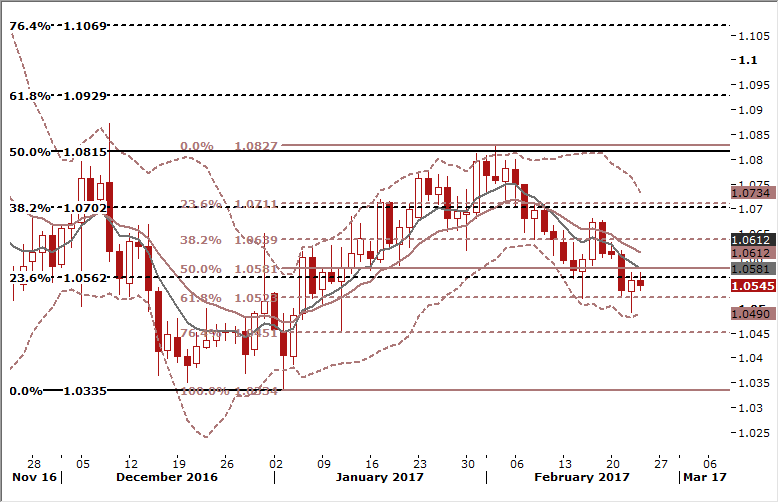
Yesterday's EUR/USD recovery was only modest and the rate remains in a bearish trend. There are two main hurdles ahead: 1.0494 low on Wednesday and 1.0451 (76.4% fibo of January-February rise).
Trading strategy
We stay sideways. We see some risks for current bearish trend from fundamental factors - no hint on timing of next hike in FOMC statement and minutes, more dovish FOMC roster in 2017 and strong improvement in data from the Eurozone. That is why short-term EUR/USD forecast is uncertain and today's close may be pivotal. Long-term outlook is even slightly bullish.
AUD/USD: Australian business spending came in below expectations
Macroeconomic overview
Australian business investment fell a surprisingly large 2.1% last quarter as miners continued their long pullback, but spending bounced in other sectors which also upgraded plans for the coming year or so.
The detail in the data is not as soft as it first appears. The decline in the headline number was concentrated in buildings and structures - that particular component is not a driver that goes into the GDP. But the plant and equipment number actually rose, so that is helpful.
The data so far suggest that while economic growth likely did bounce in the fourth quarter after the third quarter's shock contraction, the rise was only modest at best.
The Australian Bureau of Statistics' latest survey estimate of investment for 2016/17 was upgraded to AUD 112 billion, when analysts had looked for a steady outcome around AUD 108 billion.
Technical analysis
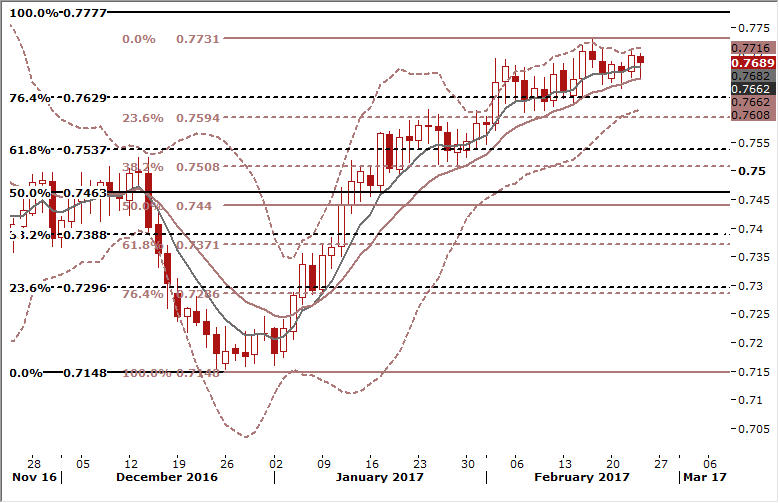
The AUD lost some ground after a surprisingly sharp fall in business spending, but remained above 14-day exponential moving average. The overall structure is bullish.
Trading strategy
We stay long for 0.7750.
Author
Growth Aces Research Team
Growth Aces
GrowthAces.com is an independent macroeconomic consultancy. They offer you daily forex analysis with forex signals for traders.