EUR/USD Analysis: Recovery momentum from multi-month lows falters ahead of 1.2000 mark
- A combination of factors assisted EUR/USD to gain some follow-through traction on Thursday.
- Calmer bond markets boosted investors’ appetite and weighed heavily on the safe-haven USD.
- The ECB’s willingness to curb the recent rise in bond yields further lifted the common currency.


The EUR/USD pair built on this week's goodish rebound from three-and-half-month lows and gained traction for the third consecutive session on Thursday. The momentum pushed the pair to one-week tops and was sponsored by a combination of factors. Wednesday's mixed US consumer inflation figures eased market concerns about runaway inflation. Apart from this, the successful conclusion of auctions for ten-year and 30-year US government bonds boosted investors sentiment, which, in turn, undermined the safe-haven US dollar. The upbeat market mood got an additional boost after US President Joe Biden signed a $1.9 trillion stimulus bill into law.
On the other hand, the shared currency was further supported by the fact that the European Central Bank showed a willingness to address concerns about the recent upward shift in bond yields. The ECB predictably left its main policy rates unchanged and pledged to step up the pace of its bond purchases to maintain favourable financing conditions. The central bank looked through the likely contraction in Q1 2021 and upped its 2021 GDP forecast amidst expectations that the recovery would pick up more rapidly in the second half. The ECB anticipates growth to rise above pre-pandemic levels in the middle of next year, though lowered its GDP forecast for 2022 to 4.1% from 4.2%.
Despite the supporting factors, the pair struggled to capitalize on the move and retreated from the vicinity of the key 1.2000 psychological mark during the Asian session on Friday. A modest uptick in the US Treasury bond yields extended some support to the greenback and was seen as a key factor exerting some pressure. Market participants now look forward to the final version of the German CPI print for some impetus. The US economic docket features the release of the February Producer Price Index and the preliminary estimate of the Michigan Consumer Sentiment Index for March. The data, along with the broader market risk sentiment and the US bond yields, will influence the USD price dynamics and produce some trading opportunities on the last day of the week.
Short-term technical outlook
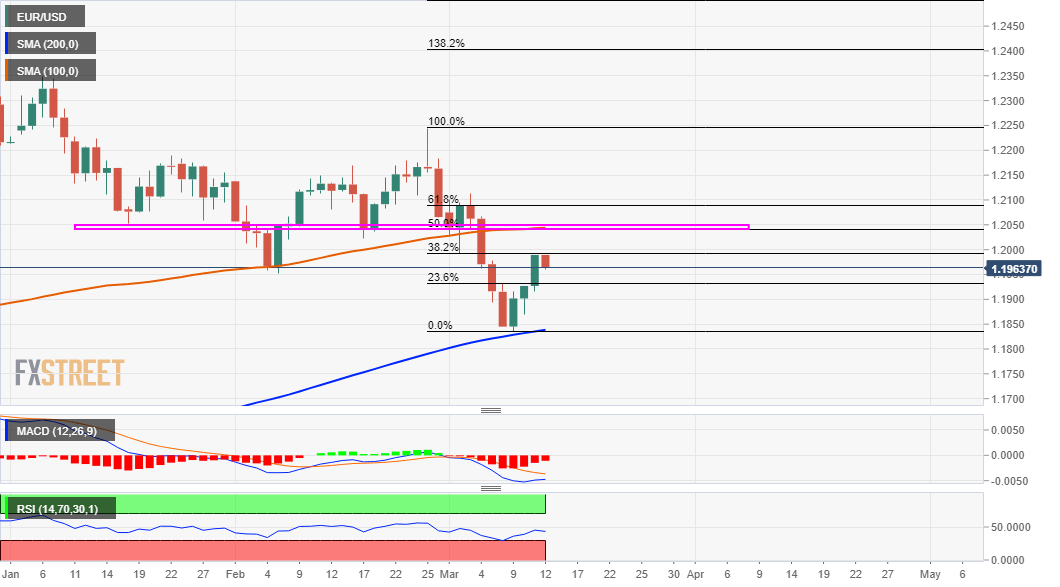
From a technical perspective, the positive momentum stalled near a resistance marked by the 38.2% Fibonacci level of the 1.2243-1.1836 recent fall. This should now act as a key pivotal point for short-term traders. A sustained move beyond the 1.2000 mark is likely to push the pair further towards the 50% Fibo. level, around the 1.2040 region. Bulls might then aim back to reclaim the 1.2100 mark. The latter coincides with the 61.8% Fibo. level, which if cleared decisively will negate any near-term bearish bias and set the stage for the resumption of the prior/well-established upward trajectory.
On the flip side, the 23.6% Fibo. level, around the 1.1935 region now seems to protect the immediate downside and is followed by the 1.1900 mark. Failure to defend the mentioned support levels might turn the pair vulnerable to accelerate the slide back towards challenging the very important 200-day SMA support, around the 1.1835 region tested earlier this week.
Premium
You have reached your limit of 3 free articles for this month.
Start your subscription and get access to all our original articles.
Author
Haresh Menghani
FXStreet
Haresh Menghani is a detail-oriented professional with 10+ years of extensive experience in analysing the global financial markets.