EUR/USD Analysis: Manage to defend and rebound from 200-day SMA, not out of the woods yet
- EUR/USD ticks higher for the second straight day amid a modest USD weakness.
- Reduced bets for a March Fed rate cut should limit any meaningful USD decline.
- Mixed signals from ECB policymakers to cap the upside for the shared currency.

The EUR/USD pair builds on the overnight bounce from its lowest level since December 13, around the 1.0845 region, which coincides with the 200-day Simple Moving Average (SMA) and gains some follow-through traction on Thursday. Spot prices draw support from a softer US Dollar (USD) and stick to modest intraday gains around the 1.0900 round-figure mark through the early European session. That said, the fundamental backdrop warrants caution for aggressive bullish traders and before positioning for any further appreciating move.
The USD downtick could be attributed to some profit-taking following the recent run-up to over a one-month peak and is likely to be limited amid doubts over an early interest rate cut by the Federal Reserve (Fed). Against the backdrop of the recent hawkish remarks by Fed officials, the US Retail Sales data released on Wednesday pointed to a still-resilient consumer spending and suggested that the economy is in good shape. This gives the US central bank more headroom to keep rates higher for longer, which should act as a tailwind for the buck.
Adding to this, a weaker risk tone could benefit the Greenback's relative safe-haven status and further contribute to capping the upside for the EUR/USD pair. The market sentiment remains fragile amid concerns about China's weak economic recovery and geopolitical tensions. Yemen-based Houthi rebels claimed their second attack this week on a US-operated vessel in the Red Sea and have threatened to expand attacks in response to the American and British strikes. This keeps investors on the edge and should lend some support to the USD.
Bulls might also refrain from placing aggressive bets around the shared currency in the wake of mixed views on inflation and interest rates by the European Central Bank (ECB) policymakers. In fact, ECB President Christine Lagarde, during a discussion at the Bloomberg House in Davos on Wednesday, declined to push back against bets for a cumulative of over 150 basis points (bps) rate cuts this year. Lagarde, however, cautioned against premature optimism in markets amid a rise in the Eurozone inflation, to the 2.9% YoY rate in December.
The aforementioned fundamental backdrop makes it prudent to wait for strong follow-through buying before confirming that the EUR/USD pair has formed a near-term bottom around the 1.0850-1.0845 region. Market participants now look to the release of the ECB Monetary Policy Meeting Accounts, which, along with Lagarde's comments at the World Economic Forum, will influence the Euro. Traders will further take cues from the US economic docket, featuring Initial Jobless Claims, the Philly Fed Manufacturing Index and housing market data.
Technical Outlook
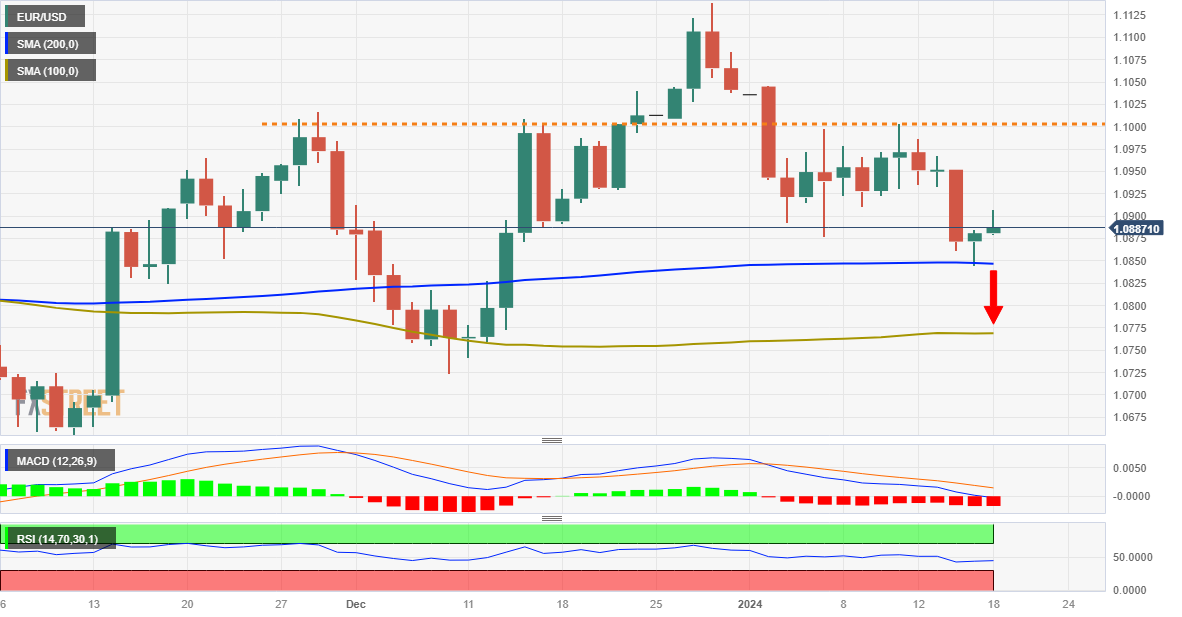
From a technical perspective, the recent breakdown through a short-term trading range favours bearish traders. Moreover, oscillators on the daily chart have just started gaining negative traction and suggest that the path of least resistance for the EUR/USD pair is to the downside. Hence, any subsequent move-up is more likely to attract fresh sellers near the 1.0920 area or the trading range support breakpoint. Some follow-through buying, however, might trigger a short-covering rally towards the 1.0970-1.0975 region en route to the 1.1000 psychological mark. The latter should act as a key pivotal point, which if cleared will negate any near-term negative bias.
On the flip side, the 1.0845 region, or the 200-day SMA, might continue to act as an immediate strong support. A convincing break below should pave the way for a slide towards the 1.0800 round figure. The next relevant support is pegged near the 100-day SMA, currently around the 1.0765 region, below which the EUR/USD pair could accelerate the downfall towards testing the December monthly swing low, around the 1.0725-1.0720 zone.
Author

Haresh Menghani
FXStreet
Haresh Menghani is a detail-oriented professional with 10+ years of extensive experience in analysing the global financial markets.