EUR/USD tests two-month low: What’s driving the decline?

EUR/USD fell to 1.1378 on Thursday, with the US dollar holding near a two-month high. The dollar has been supported by strong macroeconomic data, which have heightened inflation concerns and expectations of further Federal Reserve tightening.
According to S&P Global, US private sector business activity expanded at its fastest pace in more than five years in September. Improvements were recorded in both the services and manufacturing sectors, although price pressures also intensified.
Several Fed officials also backed last week’s rate hike and again highlighted inflation risks. Against this backdrop, markets now estimate the probability of another rate hike in October at approximately 70%, up from 55% the previous day.
Elevated oil prices remain an additional factor. Uncertainty surrounding US-Iran negotiations is keeping oil prices high and continuing to fuel inflation expectations.
Technical analysis
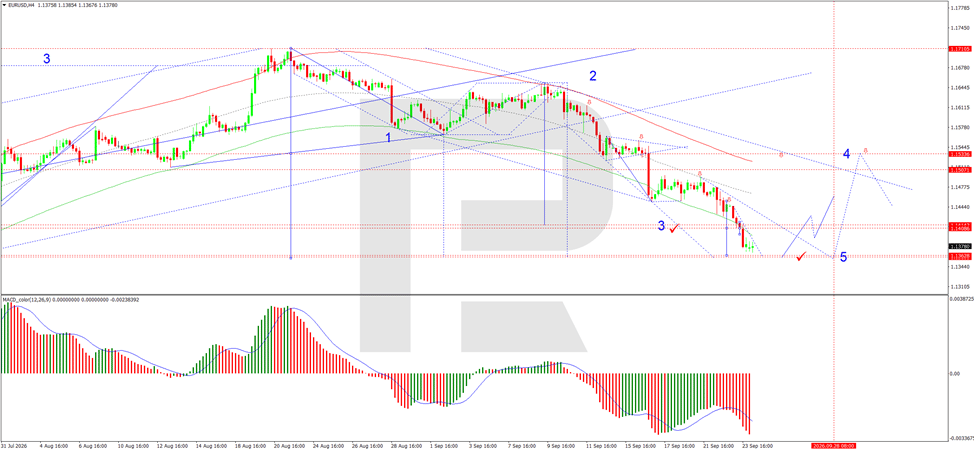
On the H4 EUR/USD chart, the market completed a downward move towards 1.1369, followed by a corrective rebound to 1.1392. A consolidation range is now effectively forming between these levels.
A further move higher towards 1.1396 is possible, followed by a decline towards 1.1360.
The MACD indicator supports the short-term bearish scenario. Its signal line remains below zero and is pointing firmly downwards.
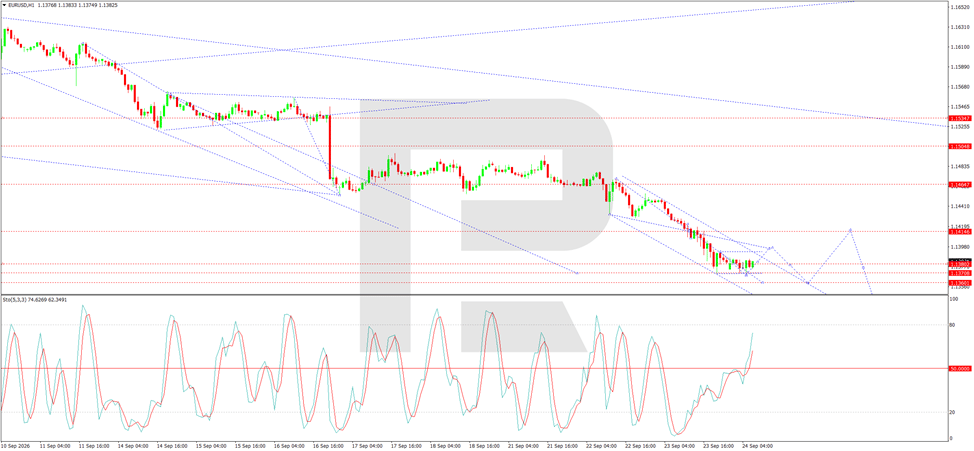
On the H1 EUR/USD chart, the market completed another downward move towards 1.1369. A consolidation range is currently forming above this level.
Another move higher towards 1.1396 is expected today.
The Stochastic oscillator supports this short-term corrective scenario. Its signal line remains above 50 and is pointing firmly upwards towards 80.
Conclusion
EUR/USD has fallen to a two-month low as the US dollar continues to benefit from strong US economic data and hawkish Fed signals. US private sector activity expanded at its fastest pace in more than five years in September, intensifying inflation concerns and pushing the estimated probability of an October rate hike to around 70%. Elevated oil prices, amid uncertainty surrounding US-Iran negotiations, are adding further pressure to the inflation outlook.
From a technical perspective, EUR/USD may see a short-term corrective move towards 1.1396. Once this move is complete, the H4 scenario envisages a renewed decline towards 1.1360. The near-term direction will depend on upcoming US data and Fed commentary, with the US dollar likely to remain supported in the current environment.
Author

RoboForex Analysis Department
RoboForex
RoboForex Analysis Department provides timely market insights, expert technical analysis, and actionable forecasts across forex, commodities, indices, and equities.