Elliott Wave strategies for USD/JPY, S&P 500, and Dollar [Video]
![Elliott Wave strategies for USD/JPY, S&P 500, and Dollar [Video]](https://editorial.fxsstatic.com/images/i/USDJPY-neutral-line_XtraLarge.png)

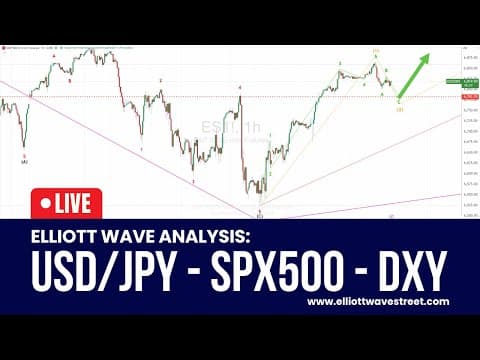
Each trading week reveals market movements shaped by institutional liquidity, macro expectations, and technical structures that offer measurable scenarios for directional positioning. This analysis evaluates high-probability technical opportunities across USD/JPY, S&P 500 Futures, and the U.S. Dollar Index (DXY) through the lens of Elliott Wave Theory, Smart Money methodology, and professional risk-controlled execution.
The objective of this market breakdown is to provide:
- A clear institutional market perspective
- Pre-validated price reaction scenarios
- Capital protection protocols
- Pre-planned entries, targets, and stop levels
This structure follows best practices commonly used in institutional trading and hedge-managed risk models.
USD/JPY: Why Institutional Flow Supports a Sell-Only Framework
The USD/JPY pair trades near a sensitive technical zone, coinciding with trader positioning ahead of Federal Reserve interest rate decisions. Based on present Elliott Wave counts, the prevailing structure indicates a downtrend continuation scenario.
Institutional operators consider that:
- Recent price rallies do not reflect organic demand but rather liquidity expansion intended for optimal sell placement.
- Retail participants continue to favor long positions, while institutional capital strategically distributes shorts at premium prices.
- Wave 2 retracements often become the most efficient region to prepare short exposure ahead of Wave 3 extensions.
- Trading without a stop-loss order is incompatible with professional capital protection models and must be avoided.
USD/JPY – Execution Model Based on Elliott Structure
Strategy Framework | Objective Entry Zone | Stop-Loss Logic | Expected Target Scenario |
|---|---|---|---|
Retracement-based short exposure | Structural Wave 2 zones | Technical invalidation levels | Wave 3 bearish development |
Institutional trading prioritizes exiting near break-even or small controlled losses if a wave count is invalidated—capital preservation always outweighs directional bias conviction.
Smart Money in FX Markets: Definition & Behavioral Footprint
Smart Money refers to large institutional capital whose objective is to execute ahead of broad retail visibility, while also absorbing or creating tradable liquidity.
Their market behavior generally includes:
- Relatively short accumulation during retail-driven upswings
- Controlled and persistent selling at key resistance zones
- Directional continuation under validated wave impulses with predefined risk limits
Retail traders can tactically align with institutional positioning—but only when following a pre-validated analysis framework and adhering to strict stop-losses.
S&P 500 Futures: AI-Supported Buy-Side Execution in a Confirmed Uptrend Cycle
Unlike USD/JPY and DXY, the S&P 500 Futures market maintains a bullish impulse cycle, as evidenced by both liquidity conditions and technical trend parameters.
Institutional trade-side notes include:
- Market AI models provide optimized entry levels, including stop-loss and ATR-adjusted target ranges.
- There is currently no dominant technical structure supporting efficient short-side exposure.
- Retracements inside bullish Elliott impulses must be read as trend-aligned long restructuring zones.
S&P 500 Futures – Operational Checklist
- Identify liquidity retracements respecting bullish structure.
- Execute in alignment with AI-modeled stops and ATR-measured targets.
- Validate entries using Elliott structural confluence.
- Expand position size only when liquidity allows controlled risk impact.
Based on current macro liquidity cycles and structural trend alignment, a 2026 price scenario above 7,000 remains technically plausible under long-cycle asset risk appetite.
Mandatory Risk Execution Principles in Volatile Market Conditions
Volatility is not a risk when trades are pre-planned—it becomes a risk when execution lacks invalidation logic.
Professional risk standards include:
- Stop-loss orders in every open position
- Liquidity assessment before increasing leverage
- ATR-measured take-profit zones
- Market AI used for dynamic stop and target alignment, not trade justification
Dollar Index (DXY): Sell-Side Positioning Until a Confirmed Wave Reversal
The U.S. Dollar Index (DXY) holds a descending structure, often delivering liquidity traps that attract retail longs while institutional capital continues structured selling.
The current institutional strategy framework supports:
- Short positioning at minor resistance pullbacks
- Avoid long positions until a machine-validated wave reversal completes an impulse change confirmation
Summary Table – Instrument Prioritization by Directional Probability
Instrument | Institutional Framework | Current Opportunity Zone |
|---|---|---|
USD/JPY | Sell-only exposure | Wave 2 retracements |
S&P 500 Futures | Buy-only exposure | Trend retracements |
Dollar Index (DXY) | Short until validated reversal | Weak resistance pullbacks |
Trading Acceleration Through Education & Community AI-Supported Execution
Sustained profitability in institutional contexts improves when execution aligns with analysis discipline and structured community feedback—not independent impulse.
Current resources include:
- Daily U.S. Session Live Analysis (Mon-Fri)
- Institutional salon trading rooms
- Liquidity-AI execution modeling
- Educational modules for wave confirmation
Trading institutional liquidity frameworks with Elliott Wave structure provides directional anticipation without narrative bias, supporting execution efficiency and, most importantly:
A trade can only be considered professional when capital invalidation logic, timing, and risk exposure are pre-planned before directional opportunity is pursued.
Author
Juan Maldonado
Elliott Wave Street
Juan Maldonado has a University degree in Finance, and Foreign trade started his trading career in 2008. Since 2010 has been analyzing the markets using Elliott Wave with different strategies to spot high probability trades.